
Choose resin bound driveway colours by comparing real samples against your house, then select an edge that makes the whole frontage feel connected. A blend that looks attractive on a screen can feel quite different beside red brick, pale render or weathered stone. Start with the materials you already have and keep the palette simple.
The best-looking result also needs a practical specification. Colour, borders, access covers and the route to the front door should be agreed alongside the base and drainage, before an installer starts work.
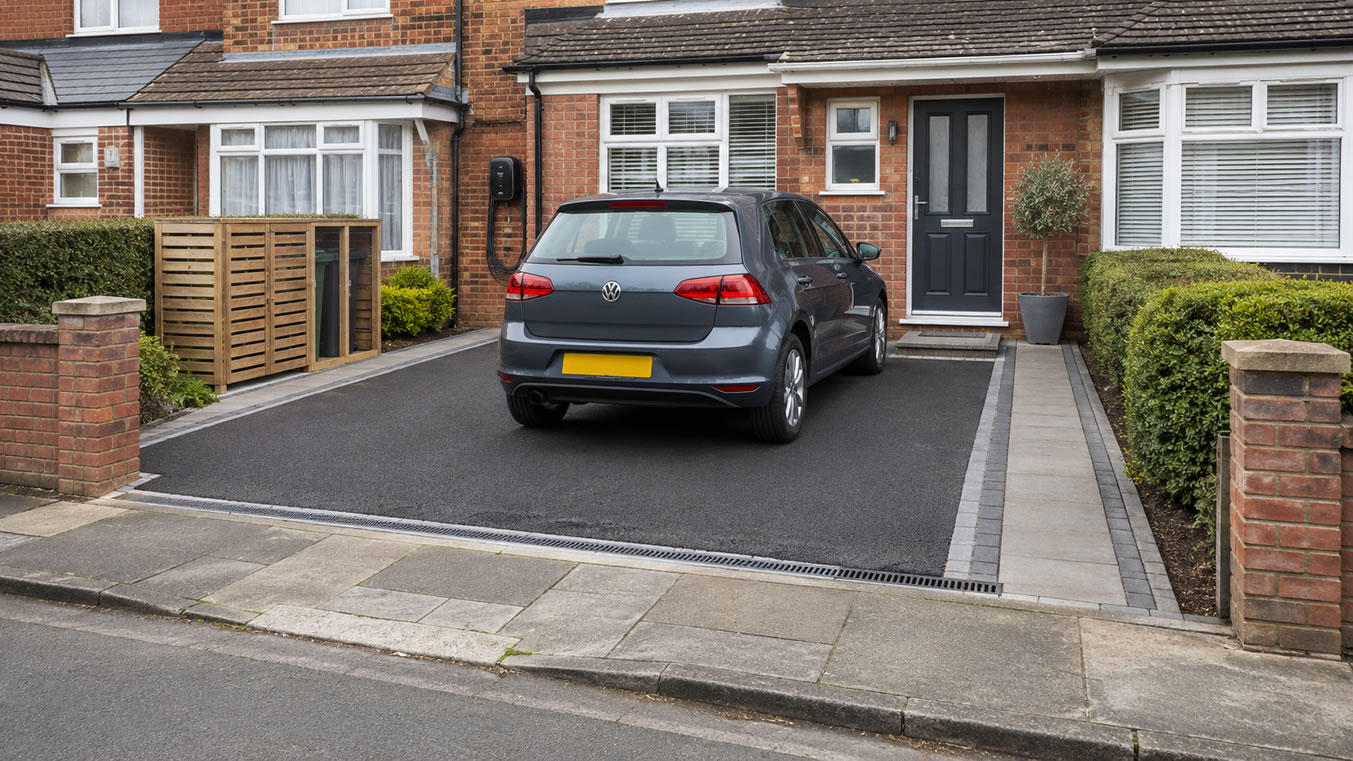
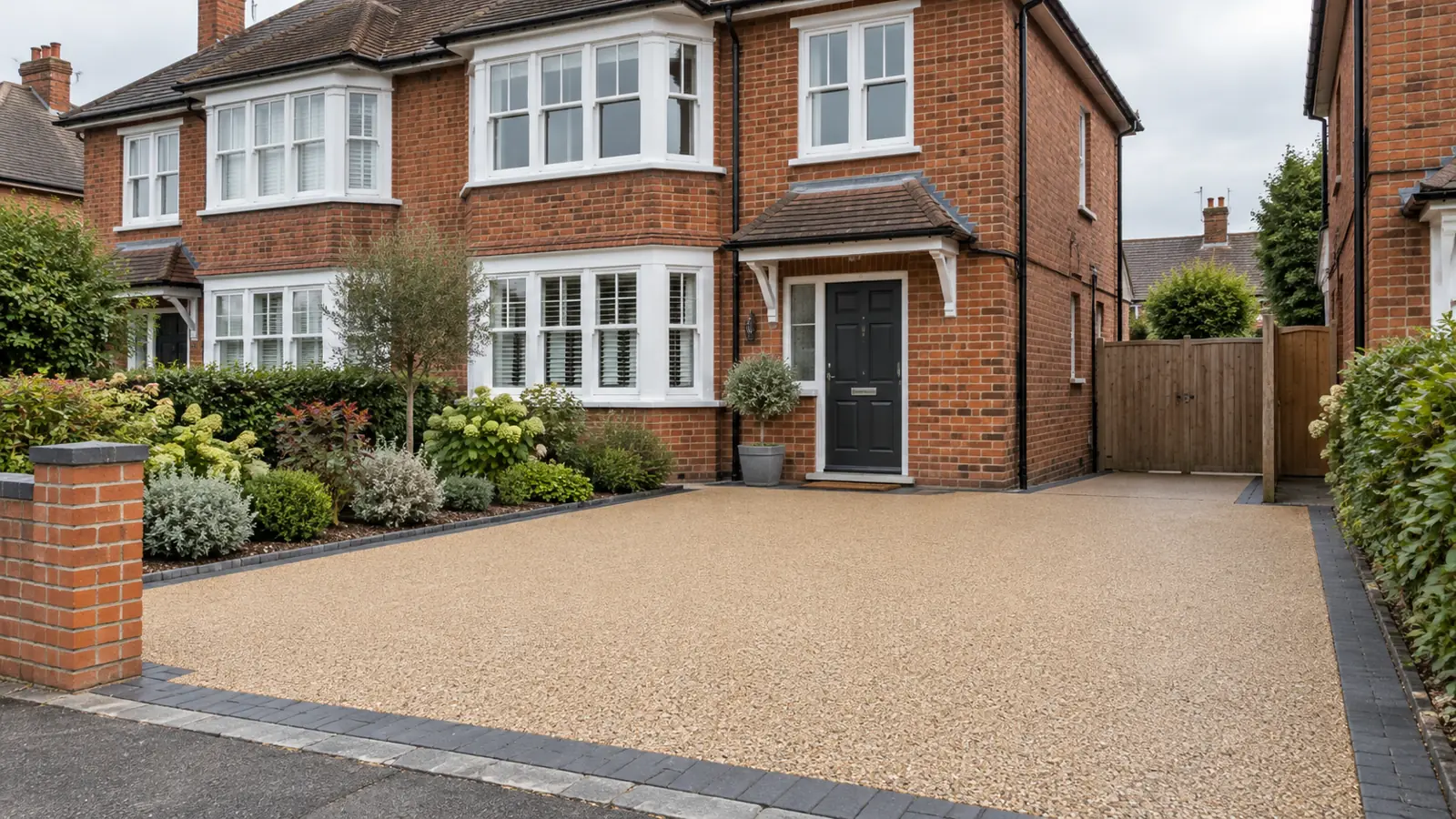
Featured image: AI-generated illustration of a buff resin bound driveway with charcoal edging; it does not show an actual contractor project.
Which resin bound driveway colours suit your house?
Look at the frontage from the pavement first. Note the main wall colour, roof, front door, window frames and any stone steps or boundary walls. Choose one permanent material as your starting point. A front door can be repainted; a large brick facade is a longer commitment.
Think in terms of warm, cool and mixed tones rather than searching for an exact match. A warm buff blend can sit comfortably beside red brick without trying to imitate it. A soft grey may work with pale render, while a blend containing both grey and brown stones can bridge several existing materials.
| Existing frontage | Starting point for the resin | Edging to compare |
|---|---|---|
| Warm red or orange brick | Buff, honey or a restrained brown-and-grey blend | Dark grey blocks or a complementary brick tone |
| Cream or white render | Soft grey, beige or a muted mixed aggregate | A mid-grey border or existing stone colour |
| Traditional stone | A blend picking up one of the stone’s quieter tones | Stone or blocks with a similar undertone |
| Dark frames and contemporary details | Pale-to-mid grey, or a warmer neutral for balance | A simple charcoal outline |
These are design suggestions, not fixed rules. Very light stone can create a strong contrast with dark walls, while a dark surface can make a small frontage feel visually heavier. Stand back and judge the whole view rather than the sample alone.
If the parking layout is still undecided, start with our guide to front garden driveway design with parking and planting. A good colour cannot compensate for an awkward route to the door or a border that leaves too little room to open a car door.
Compare samples in daylight, shade and damp conditions
Ask for a cured sample of each shortlisted blend, with its supplier and product code. Loose stones do not show the finished bound surface. Keep the shortlist to two or three options so you can compare them properly.
Place each sample flat outside beside the house, then move it next to the proposed edging and steps. Look in daylight and shade, and compare dry and damp appearances where the supplier permits. Photographs are useful for remembering combinations, but phone processing and screens can alter colours.
Manufacturers offer samples for specification: for example, SureSet’s natural aggregate sample information explains that the range varies in colour, aggregate size and texture. Ask your chosen installer for the actual blend they intend to use, rather than assuming similar names from different suppliers describe the same finish.
Consider everyday marks too. A pale, fairly uniform surface may make muddy tyre tracks conspicuous; a varied mid-tone can be more forgiving visually. No colour removes the need to sweep away leaves and soil. If the drive sits under trees, ask to see a comparable older installation as well as a newly completed one.
Choose edging that gives the driveway a clear outline
Edging is part of the construction, as well as the design. Ask the installer to explain how the resin will be restrained wherever it meets planting, the pavement, a path or another surface. A thin decorative line on a drawing does not describe the support beneath it.
Use contrast with a purpose
A charcoal border around warm buff resin can create a crisp outline. A closer colour match gives a quieter result. On a small drive, start by drawing one perimeter border; add a second colour only if it helps explain the route or shape.
Request the border’s actual width and product in the quotation. A line that seems discreet in a brochure may become a dominant feature when it runs around the entire parking space. Check corners, curves and the entrance together rather than approving a single straight section.
Resolve paths, covers and planting edges together
Decide whether the front-door route should continue in resin or use a contrasting material. Keep transitions comfortable for the people who use them, including anyone pushing a buggy or using a mobility aid. Ask the contractor to assess levels and slip resistance for the location.
Inspection covers need to stay accessible. Ask how their frames will look and whether a suitable recessed cover is practical. At beds and borders, agree how soil will be retained so it does not continually wash onto the resin. Leave enough planting space for a convincing border, rather than a thin strip that is difficult to maintain.
A colour choice still needs the right construction specification
Make sure the quote explicitly says resin bound if that is the finish you want. In a bound system, aggregate and resin are mixed before laying. Resin bonded surfacing uses a different process and should not be treated as an interchangeable description.
Ask which binder will be used and whether it is UV-stable. Resinmill’s resin bound product information describes UV-stable binder options. That is a reason to identify the specified product, not a promise that every resin driveway will retain an identical appearance indefinitely. Obtain the supplier’s care instructions and warranty terms for your particular system.
The installer should assess the existing base before proposing an overlay. Ask for the preparation, aggregate blend, system depth, edge construction, treatment of joints and finished levels in writing. Gate clearance, air bricks, garage thresholds and access covers all deserve attention before the new height is agreed.
Permeability also depends on the construction beneath the finish and where water can go. A porous surface over an unsuitable base does not, by itself, establish a working drainage scheme. Ask the contractor to describe the complete route for rainwater.
For properties in England, government guidance on front-garden surfacing explains the distinction between permeable surfaces and impermeable areas draining within the garden. Check your particular proposal with the local planning authority, especially where restrictions apply. Requirements elsewhere in the UK differ; use the relevant local authority’s advice.
How to prepare a resin driveway colour and edging brief
You will need a phone camera, paper, pencil and the cured samples supplied for your shortlist. This is a design exercise for discussing professional installation; it does not replace a site survey.
- Record the fixed colours. Photograph the walls, roof, steps and boundary from the pavement. Pick the permanent feature that should guide the palette.
- Compare three samples. Place the shortlisted cured blends beside the house and proposed edging. Record the supplier and code for each, and compare their appearance outdoors.
- Sketch the visible details. Mark the perimeter border, pedestrian route, planting edges, inspection covers and changes of surface. Note which existing features you want to retain.
- Request a written specification. Ask the installer to assess the base, drainage and levels, then identify the agreed blend, binder, border products and care requirements in the quote.
Frequently asked questions
Does grey resin bound paving suit a red-brick house?
It can. Try a warm or mixed grey beside the actual brick and mortar, and compare it with a buff alternative. The undertone and border colour matter more than the word grey on a sample label.
Should the edging match the resin colour?
A close match creates a subtle outline, while contrast emphasises the driveway’s shape. Compare a complete combination of resin, edging and the nearest step or wall before deciding.
Will a small sample show exactly how the whole driveway will look?
A cured sample helps you judge texture and colour, but it cannot reproduce the scale, lighting and natural aggregate variation of a full driveway. Confirm the product code and ask to view a larger completed example where possible.
Can I change the colour later without replacing the surface?
Do not assume a simple recolouring treatment will be suitable. Ask the system supplier and installer about compatible options and how they would affect drainage, levels and warranty. A new surface proposal needs assessment.
Turn the shortlist into a clear installation enquiry
Once you have a preferred blend and border, include photographs and the sample codes when discussing resin bound paving installation. The linked website is an enquiry service connecting homeowners with independent specialists; the contractor you choose will survey the site and agree the work with you.
Request a quote that covers the appearance and the construction together. That gives you something useful to compare: a named finish, a defined edge detail and an explanation of how the driveway will work at your home.