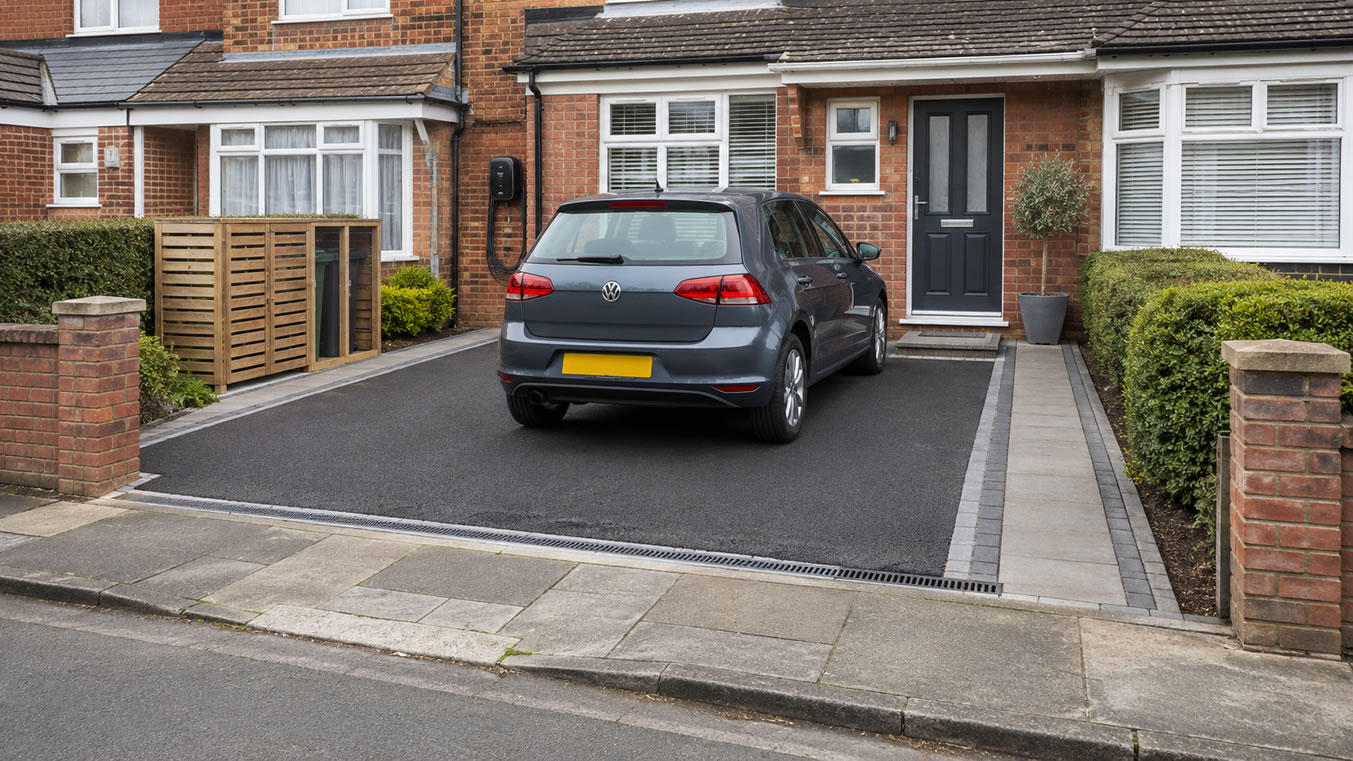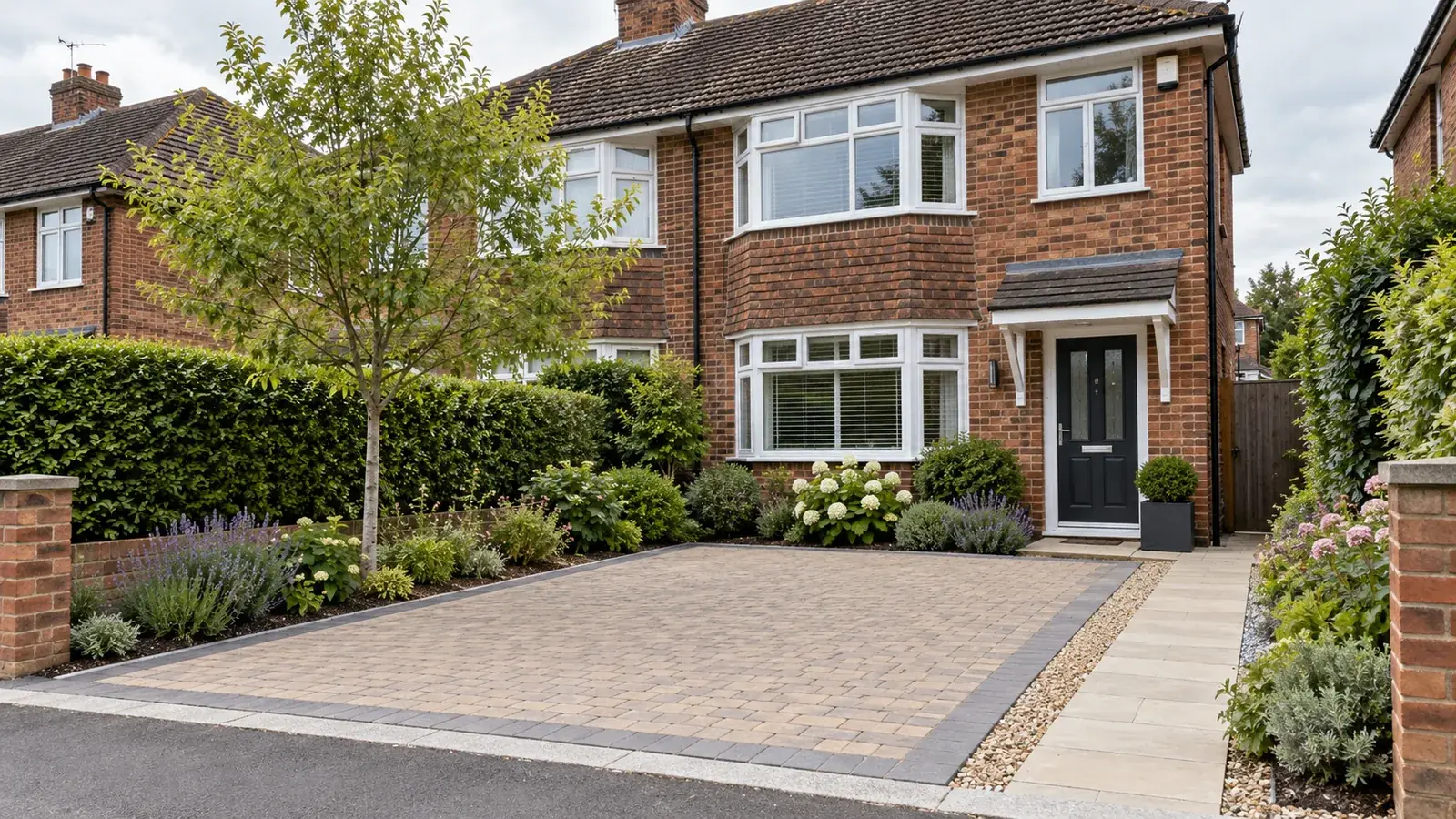

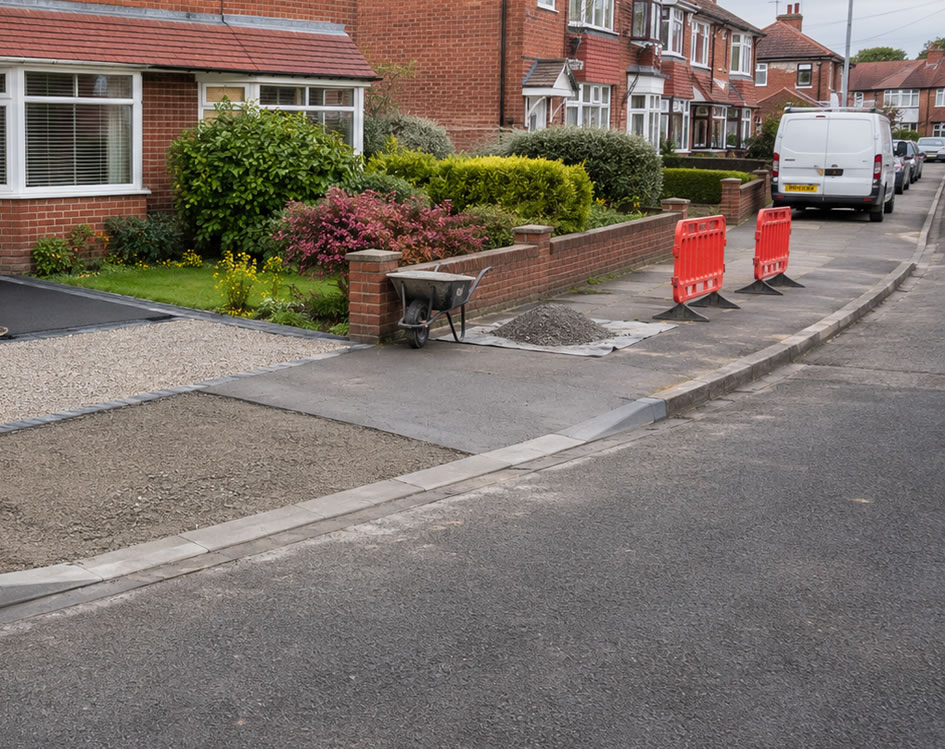
Creating a new driveway at the front of a British home often involves two separate parts of the job.
First, you need a suitable hardstanding or driveway within your property. Secondly, if vehicles need to cross a pavement or verge to reach it, you will normally need an approved dropped kerb or vehicle crossover.
Asphalt is a popular choice for this type of project because it creates a smooth, durable surface that works particularly well for everyday vehicle parking.
However, homeowners sometimes make the mistake of arranging the driveway first and only thinking about the dropped kerb afterwards.
The better approach is usually to plan both together.
The local highway authority needs to approve the vehicle access, while the driveway itself needs suitable:
- groundwork
- drainage
- levels
- edging
- access width
As a broad 2026 UK guide, asphalt driveway installation commonly costs around £70 to £110 per m², with approximately £90 per m² being a useful average for a properly constructed domestic driveway.
A new dropped kerb can commonly add around £800 to £1,500 or more, although council application fees, construction charges and local requirements vary considerably.
Therefore, a typical new front driveway with a dropped kerb may cost anywhere from around £3,000 to £7,000 or more, depending on driveway size and the amount of highway work involved.
This guide explains asphalt driveway costs, dropped kerb applications, drainage, planning considerations and what homeowners should compare when requesting quotations.
What Is an Asphalt Driveway?
Modern asphalt driveways use aggregates bound together with bitumen.
Homeowners and contractors often refer to the same type of surface as:
- asphalt
- tarmac
- blacktop
- tarmacadam
Strictly speaking, traditional tarmac and modern asphalt are different materials.
However, for normal domestic driveway quotations, the terms are often used interchangeably.
The important thing is to understand the construction specification rather than getting too caught up in terminology.
How Much Does an Asphalt Driveway Cost?
Typical UK guide driveway prices include:
| Asphalt Driveway | Typical Cost |
|---|---|
| Asphalt driveway installation | £70–£110 per m² |
| Useful average | Around £90 per m² |
| Small 20m² driveway | £1,800–£2,500 |
| 30m² driveway | £2,500–£3,500 |
| 40–50m² driveway | £3,500–£5,000 |
| 60m² driveway | £4,500–£6,000+ |
| 100m² driveway | £7,000–£10,000+ |
The cost depends heavily on:
- excavation
- existing ground
- drainage
- access
- edging
- waste disposal
A driveway laid over a good existing base may cost less than a completely new front garden conversion.
What Is a Dropped Kerb?
A dropped kerb is a section of pavement and kerb altered to allow vehicles to cross safely from the road onto private property.
It is also commonly called:
- vehicle crossover
- vehicular crossover
- driveway crossover
The work normally involves more than simply lowering the kerbstones.
The highway authority may also require the pavement to be strengthened so that it can safely carry vehicle loads.
Do I Need a Dropped Kerb for a Driveway?
If your vehicle needs to cross a public pavement to reach your driveway, you will normally need an approved vehicle crossover.
You should not simply drive over an ordinary full-height kerb.
Likewise, installing your own makeshift ramp does not create a legal vehicle access.
The local highway authority controls work affecting the public pavement.
Can a Driveway Contractor Install the Dropped Kerb?
That depends on the council.
Some local authorities:
- carry out the work using their own contractor
Others may allow:
- approved contractors
- accredited highway contractors
to complete it.
Therefore, do not assume the company installing your asphalt driveway can automatically alter the pavement.
Check the local authority process first.
How Much Does a Dropped Kerb Cost?
Typical guide costs might include:
| Dropped Kerb Work | Typical Cost |
| Application / inspection fees | £100–£400+ |
| Standard crossover construction | £800–£1,500+ |
| Wide crossover | £1,200–£2,500+ |
| Utility alterations | Additional |
| Street furniture relocation | Additional |
| Tree-related work | Potentially significant |
Costs vary widely between councils.
In some areas, the authority calculates a project-specific price after inspecting the site.
Why Dropped Kerb Prices Vary
The final price can depend on:
- crossover width
- pavement construction
- kerb type
- grass verge
- road layout
- utility covers
- street lights
- trees
- drainage
- local council charges
A straightforward suburban pavement is normally cheaper than a site affected by several utilities or street features.
Apply Before Building the Driveway
It is sensible to deal with the dropped kerb application early.
Otherwise, you could spend several thousand pounds creating a new driveway and then discover that the proposed vehicle access is not acceptable.
Possible reasons for refusal can include:
- poor visibility
- location near a junction
- inadequate parking depth
- street furniture
- trees
- road safety concerns
Therefore, get approval before committing to major driveway work.
Minimum Parking Space Requirements
Councils often specify minimum dimensions for the parking area behind a dropped kerb.
The exact rules vary locally.
Typical requirements may be around:
- 2.4–3.0 metres wide
- 4.8–5.3 metres deep
The vehicle normally needs to sit fully within your property without overhanging the public pavement.
Some authorities require even more space depending on the road.
Why Driveway Depth Matters
A very shallow front garden may not qualify for a dropped kerb.
If a car overhangs the pavement, it can:
- obstruct pedestrians
- reduce wheelchair access
- create a road safety problem
Measure the usable parking area before applying.
Do not base the calculation only on the total garden size.
Classified Roads
Planning permission is more likely to be required where a new vehicle access opens onto a classified road.
These include many:
- A roads
- B roads
- other designated routes
The local highway authority can tell you whether your road is classified.
Conservation Areas
Additional restrictions can apply in conservation areas.
The council may consider:
- loss of garden walls
- loss of front gardens
- appearance of the street
- historic surfacing
- gateposts
Therefore, check both highways and planning requirements before starting.
Listed Buildings
A listed property may require listed building consent for alterations affecting:
- boundary walls
- gates
- historic paving
- building fabric
This can apply even where the driveway itself seems straightforward.
What Can Stop a Dropped Kerb Application?
Common issues include:
Poor visibility
Drivers need to see pedestrians and traffic when entering or leaving.
Road junctions
Access too close to a junction can create safety risks.
Street lights
A lamp post may sit directly in the proposed crossover.
Utility cabinets
Telephone or electrical equipment can affect the design.
Trees
Protected or highway trees can prevent or complicate the works.
Bus stops
Access close to public transport infrastructure may be refused.
Pedestrian crossings
These can create restrictions.
Insufficient driveway depth
The vehicle needs to fit completely on your property.
What Happens if There Is a Lamp Post in the Way?
It may need relocating.
However, this can be expensive.
Moving highway equipment may cost considerably more than the dropped kerb itself.
The council or utility provider will normally control this work.
Never assume the installer can simply move street furniture.
Trees and Dropped Kerbs
Trees can be another major obstacle.
A crossover may affect:
- tree roots
- trunk protection areas
- highway trees
The council may refuse an application if construction would damage an important tree.
Sometimes the driveway layout can be altered to avoid it.
Converting a Front Garden Into an Asphalt Driveway
A common project involves removing:
- lawn
- planting
- old paths
- low walls
and creating parking instead.
The contractor may need to:
- remove vegetation
- excavate soil
- install sub-base
- install drainage
- fit edging
- lay asphalt
The driveway should be planned around the approved crossover position.
Asphalt Driveway Construction
A properly installed asphalt driveway has several layers.
Excavated formation
Weak topsoil and unsuitable material are removed.
Sub-base
A strong granular sub-base provides structural support.
Base or binder layer
This helps spread vehicle loads.
Surface course
The final asphalt layer creates the smooth visible finish.
Cutting corners on the layers underneath can lead to early failure.
Typical Excavation Depth
A domestic driveway may need approximately 150–250mm of excavation, depending on:
- soil
- previous surface
- expected traffic
- drainage
There is no single correct depth for every property.
The contractor should design the build-up for the site.
Driveway Sub-Base
The sub-base is one of the most important parts of the driveway.
It needs to be:
- suitable material
- laid at the correct depth
- mechanically compacted
A weak foundation can cause:
- sinking
- depressions
- cracks
- wheel ruts
The asphalt surface cannot compensate for a poor base underneath.
Asphalt Thickness
A driveway normally uses more than a token skim of asphalt.
The installer may use:
- binder course
- surface course
with depths selected for domestic vehicle loads.
Ask contractors to state the proposed layer thicknesses in the quotation.
Driveway Edging
Asphalt needs strong edge support.
Without suitable restraint, edges may:
- crack
- crumble
- spread
Common edging options include:
- block paving
- concrete kerbs
- brick
- stone setts
Decorative edging can also improve appearance.
Block-Paved Borders
A dark asphalt drive with a block border is one of the most common designs.
Popular border colours include:
- charcoal
- red
- brindle
- grey
Borders can also mark:
- parking bays
- paths
- entrances
Driveway Drainage
Drainage needs careful attention when installing an asphalt front driveway.
Traditional asphalt is generally impermeable.
Therefore, rainwater cannot simply soak through it in the same way as loose gravel.
The driveway should be designed so water drains safely.
The 5m² Front Garden Rule
In England, planning considerations apply when more than 5m² of front garden is covered with impermeable surfacing and water is not directed to a permeable area within the property.
This is intended to reduce pressure on drains and surface-water flooding.
Possible solutions include directing water towards:
- lawn
- flower beds
- rain garden
- soakaway
- permeable drainage system
Linear Drainage Channels
Channel drains are commonly installed near:
- garage doors
- house walls
- pavement boundaries
They collect surface water and direct it towards an appropriate drainage point.
Make sure the quote explains where that water will ultimately go.
A drain is only useful if it discharges somewhere suitable.
Driveway Fall
The finished driveway should have a gentle fall.
Water should generally move away from buildings.
Poor levels can cause water to collect:
- near the front door
- against walls
- outside the garage
Fixing levels after asphalt has been laid is difficult.
Therefore, they should be established during groundwork.
Drainage at the Pavement
Do not assume rainwater can simply run across the pavement into the road.
The driveway should normally manage its own surface water within the property where required.
This is one reason the driveway and crossover should be planned together.
New Asphalt Driveway With Dropped Kerb Cost
Example guide budgets might look like:
| Project | Typical Total |
| 20m² asphalt drive + basic crossover | £2,800–£4,000 |
| 30m² driveway + crossover | £3,500–£5,000 |
| 40m² driveway + crossover | £4,500–£6,500 |
| 50m² driveway + crossover | £5,000–£7,000+ |
| Large frontage / complicated crossover | £7,000–£12,000+ |
These are broad combined estimates.
Utility alterations can increase costs substantially.
Resurfacing an Existing Driveway
If you already have a legal dropped kerb and a sound driveway base, resurfacing may be much cheaper.
The contractor may:
- repair damaged areas
- adjust levels
- install a fresh asphalt surface
This avoids rebuilding the entire foundation.
When Is Asphalt Resurfacing Suitable?
Resurfacing may work when:
- the driveway remains structurally stable
- cracking is mainly superficial
- there are no major sunken areas
- drainage still works
It is not a good solution for a failed sub-base.
Extending an Existing Driveway
Homeowners often widen driveways to create room for a second vehicle.
This may involve:
- removing additional garden
- extending the sub-base
- widening the asphalt
- extending the crossover
Do not assume you can widen the driveway access simply because an existing dropped kerb is already present.
A wider crossover may need a new application.
Extending an Existing Dropped Kerb
Councils normally control extensions to existing vehicle crossovers.
They may limit the total width.
This helps retain:
- on-street parking
- pedestrian safety
- street appearance
Therefore, check permission before widening the entrance.
Shared Dropped Kerbs
Neighbouring properties sometimes share a crossover.
This can reduce the amount of raised kerb between two driveways.
However, each property may still need to satisfy local rules.
Do not assume your neighbour’s approval automatically covers your property.
Can I Use My Neighbour’s Dropped Kerb?
You should not routinely drive over the pavement from an unapproved section just because the neighbouring property has a crossover.
Your own vehicle access needs to correspond with the approved crossover arrangement.
Removing a Front Wall
Creating access may require removing part of:
- brick wall
- fence
- hedge
This should be included in the driveway planning.
You may need:
- new gateposts
- retaining walls
- boundary finishing
In some locations, planning restrictions can affect front boundaries.
Driveway Gates
If gates are fitted, they should not normally open outward across the public pavement.
Sliding or inward-opening gates are usually more appropriate.
The parking area also needs enough depth for:
- vehicle
- gate movement
Dropped Kerb and Driveway Installation Order
A sensible sequence is usually:
1. Check feasibility
Measure the front garden and inspect the road layout.
2. Apply for crossover permission
Get highway approval.
3. Obtain planning permission if required
Do this before major construction.
4. Finalise driveway design
Set:
- entrance position
- drainage
- levels
- parking layout
5. Carry out driveway groundwork
Prepare the private land.
6. Construct the crossover
The exact timing depends on the council.
7. Complete final driveway surfacing
Coordinate levels between the driveway and pavement.
The contractors should agree how the two surfaces will meet.
Why Coordination Matters
If the driveway contractor guesses the future pavement height, you can end up with:
- a step
- poor drainage
- awkward vehicle access
Likewise, the crossover contractor needs to understand the finished driveway level.
Coordination prevents expensive rework.
Can You Lay Asphalt Before the Dropped Kerb?
Sometimes, but it is not always ideal.
Heavy crossover construction can damage a freshly finished driveway.
Often it makes sense to complete most of the groundwork first and coordinate final surfacing around the highway works.
Your local authority or contractor may have its own preferred process.
Dropped Kerb Without a Driveway
Some councils may require the off-street parking area to exist or meet certain standards before the crossover is completed.
Others may coordinate approval before construction.
Check the local process rather than assuming a fixed nationwide sequence.
How Long Does the Driveway Work Take?
A normal asphalt driveway may take around:
| Project | Typical Time |
| Small driveway | 2–3 days |
| 30–50m² driveway | 3–5 days |
| Large driveway | 4–7+ days |
| Resurfacing | 1–2 days |
However, the dropped kerb approval process can take much longer than the physical driveway installation.
Allow for council administration before choosing your driveway start date.
How Long Does a Dropped Kerb Application Take?
Timescales vary by authority.
The process may involve:
- application review
- site inspection
- planning permission
- utility searches
- quotation
- contractor scheduling
Therefore, it can take several weeks or longer.
Start the application well before you want the finished driveway.
Utilities Under the Pavement
Public pavements often contain:
- gas pipes
- electricity cables
- water pipes
- telecommunications ducts
The highway authority may need searches before construction.
Some inspection covers can be adjusted.
Others may significantly affect the crossover design.
Asphalt Driveways and Manhole Covers
There may also be drainage inspection covers within the private driveway.
These need to remain accessible.
The contractor can often:
- raise
- lower
- replace
the cover frame to match the new asphalt level.
Ask whether this is included.
Asphalt Driveway Lifespan
A well-installed domestic asphalt driveway can last around 15 to 25 years or more.
Its lifespan depends on:
- sub-base quality
- drainage
- vehicle loads
- installation quality
- maintenance
The surface can often be resurfaced later without completely rebuilding the base.
Asphalt Driveway Maintenance
Asphalt requires relatively little routine work.
Useful maintenance includes:
- keeping drainage channels clear
- cleaning oil spills
- controlling weeds at the edges
- repairing small cracks
- checking damaged edges
Early repairs can stop water entering the foundation.
Asphalt Driveway Cracks
Small cracks may appear because of:
- age
- ground movement
- tree roots
- weak construction
A few small cracks can often be repaired.
Widespread cracking may indicate deeper movement.
Potholes
Potholes usually require more than filling the visible hole.
The contractor may need to remove failed material and repair the base underneath.
Otherwise, the pothole may return.
Asphalt vs Gravel for a New Front Driveway
| Feature | Asphalt | Gravel |
| Surface | Solid | Loose |
| Typical cost | Higher | Lower |
| Maintenance | Low | Moderate |
| Drainage | Needs design | Naturally permeable |
| Wheelchair access | Good | More difficult |
| Gravel movement | None | Yes |
| Appearance | Simple | Traditional |
Gravel may make drainage compliance easier.
Asphalt gives a smoother everyday surface.
Asphalt vs Block Paving
Block paving generally offers more decorative choice.
However, asphalt is normally:
- quicker to install
- cheaper
- easier on large areas
Block paving makes individual local repairs easier because blocks can be lifted and replaced.
Asphalt vs Resin
Resin-bound surfacing provides a more decorative aggregate finish.
It can also be permeable when installed as part of the correct system.
However, resin usually costs more.
Asphalt remains popular where:
- budget
- practicality
- durability
matter most.
Does an Asphalt Driveway Add Value?
Off-street parking can be attractive to buyers, especially in areas where road parking is limited.
A properly approved driveway also avoids uncertainty over vehicle access.
However, value depends heavily on location.
Removing an entire attractive front garden for one small parking space is not always the best design decision.
Keep Some Front Garden Planting
A driveway does not need to cover every square metre.
Retaining:
- hedging
- planting beds
- small trees
can improve:
- appearance
- biodiversity
- drainage
It can also make a large asphalt area feel less harsh.
EV Charger Planning
If you are creating a completely new driveway, consider whether you may want an EV charger later.
It can be sensible to install:
- ducting
- cable route
before the driveway surface is finished.
This can avoid digging up the new asphalt later.
What Affects Asphalt Driveway Quotes?
Driveway size
Larger areas need more material.
Existing surface
Breaking out reinforced concrete costs more than removing lawn.
Ground conditions
Weak soil may need additional excavation.
Drainage
Channels and soakaways add cost.
Edging
Decorative blocks cost more than basic restraints.
Access
Poor machinery access can increase labour.
Waste removal
Soil and broken paving need disposal.
Crossover
A new dropped kerb adds a separate highway cost.
What Should an Asphalt Driveway Quote Include?
Compare the following:
| Quote Item | What to Check |
| Excavation | Depth stated? |
| Waste disposal | Included? |
| Sub-base | Material and depth |
| Compaction | Included? |
| Asphalt layers | Specification stated? |
| Final thickness | Confirmed? |
| Drainage | Where does water go? |
| Edging | Included? |
| Manholes | Adjusted if needed? |
| Walls / gates | Included? |
| Labour | Included? |
| VAT | Included or extra? |
| Guarantee | What is covered? |
What Should a Dropped Kerb Quote Include?
Depending on how your council operates, check for:
- application fee
- inspection
- kerb removal
- lowered kerbs
- reinforced pavement crossover
- excavation
- surfacing
- utility searches
- traffic management
- disposal
- VAT
Do not assume the initial application fee is the full cost.
Cheap Driveway Quotes
Be cautious if a quote seems dramatically cheaper than others.
Savings may come from:
- shallow excavation
- thin sub-base
- poor compaction
- inadequate asphalt thickness
- no proper drainage
These shortcuts may not be obvious on completion.
Problems often appear months or years later.
Cheap Dropped Kerb Offers
Be especially cautious of anyone offering to alter the public kerb without the required authority approval.
The pavement is normally highway land rather than part of your driveway.
Unauthorised work can create:
- safety issues
- enforcement problems
- liability
Follow the council’s proper process.
Questions to Ask an Asphalt Driveway Contractor
Before choosing a contractor, ask:
- How deep will you excavate?
- What sub-base will you use?
- How will it be compacted?
- How many asphalt layers will you install?
- What will the finished thickness be?
- How will rainwater drain?
- Is block edging included?
- How will the driveway meet the crossover?
- Are manhole adjustments included?
- Is all waste removed?
- When can vehicles use the surface?
- What guarantee is provided?
Questions to Ask About the Dropped Kerb
Also confirm:
- Do I need planning permission?
- What driveway dimensions are required?
- What crossover width is allowed?
- Are there any nearby highway trees?
- Does street furniture affect the proposal?
- Who is allowed to construct it?
- What fees apply?
- Are utility searches included?
- When should it be built relative to the driveway?
Get Asphalt Driveway and Dropped Kerb Quotes
Creating a new driveway with legal vehicle access involves more than choosing a surface material.
The asphalt needs a properly constructed foundation and suitable drainage, while the dropped kerb needs approval from the local highway authority.
As a broad 2026 guide, asphalt driveway installation costs around £70 to £110 per m², with approximately £90 per m² being a useful average.
A new dropped kerb may add around £800 to £1,500 or more, although local council costs vary significantly.
Plan the vehicle crossover before completing the driveway so the levels, drainage and entrance all work together.
Use the quotation form on this page to compare asphalt driveway installation quotes from local driveway specialists, and check your local authority requirements before arranging a new dropped kerb.
Frequently Asked Questions
How much does an asphalt driveway cost?
A professionally installed asphalt driveway typically costs around £70 to £110 per m², depending on groundwork, drainage, access and specification.
How much does a dropped kerb cost?
A straightforward vehicle crossover may cost around £800 to £1,500 or more, but council charges vary considerably around the UK.
Do I need permission for a dropped kerb?
Yes. If the crossover affects a public pavement or highway, you normally need approval from the local highway authority.
Do I need planning permission for a dropped kerb?
Not always. However, planning permission may be needed on classified roads and in certain conservation, listed-building or other restricted circumstances.
Can I build the driveway before applying for a dropped kerb?
You can physically create hardstanding on your own land in some circumstances, but it is sensible to obtain crossover approval first so you know vehicles will legally be able to access it.
Can any driveway contractor lower the kerb?
No. Many councils only allow their own contractor or an approved highway contractor to carry out crossover work.
How big does my driveway need to be for a dropped kerb?
Local requirements vary, but many councils expect enough room for a vehicle to park completely within the property, commonly around 4.8–5.3 metres deep.
Can a dropped kerb application be refused?
Yes. Possible reasons include poor visibility, insufficient parking space, nearby junctions, trees, street furniture and road safety concerns.
Does an asphalt driveway need drainage?
Yes. Standard asphalt is generally impermeable, so the driveway needs a suitable surface-water drainage design.
What is the 5m² front garden rule?
In England, impermeable surfacing over more than 5m² can require planning permission unless runoff is directed to a permeable area within the property.
Can I widen an existing dropped kerb?
Possibly, but you will normally need permission from the highway authority before extending the crossover.
How long does an asphalt driveway last?
A properly installed asphalt driveway can commonly last around 15 to 25 years or more.
Should I arrange the dropped kerb or driveway first?
Normally, start with the dropped kerb approval process. Once the approved entrance position is known, the driveway can be designed around it.