

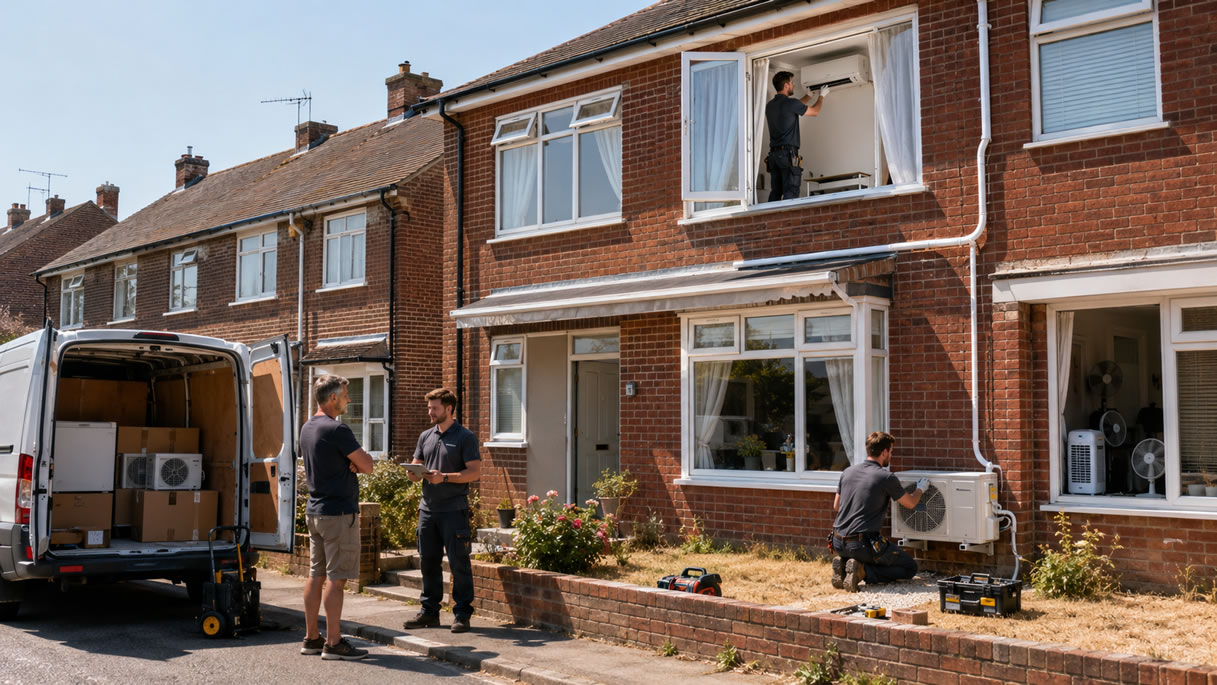
Air conditioning has traditionally felt like something associated with Mediterranean holidays, offices and hotels. However, Britain’s exceptionally hot summer of 2026 has caused many homeowners to think differently.
Repeated heatwaves, record-breaking daytime temperatures and unusually warm nights have made bedrooms, loft conversions and home offices difficult to keep comfortable. As a result, demand for professionally installed air conditioning has risen sharply across the country.
The change is not based on impressions alone. Figures published during the summer show record-challenging temperatures, a large increase in installation enquiries and shortages of some cooling products. Although Britain remains far behind warmer countries in air-conditioning ownership, the market appears to be changing quickly.
This article looks at what made summer 2026 so unusual, why air conditioning installations have become more popular and what homeowners should check before choosing a system.
How Hot Has Britain Been in 2026?
The hot weather started before meteorological summer officially began. On 26 May, Kew Gardens reached 35.1°C, setting a new verified UK record for both May and meteorological spring.
June then brought another series of exceptional temperatures. According to the Met Office review of the June heatwave, Lingwood in Norfolk reached a provisional 37.7°C on 26 June. That passed the previous UK June record of 35.6°C, which Southampton recorded in 1976.
The heat did not disappear after June. July became the UK’s second-warmest July on record and its sunniest July in a series dating back to 1910. Southern England recorded its warmest July for mean temperature, while Wales experienced its joint-warmest July.
Key UK temperature statistics from summer 2026
| Statistic | 2026 figure | Why it stands out |
|---|---|---|
| Highest verified May temperature | 35.1°C at Kew Gardens | A new UK record for May and meteorological spring |
| Provisional June maximum | 37.7°C at Lingwood, Norfolk | Exceeded the previous UK June record of 35.6°C |
| July UK mean temperature | 17.4°C | Around 2°C above the 1991–2020 July average |
| Summer mean from 1 June to 10 August | 16.48°C | 1.88°C above the 1991–2020 summer average |
| Summer days above 30°C by 15 July | More than the whole summer of 1976 | Shows how frequently high temperatures occurred |
| Long heatwave spell | 37 days, from 30 June to 5 August | The second-longest spell in the Met Office dataset from 1900 to 2026 |
The Met Office said on 11 August that Britain was on course for its warmest summer on record for mean temperature. However, the final seasonal result remains provisional until meteorological summer ends and the complete data has been checked.
Warm Nights Have Made the Heat Harder to Escape
Headline temperatures only explain part of the rising interest in home cooling. Warm nights have also caused problems because many homes have struggled to release the heat they absorbed during the day.
During the June heatwave, Cardiff Bute Park recorded a minimum temperature of 23.5°C. Hastings recorded 23.2°C. Therefore, even opening windows late at night offered limited relief in some areas.
By the middle of July, average UK minimum temperatures were running 1.5°C above the seasonal average. Meanwhile, average maximum temperatures were 2.1°C higher than usual. The Met Office also reported that 2026 became the first year on record to reach at least 35°C in May, June and July.
Warm nights particularly affect:
- Bedrooms located in converted lofts
- South-facing rooms with large windows
- Modern flats with limited cross-ventilation
- Conservatories and highly glazed extensions
- Top-floor apartments beneath poorly shaded roofs
- Home offices containing computers and other equipment
- Older people, babies and anyone vulnerable to heat
A fan moves air across the skin, which can make someone feel cooler. Nevertheless, it does not lower the room temperature. A fitted air-conditioning system actively removes heat and usually reduces humidity as well. That difference becomes far more noticeable when indoor temperatures remain high overnight.
Air Conditioning Installation Enquiries Rose by 320%
The demand figures have been just as striking as the weather data. New information from trades marketplace MyBuilder showed that UK requests for domestic air-conditioning installation rose by 320% compared with the same period in 2025.
The increase represented the highest level recorded on the platform, according to reports covering the MyBuilder data. Importantly, this figure refers to requests for installation work rather than completed installations across the whole UK market. Even so, it provides a strong indication of how quickly homeowner interest changed during the heatwave.
Other signs of exceptional demand appeared at the same time:
- Currys reportedly recorded a 330% rise in air-conditioning sales during the June heatwave period.
- Retailers sold out of several popular portable air conditioners and experienced delayed restocking.
- One East Midlands installation company reported an 838% week-on-week increase in clicks during the May heatwave. This was a single-company website figure rather than a national market measure, but it shows how suddenly enquiries can spike.
- MyBuilder’s related European platforms also recorded sharp rises in Germany and the Netherlands.
These figures measure different parts of the market. Retail sales include portable machines, whereas MyBuilder’s data relates to requests for installation work. Consequently, the percentages should not be added together or treated as a total increase in completed UK installations.
Britain Started from a Low Level of Air Conditioning Ownership
Air conditioning remains much less common in Britain than in southern Europe or the United States. Carbon Brief reported that one established estimate put air-conditioning use at only around 4% of homes in England.
A more recent YouGov survey, which included portable and central systems, placed UK take-up at 11%. Different definitions and survey methods help explain the gap. Either way, Britain still has a relatively low level of home cooling.
Historically, this made sense. British houses were designed mainly to retain warmth through a cold winter. Insulation, smaller openings and limited shading helped reduce heating requirements. During a prolonged hot spell, however, the same features can hold heat inside.
Many UK homes also lack features commonly found in warmer countries, such as external shutters, deep roof overhangs and effective solar shading. As summers become warmer, homeowners may need a mixture of passive measures and mechanical cooling.
Why Home Air Conditioning Is Becoming More Popular
More people work from home
Hybrid and home working have changed how people experience hot weather. Previously, someone might spend the hottest part of the day in an air-conditioned office. Now, a spare bedroom or loft conversion may act as a workplace for eight hours.
Computers, monitors and other electrical equipment produce extra heat. In addition, closing the door for calls can restrict airflow. A small home office can therefore become uncomfortable surprisingly quickly.
Bedrooms remain hot after sunset
Sleep is one of the main reasons homeowners consider air conditioning. Upstairs rooms often stay warm long after the outdoor temperature starts to fall. Loft bedrooms can experience an even greater build-up of heat because they sit directly beneath the roof.
A correctly sized bedroom unit can cool the room before bedtime and maintain a more stable temperature overnight. Many modern systems also include quiet operating modes, although actual noise levels vary between products.
Fixed systems can provide heating too
Many modern wall-mounted air-conditioning units work as air-to-air heat pumps. Therefore, they can provide efficient heating during cooler weather as well as cooling in summer.
This makes the equipment useful for garden offices, conservatories, extensions and rooms without an existing wet central-heating radiator. However, homeowners should compare running costs and performance rather than assuming that every system works equally well.
Repeated heatwaves have changed expectations
A single hot weekend may encourage people to buy a fan. Several long spells of heat can prompt a more permanent decision. Summer 2026 has shown that uncomfortable indoor temperatures may continue for days and return several times within one season.
Consequently, homeowners are starting to plan cooling in the same way that they plan heating, ventilation and insulation.
Which Air Conditioning Systems Are Homeowners Choosing?
The right type of air conditioning depends on the number of rooms, the building layout and the available position for outdoor equipment.
| System type | Typical use | Main advantage | Main limitation |
| Single-split system | One bedroom, lounge or home office | Efficient cooling for one main room | Requires an indoor and outdoor unit |
| Multi-split system | Several bedrooms or living spaces | Several indoor units can connect to one outdoor unit | More planning, pipework and installation work required |
| Ducted system | Larger renovations and whole-home projects | Discreet grilles and more even cooling | Usually more expensive and disruptive to install |
| Portable air conditioner | Temporary cooling in one room | No permanent outdoor unit installation | Noisier, less efficient and needs an exhaust hose |
| Air-to-air heat pump | Rooms needing heating and cooling | Useful throughout much of the year | Still requires careful sizing and professional installation |
A portable machine may help during a short heatwave, but it is not the same as a professionally fitted split system. The hose needs to discharge hot air outside, while gaps around an open window can allow heat back into the room. Portable units also keep the compressor inside, so they tend to create more indoor noise.
High Demand Can Mean Longer Installation Times
Air-conditioning demand often rises suddenly when temperatures are already high. Unfortunately, that is also the most difficult time to secure a quick installation.
Installers may face:
- Full survey and installation diaries
- Shortages of popular unit sizes
- Delays obtaining matching indoor and outdoor equipment
- Greater demand for electrical work
- Limited availability of qualified engineers
- Longer waits for scaffolding or specialist access equipment
Manufacturers and distributors plan stock before summer begins. If several countries experience heatwaves at the same time, replacement supplies cannot always reach the UK immediately. Professionally fitted systems also need the correct combination of indoor unit, outdoor unit, pipework and controls.
Therefore, autumn, winter or early spring may offer more time to compare systems and arrange the work. Booking outside a heatwave does not guarantee a lower price, but it can reduce the pressure to accept the first available product or installation date.
How to Arrange an Air Conditioning Installation
1. Decide which rooms need cooling
Start with the rooms that overheat most often. Note their size, ceiling height, window direction, insulation and typical number of occupants.
2. Request a proper heat-load assessment
Ask an installer to calculate the cooling requirement rather than selecting a unit from floor area alone. Glazing, roof exposure, equipment and room use can all change the required capacity.
3. Discuss indoor and outdoor unit positions
The indoor unit needs to distribute air without blowing directly onto beds or desks. Meanwhile, the outdoor unit needs suitable airflow, secure support and a position that limits noise disturbance.
4. Check permissions and installer qualifications
Flats, leasehold homes, listed buildings and some external unit positions may need consent. In addition, anyone working on equipment containing fluorinated refrigerant must hold the appropriate F-gas qualification. The installation company may also need certification.
5. Compare detailed written quotations
Check the proposed make, model, capacity, energy performance, noise rating and warranty. The quotation should also explain electrical work, pipe routes, condensate drainage, access equipment and removal of waste.
6. Plan servicing and ongoing use
Ask how often the filters need cleaning and when the system should receive professional air con maintenance. Sensible temperature settings, closed windows and suitable shading can reduce unnecessary energy use.
Do Not Rush into Buying the Wrong System
An undersized unit may run continuously without making the room comfortable. On the other hand, an oversized system can cycle on and off too frequently, create draughts and control humidity poorly.
The cheapest quotation may also exclude important work. Before accepting it, check whether the price covers:
- Electrical supply and isolation
- Condensate drainage
- Pipework and protective trunking
- Wall drilling and making good
- Outdoor-unit brackets or a ground base
- Access equipment where required
- Commissioning and customer instructions
- Manufacturer warranty registration
- Waste and packaging removal
Homeowners should also consider appearance and neighbour noise. A discreet outdoor position may require a longer pipe route, which can affect the design and price. However, hiding a unit in an enclosed space can restrict airflow and reduce performance.
Who Can Legally Install a Split Air Conditioning System?
Split air-conditioning systems normally contain refrigerant. According to current government F-gas guidance, an individual must hold the correct qualification to install, maintain, service, leak-check or decommission relevant equipment.
The business may also need company certification when it works on stationary air-conditioning equipment for customers. Consequently, homeowners should ask for evidence of the appropriate F-gas credentials rather than hiring a general handyman to connect the refrigerant circuit.
A qualified installer should also explain the electrical requirements, condensate route and commissioning process. Depending on the work, a separate qualified electrician may need to complete or certify the electrical supply.
Cooling Should Form Part of a Wider Overheating Plan
Air conditioning provides effective control, but it does not need to work alone. Reducing the amount of heat entering a room can lower the cooling load and running time.
Practical measures include:
- External shading, shutters or suitable awnings
- Solar-control blinds or carefully selected window film
- Closing curtains before direct sunlight reaches the glass
- Ventilating during cooler parts of the day
- Improving loft insulation while maintaining suitable ventilation
- Using light-coloured roof or external finishes where appropriate
- Turning off unnecessary electrical equipment
- Planting suitable trees or climbers to provide seasonal shade
External shading usually stops more solar heat than an internal blind because it blocks sunlight before it passes through the glass. Nevertheless, every property differs. A combination of shading, ventilation and targeted air conditioning may provide the most practical result.
Comparing Air Conditioning Installation Quotes
The 320% increase in installation requests shows why it is worth planning ahead. During a heatwave, some homeowners may feel tempted to accept the earliest available appointment without comparing the equipment or specification.
Instead, try to obtain more than one written quotation from qualified local installers. Give each company the same information about the rooms, preferred use and available outdoor space. That makes it easier to compare capacity, efficiency, noise, warranty and price on a similar basis.
Ask how long the quoted equipment will remain available and whether the proposed installation date depends on confirmed stock. You should also find out who will handle any electrical work and what happens if the chosen unit becomes unavailable.
Britain’s summer of 2026 has demonstrated that domestic cooling is moving from a niche purchase towards a more common home improvement. A well-designed installation can make hot bedrooms, home offices and living areas much more comfortable. However, careful sizing, suitable positioning and qualified installation remain more important than rushing to secure whichever unit happens to be in stock.
Frequently Asked Questions
How much did demand for home air conditioning rise in 2026?
MyBuilder reported that requests for domestic air-conditioning installation increased by 320% compared with the same period in 2025. This figure measures enquiries posted through its platform rather than every completed UK installation.
Was summer 2026 Britain’s hottest summer on record?
Met Office data published on 11 August showed the UK on course for its warmest meteorological summer by mean temperature. The figure remained provisional because summer had not yet ended when the update was published.
What was the highest UK temperature during summer 2026?
A provisional temperature of 37.7°C was recorded at Lingwood in Norfolk on 26 June. This exceeded the previous UK June record of 35.6°C set in Southampton in 1976.
Why do British homes become so hot?
Many British homes were designed to retain heat during winter and lack external shading. Large south-facing windows, converted lofts, limited ventilation and heat-producing equipment can make overheating worse.
Is a portable air conditioner as effective as a fitted system?
A portable unit can provide temporary cooling, but it usually creates more indoor noise and needs an exhaust hose through a window or wall. A correctly sized split system generally offers quieter and more efficient cooling.
Can a home air-conditioning unit provide heating?
Many modern split systems operate as air-to-air heat pumps, allowing them to heat as well as cool. Check the model specification, efficiency and suitability for the room before buying.
Does an air-conditioning installer need F-gas qualifications?
Anyone who installs or works on relevant equipment containing F gas must hold the correct qualification. Companies carrying out work on stationary air-conditioning systems may also need company certification.
When is the best time to arrange air conditioning installation?
Autumn, winter and early spring can be good times to request quotes because installers may face less heatwave-driven demand. Planning early also provides more time to compare units, positions and warranties.