
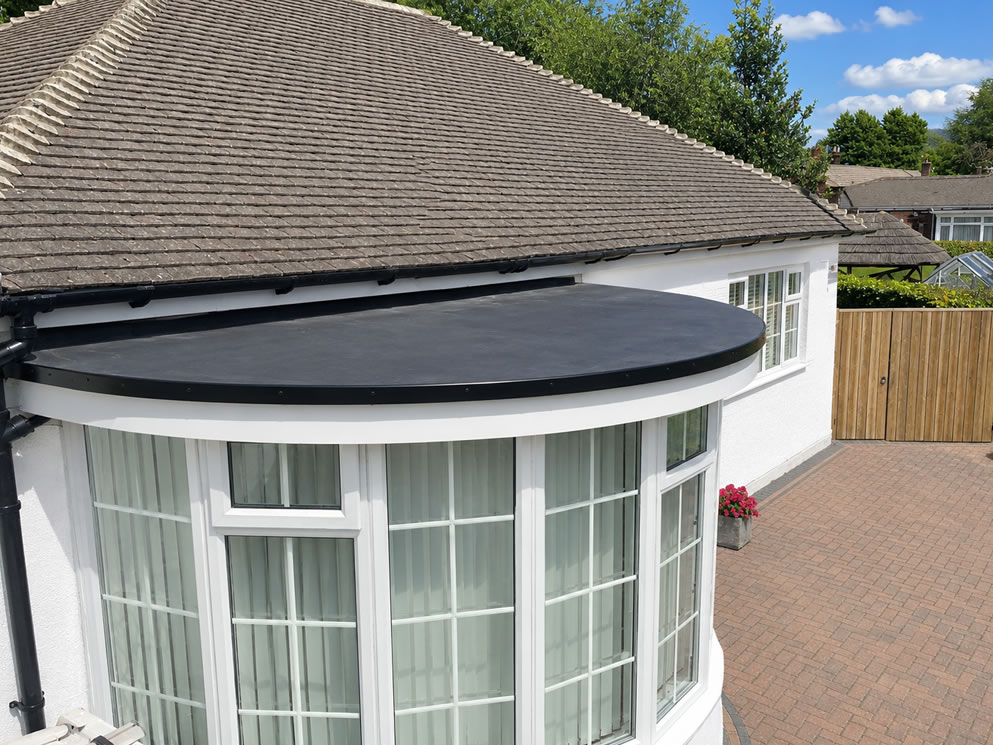
Bay windows add character, extra light and useful space to many UK homes. However, the small roof above a bay window often develops problems before the main roof does.
Bay window roofs usually have a shallow pitch and several vulnerable joints. Rainwater can collect around the edges, while failed flashing, cracked felt, damaged leadwork and blocked outlets can all allow water into the room below.
A leak may begin as a small damp mark above the bay window. Left untreated, it can damage plaster, insulation, timber and decorations.
This guide explains the most common bay window roof faults, repair methods, likely UK costs and how to prevent the same problem returning.
What Is a Bay Window Roof?
A bay window projects outwards from the main wall of a property. The roof above it protects the window structure and directs rainwater away from the building.
Bay window roofs come in several designs, including:
- Flat felt roofs
- Lead-covered roofs
- Tiled pitched roofs
- Slate roofs
- GRP fibreglass roofs
- EPDM rubber roofs
- Zinc or other sheet-metal roofs
- Decorative tiled canopies
Some bay roofs sit beneath a first-floor window, while others join directly into the main house wall.
Because the roof area is small, homeowners sometimes assume repairs will be simple. In reality, the junction between the bay roof and the wall can require careful detailing.
Why Do Bay Window Roofs Leak?
Most bay roof leaks start at joints, edges or drainage points rather than in the centre of the covering.
Common causes include:
- Split or worn roofing felt
- Cracked leadwork
- Failed wall flashing
- Loose roof tiles or slates
- Damaged mortar
- Blocked gutters or outlets
- Standing water
- Poor roof falls
- Rotten timber decking
- Failed sealant around windows
- Cracked GRP
- Shrunk or punctured EPDM
- Wind damage
- Poor previous repairs
- Condensation inside the bay structure
The leak may only appear during heavy or wind-driven rain. This often suggests a problem with flashing, laps or the roof-to-wall junction.
Common Bay Window Roof Problems
| Fault | Common Cause | Possible Result |
|---|---|---|
| Split felt | Age, UV exposure or movement | Water reaches the roof deck |
| Failed wall flashing | Poor installation or cracked mortar | Water runs behind the roof covering |
| Cracked lead | Thermal movement or fatigue | Persistent localised leak |
| Standing water | Inadequate fall or blocked outlet | Faster roof deterioration |
| Loose tiles | Failed fixings or storm damage | Exposed underlay |
| Cracked GRP | Movement, impact or poor installation | Water penetration |
| Damaged EPDM | Puncture, shrinking or failed seam | Leaks at joints and edges |
| Rotten decking | Long-term moisture exposure | Soft or sagging roof surface |
| Blocked gutter | Leaves, moss and debris | Overflow onto walls or windows |
| Failed sealant | Age or unsuitable product | Water enters around trims and frames |
| Condensation | Poor insulation or ventilation | Damp patches without an external leak |
| Damaged fascia | Rot or water overflow | Poor support for gutters and roof edges |
Signs a Bay Window Roof Needs Repair
A bay roof fault may show both inside and outside the property.
Look out for:
- Damp patches above the bay window
- Brown ceiling stains
- Peeling paint or wallpaper
- Mould around the top of the window
- Water dripping during rainfall
- Cracked or bubbling roof felt
- Loose flashing
- Missing tiles or slates
- Sagging roof edges
- Standing water
- Moss collecting on the roof
- Rotten fascia boards
- Overflowing guttering
- A musty smell inside the bay
- Soft plaster or timber
A damp mark does not always confirm the exact leak location. Water may travel along the deck or timber before becoming visible inside.
Main Types of Bay Window Roof
| Roof Type | Typical Features | Common Faults |
| Felt roof | Mineral felt over timber deck | Splits, bubbles and failed laps |
| Lead roof | Traditional lead sheet covering | Cracking, fatigue and poor joints |
| Tiled roof | Small pitched roof with tiles | Slipped tiles and failed flashing |
| Slate roof | Pitched covering using small slates | Broken slates and fixing failure |
| GRP roof | Seamless fibreglass finish | Cracks, pinholes and edge failure |
| EPDM roof | Rubber membrane | Punctures and loose seams |
| Zinc roof | Folded sheet-metal covering | Corrosion and joint failure |
| Decorative canopy | Tiles, lead or mixed materials | Complex junction and drainage problems |
1. Felt Bay Window Roof Problems
Traditional felt remains common on small flat bay roofs.
Older systems may use several layers of bituminous felt. Over time, heat and sunlight make the surface brittle. Cracks often develop around edges, corners and wall joints.
Typical felt roof faults include:
- Surface cracking
- Blisters and bubbles
- Open seams
- Split corners
- Failed mineral finish
- Felt lifting around trims
- Water trapped beneath the covering
- Felt shrinking away from the wall
Small defects may accept a local patch. However, widespread cracking usually means the felt has reached the end of its useful life.
2. Lead Bay Roof Problems
Lead is widely used on traditional bay windows, especially on period properties.
A correctly installed lead roof can last for many years. However, lead expands and contracts as temperatures change. If sheets are too large or fixed too tightly, cracks can form.
Common lead faults include:
- Splits across the sheet
- Cracks near fixings
- Poorly formed joints
- Inadequate upstands
- Loose wall flashing
- Punctures from foot traffic
- Corrosion from unsuitable materials
- Previous repairs using sealant or bitumen
Small splits can sometimes be repaired with a properly formed lead patch. Repeated cracking may indicate that the entire bay roof needs replacing in correctly sized sections.
3. Bay Window Flashing Failure
The roof-to-wall junction is one of the most common sources of leaks.
Flashing should prevent water running behind the roof covering where it meets the brickwork or render.
Problems may develop when:
- Lead flashing pulls away
- Mortar joints crack
- Flashing is too short
- Sealant replaces proper flashing
- Render cracks above the roof
- The upstand is too low
- Cavity trays are missing or damaged
- Water tracks behind cladding
Simply adding sealant along the edge may reduce the leak briefly, but it rarely replaces correct flashing.
4. Standing Water on a Bay Roof
Flat roofs should still have a slight fall towards a gutter or outlet.
If the roof surface is completely level or has started to sag, rainwater can remain for long periods.
Standing water can cause:
- Faster felt deterioration
- Moss and algae growth
- Additional weight on the deck
- Damage during freezing weather
- Water entering small cracks
- Staining around roof edges
A good roofer may need to improve the roof fall by adjusting firring strips or replacing the roof deck.
5. Rotten Bay Roof Decking
Flat roof coverings normally sit on plywood, OSB or timber boards.
If water reaches the deck repeatedly, the timber can soften, swell or rot. The roof may then feel spongy or develop visible dips.
Covering rotten decking with a new waterproof layer will not provide a reliable repair. The damaged boards must be removed and replaced first.
Rot can also affect:
- Roof joists
- Fascia boards
- Timber window frames
- Decorative mouldings
- Internal ceiling battens
6. Tiled or Slate Bay Roof Faults
Some bay windows have a small pitched roof covered with tiles or slates.
Common problems include:
- Slipped tiles
- Broken slates
- Failed nails
- Cracked mortar
- Loose ridge tiles
- Damaged underlay
- Incorrect tile overlap
- Failed flashing
- Moss blocking drainage paths
Because the roof is small, cut tiles around the edges may have limited fixing points. Strong winds can loosen them more easily than full-sized tiles.
7. GRP Bay Roof Problems
GRP fibreglass creates a hard, seamless surface when installed correctly.
However, cracks can form if the timber deck moves, the resin mix is incorrect or the surface was installed in unsuitable weather.
Typical GRP faults include:
- Hairline cracks
- Pinholes
- Cracks around trims
- Delamination
- Ponding water
- Poorly sealed wall junctions
- Damage from ladders or dropped tools
A local GRP repair may work where the surrounding laminate remains sound. Widespread cracking may require the roof to be stripped and renewed.
8. EPDM Bay Roof Problems
EPDM is a flexible rubber membrane often used on modern flat roofs.
The main sheet can last for many years, but faults often occur at the edges, corners or joins.
Common issues include:
- Punctures
- Failed adhesive
- Loose perimeter trims
- Open seams
- Membrane shrinkage
- Poor wall upstands
- Water trapped beneath the rubber
A small puncture may accept a compatible patch. Larger installation faults may require partial or full replacement.
Leak or Condensation?
Not every damp patch above a bay window comes from rainwater.
Bay windows can be colder than the main walls of the house. Warm indoor air may condense on cold surfaces if insulation is poor.
Signs that condensation may contribute include:
- Damp appearing mainly in winter
- Black mould rather than brown staining
- Water collecting on window glass
- No clear link with rainfall
- Cold ceiling surfaces
- Poor ventilation
- Furniture restricting airflow
- High indoor humidity
A roofer can check the external covering, while an insulation or damp specialist may need to assess persistent condensation.
Temporary Repair or Permanent Repair?
| Condition | Possible Solution |
| Small isolated felt split | Local patch may be suitable |
| One loose flashing edge | Refix or renew the affected section |
| Small lead crack | Proper lead patch |
| One slipped tile | Replace and secure the tile |
| Minor EPDM puncture | Compatible membrane patch |
| Local GRP crack | Sand, laminate and reseal |
| Widespread felt cracking | Replace the complete covering |
| Rotten roof deck | Strip roof and replace decking |
| Repeated lead splits | Renew lead in correctly sized sections |
| Poor roof fall | Rebuild falls before covering |
| Several failed materials | Full bay roof replacement |
| Damp caused by condensation | Improve insulation and ventilation |
Temporary sealant repairs may help during an emergency, but they often hide the real problem and make later work more difficult.
Bay Window Roof Repair Methods
Felt Patching
A roofer cleans and dries the damaged area before installing a compatible felt patch.
This can work for a small isolated split where the rest of the covering remains flexible.
Full Felt Replacement
The old covering is removed, the timber deck is checked and new felt is installed.
Modern systems often use multiple layers or a high-performance membrane rather than basic shed felt.
Lead Repair
A small split may be repaired with new lead dressed over the affected area.
The repair must allow for natural movement and should not rely only on adhesive products.
Lead Roof Replacement
The roofer removes the old lead, repairs the deck and installs new sheets with suitable joints, laps and upstands.
Tile or Slate Replacement
Broken pieces are removed and replaced. The roofer also checks fixings, underlay and flashing.
GRP Repair
The damaged surface is prepared before new resin and fibreglass matting are applied.
EPDM Repair
A compatible patch or seam system is bonded over a clean, dry surface.
Deck Replacement
Rotten or sagging boards are removed and replaced before the waterproof covering goes back on.
Flashing Renewal
Failed wall flashing is removed and replaced using a suitable lead or proprietary system.
Repair or Replace the Whole Bay Roof?
A local repair can offer good value when the fault is small and the surrounding material remains sound.
Full replacement may make more sense where:
- The covering has failed in several places
- The roof has already received multiple patches
- Timber decking has rotted
- Water regularly stands on the surface
- Flashing and covering have both failed
- The roof has poor falls
- Insulation needs upgrading
- The existing material has reached the end of its useful life
- Previous repairs used unsuitable materials
- The homeowner wants a longer-term solution
Repeated emergency patches can cost more over time than replacing the roof properly.
Bay Window Roof Repair Cost in the UK
Prices vary according to the roof material, access, size and hidden damage.
The figures below provide broad budgeting estimates.
| Type of Work | Typical UK Cost |
| Small seal or patch repair | £180 to £400 |
| Felt patch repair | £250 to £500 |
| Replace several tiles or slates | £250 to £600 |
| Minor flashing repair | £300 to £650 |
| Lead patch repair | £300 to £700 |
| Small timber deck repair | £400 to £900 |
| Full felt bay roof replacement | £700 to £1,800 |
| Full EPDM bay roof replacement | £800 to £2,000 |
| Full GRP bay roof replacement | £900 to £2,200 |
| Full lead bay roof replacement | £1,200 to £3,000 or more |
| Tiled bay roof replacement | £1,000 to £3,000 |
| Scaffold tower or access equipment | £250 to £800 |
| Full scaffolding | £500 to £1,500 or more |
Properties in London and other high-cost areas may face higher labour and access charges.
What Affects the Cost?
Roof Material
Lead generally costs more than felt, GRP or EPDM. Natural slate and decorative tiles can also increase the price.
Access
A ground-floor bay may only need a tower or small scaffold. A first-floor bay above a conservatory may require a larger access system.
Condition of the Deck
Rotten timber adds labour and material costs.
Flashing Work
Repairing the roof covering alone may not solve the leak if wall flashing has failed.
Roof Shape
Curved, angled or decorative bay roofs require more cutting and detailing.
Insulation
Upgrading insulation can increase the cost but may improve comfort and reduce condensation.
Fascia and Guttering
Rotten fascia boards or damaged gutters may need replacing at the same time.
Matching Materials
Older tiles, slates or decorative trims may be difficult to source.
What Should a Bay Roof Repair Quote Include?
| Quote Item | Why It Matters |
| Cause of the leak | Confirms that the contractor has diagnosed the fault |
| Repair area | Shows whether the work is local or complete |
| Roofing material | Identifies the proposed system |
| Deck repairs | Clarifies how rotten timber will be handled |
| Wall flashing | A common source of bay roof leaks |
| Roof falls | Important where standing water is present |
| Fascia and gutter work | May affect drainage and roof edges |
| Insulation | Helps address cold spots and condensation |
| Access equipment | Can represent a large part of the price |
| Waste removal | Avoids unexpected disposal charges |
| VAT | Confirms the final payable cost |
| Guarantee | Explains what happens if the repair fails |
The quotation should also state how the contractor will charge for hidden damage found after stripping the roof.
Can You Repair a Bay Window Roof Yourself?
A low bay roof may look accessible, but DIY repairs still carry risks.
Common problems include:
- Falling from a ladder
- Damaging window glass
- Walking on weak decking
- Using incompatible repair products
- Trapping moisture beneath patches
- Failing to repair the wall flashing
- Blocking drainage paths
- Creating poor overlaps
- Applying materials to a wet surface
- Missing hidden timber rot
A temporary patch may be reasonable in an emergency where it can be applied safely from a stable platform. However, a roofer should inspect repeated leaks or structural damage.
Never rely on a window sill, conservatory roof or unsuitable ladder position as a working platform.
Why Sealant Often Fails
General-purpose roof sealant is commonly applied around bay roofs, especially where the roof meets the wall.
It may fail because:
- The surface is dirty or damp
- The roofing material moves
- UV exposure makes it brittle
- Water enters behind the sealant
- The underlying felt or lead remains damaged
- The product is incompatible with the roof covering
- The joint requires proper flashing
- Standing water remains on the surface
Sealant has a place in some proprietary roofing systems, but it should not replace correct laps, flashing or structural repairs.
What Happens During a Full Bay Roof Replacement?
1. Inspection
The contractor checks the covering, wall junction, fascia, drainage and the room below.
2. Safe Access
A scaffold tower, platform or suitable scaffolding is installed.
3. Old Roof Covering Removed
The contractor strips away felt, lead, GRP, EPDM or tiles as required.
4. Deck and Timbers Checked
Rotten boards, joists and edge timbers are identified.
5. Timber Repairs Completed
Damaged sections are replaced and the structure is levelled.
6. Roof Falls Improved
Firring strips may be fitted to create a better slope towards the gutter or outlet.
7. Insulation Installed or Upgraded
The contractor adds insulation where suitable and ensures that the roof build-up manages condensation correctly.
8. New Covering Fitted
The selected waterproof system is installed with correct laps, upstands and edge details.
9. Flashing Renewed
The roof-to-wall junction receives suitable flashing.
10. Fascia and Guttering Completed
Damaged roof edges, outlets and gutters are repaired or replaced.
11. Final Inspection
The contractor checks the surface, edges and drainage before clearing the site.
Typical Bay Roof Replacement Process
| Stage | Main Work |
| Survey | Locate the leak and assess the roof |
| Access | Install a safe working platform |
| Strip roof | Remove the old covering |
| Inspect deck | Check boards, joists and fascia |
| Repair structure | Replace damaged timber |
| Improve falls | Create suitable drainage |
| Add insulation | Improve thermal performance where needed |
| Install covering | Fit felt, lead, GRP, EPDM or tiles |
| Complete flashing | Seal the roof-to-wall junction correctly |
| Finish drainage | Repair gutters, outlets and fascia |
| Final check | Inspect the completed roof |
Which Bay Window Roofing Material Is Best?
The best material depends on the property, roof shape, budget and appearance.
| Material | Main Advantages | Possible Drawbacks |
| Felt | Affordable and widely available | Shorter life than some premium systems |
| Lead | Traditional, flexible and long-lasting | Higher cost and specialist installation |
| EPDM | Flexible and usually installed in one sheet | Edge and seam details must be correct |
| GRP | Strong, seamless and neat appearance | Can crack if the deck moves |
| Tiles | Matches the main roof | Needs enough pitch |
| Slate | Traditional and attractive | More expensive and fragile |
| Zinc | Durable and suitable for complex shapes | Specialist work and higher cost |
For a period property, appearance and conservation requirements may influence the choice.
Can a Bay Roof Be Insulated During Repair?
Yes. A full replacement provides a good opportunity to improve insulation.
Bay windows often feel cold because they project beyond the main wall and have more external surfaces.
Possible improvements include:
- Insulation above the deck
- Insulation between joists
- Insulated plasterboard internally
- Sealing gaps around the window structure
- Insulating side panels
- Improving airtightness
However, the contractor must avoid trapping moisture. The insulation, vapour control and roof covering need to work together.
Is Planning Permission Required?
A like-for-like repair will not normally need planning permission.
Permission or additional consent may be needed where:
- The building is listed
- The property sits in a conservation area
- The roof shape will change
- The replacement material changes the appearance significantly
- The bay window itself will be altered
- Planning conditions apply to the property
Listed building consent may apply even to a small roof where traditional leadwork or decorative detailing will change.
Do Building Regulations Apply?
Minor maintenance repairs may not need approval.
However, Building Regulations may apply where the work involves:
- Structural timber replacement
- Major insulation upgrades
- Significant roof renovation
- Changes to drainage
- Altering the roof construction
- Replacing a large thermal element
Requirements differ across England, Wales, Scotland and Northern Ireland. The homeowner should check with the relevant local authority or building control body where the scope is uncertain.
How Long Does Bay Window Roof Repair Take?
A small patch may take a few hours.
Typical timescales include:
| Type of Work | Approximate Timescale |
| Small patch or seal repair | A few hours |
| Flashing repair | Half a day to one day |
| Tile or slate repair | Half a day to one day |
| Felt bay roof replacement | One to two days |
| EPDM or GRP replacement | One to three days |
| Lead roof replacement | Two to four days |
| Replacement with timber repairs | Two to five days |
Bad weather, complex shapes and difficult access can extend the work.
Can the Room Still Be Used?
In most cases, the room can remain in use during the repair.
Homeowners should expect:
- Noise above the window
- Dust and small debris
- Temporary loss of privacy due to scaffolding
- Limited access around the bay
- Possible removal of curtains or blinds
- Short periods where the roof is exposed
Furniture, curtains and valuable items should be moved away from the bay until the work is complete.
How to Prevent Future Bay Roof Problems
Keep Gutters and Outlets Clear
Remove leaves, moss and debris before water backs up onto the roof.
Check Flashing
Inspect the roof-to-wall junction for loose lead, cracked mortar or gaps.
Deal with Standing Water
Persistent puddles may indicate poor falls or sagging decking.
Maintain Sealant and Trims
Where the roofing system uses sealant, replace it before it fully separates.
Cut Back Overhanging Branches
Branches can damage the covering and add debris.
Repair Small Defects Early
A small split costs less to fix before the deck begins to rot.
Inspect After Storms
Strong winds can lift felt edges, loosen tiles and damage flashing.
Control Indoor Moisture
Use extractor fans and keep the room ventilated to reduce condensation around the bay.
Bay Window Roof Maintenance Checklist
| Maintenance Task | Suggested Frequency |
| Inspect roof from an upstairs window or ground level | Every 6 months |
| Clear gutters and outlets | Once or twice a year |
| Check flashing and wall junction | Once a year |
| Inspect after strong winds | As required |
| Remove moss and leaves | When visible |
| Check internal ceiling for damp | During heavy rain |
| Review condensation and mould | During winter |
| Arrange professional inspection | Every 2 to 5 years |
When Is the Repair Urgent?
Seek urgent help where:
- Water is dripping into the room
- The ceiling is bulging
- Electrical fittings are wet
- Roof decking appears to be collapsing
- Lead or felt has lifted in strong winds
- Tiles have fallen
- The leak is spreading quickly
- Timber around the window feels soft
- Water is entering above sockets or lighting
Switch off electricity to affected fittings where it is safe to do so and contact an electrician where water has reached wiring.
How to Choose a Bay Roof Repair Contractor
Ask contractors:
- What type of bay roof do I have?
- Where is the leak entering?
- Is the roof covering or flashing at fault?
- Can the roof be repaired locally?
- Does the deck need replacing?
- Will you improve the roof falls?
- What material do you recommend?
- Is insulation included?
- How will the wall junction be detailed?
- Does the quote include access equipment?
- Will you replace the fascia or gutter if required?
- How will hidden damage be priced?
- Do you hold public liability insurance?
- What guarantee do you provide?
- Will you supply photographs of the completed work?
A contractor should inspect the roof before recommending a full replacement.
Bay Window Roof Repair Checklist
| Question | Why It Matters |
| Has the actual leak source been found? | Water may travel before appearing inside |
| Is the wall flashing sound? | This is a common failure point |
| Does water stand on the roof? | Poor drainage shortens the roof’s life |
| Is the deck firm? | Soft timber must be replaced |
| Is the current covering suitable for repair? | Old materials may need full replacement |
| Is insulation required? | Bay windows often suffer from cold spots |
| Is access included? | Scaffolding can add significantly to the price |
| Are gutters and outlets clear? | Blockages may cause the leak |
| Is the repair guaranteed? | Confirms what happens if water returns |
Final Thoughts
Bay window roof leaks often start at flashing, seams, edges and drainage points. Felt may split, lead can crack, tiles may slip and timber decking can rot after repeated exposure to water.
A small isolated defect may only need a local repair. However, widespread cracking, standing water or soft decking usually points towards a complete bay roof replacement.
The roof-to-wall junction deserves particular attention because simply adding sealant rarely provides a reliable long-term fix.
A proper inspection should cover the roof surface, flashing, decking, gutters, insulation and internal signs of damp. Repairing the underlying cause early can prevent damage to plaster, timber and the bay window structure.
Frequently Asked Questions
What is the most common cause of a leaking bay window roof?
Failed flashing, split felt, cracked lead and blocked drainage are among the most common causes. The wall junction often needs careful inspection.
Can a bay window roof be repaired without replacing it?
Yes. Small splits, isolated flashing faults and individual damaged tiles may accept local repairs. Widespread deterioration or rotten decking usually requires replacement.
How much does it cost to repair a bay window roof?
Small repairs may cost between £180 and £700. A complete replacement commonly costs from around £700 to £3,000 or more, depending on the material and access.
How long should a bay window roof last?
The lifespan depends on the material. Felt may last around 10 to 20 years, while well-installed lead, EPDM, GRP or zinc systems may last considerably longer.
Can I use roof sealant on a bay window leak?
Sealant may provide temporary protection, but it will not repair rotten decking, cracked lead, failed felt or poorly installed flashing.
Why does my bay roof only leak in heavy rain?
Heavy rain can overwhelm blocked outlets or flow behind short, loose or poorly detailed flashing. Wind-driven rain may also enter beneath laps and edges.
Can standing water damage a bay roof?
Yes. Standing water places additional stress on the covering and can enter small cracks. It may also encourage moss growth and speed up timber decay.
Can bay window roof felt be patched?
A small isolated tear may accept a compatible patch. If the felt is brittle, blistered or cracked across the surface, full replacement usually offers better value.
Is lead the best material for a bay window roof?
Lead works well on traditional and complex bay roofs when installed correctly. However, EPDM, GRP and high-performance felt may also provide suitable options.
Does a bay window roof need a gutter?
Not every design uses a separate gutter. However, the roof still needs a clear method of directing water away from the wall and windows.
Can a leaking bay roof cause structural damage?
Yes. Long-term leaks can rot decking, joists, fascia boards and parts of the window structure. Early repairs reduce this risk.
Is damp above a bay window always caused by the roof?
No. Condensation, cracked render, failed window seals and penetrating damp from the wall can create similar symptoms.
Can the roof be replaced in winter?
Yes, provided the weather remains safe and dry enough. Rain, frost and strong winds may delay the work.
Should insulation be added during replacement?
A full replacement offers a good opportunity to improve insulation, especially where the bay ceiling feels cold or develops condensation.
Do I need scaffolding for a bay roof repair?
A low ground-floor bay may only need a tower or platform. Taller or difficult-to-reach roofs may require full scaffolding.