
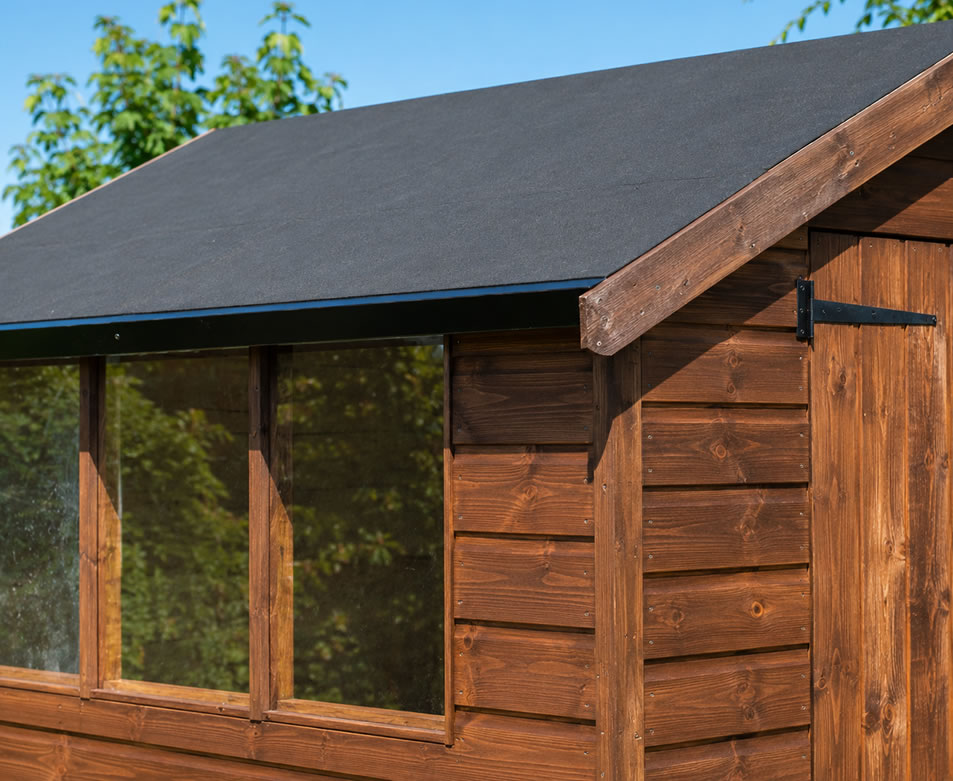
A garden shed roof may last anywhere from a few years to several decades. The difference often comes down to the roofing material, installation quality, roof slope and condition of the timber beneath it.
Basic shed felt provides an inexpensive covering, although it may split, lift or become brittle sooner than premium alternatives. In comparison, EPDM rubber, coated steel, modern fibre cement and properly installed GRP can provide much longer service lives.
However, choosing the material with the highest claimed lifespan does not always make financial sense. A small budget shed may not justify an expensive roof system, while a workshop, summer house or garden office may need a stronger and more durable covering.
This guide compares the typical lifespan of shed roof materials, their costs, maintenance requirements and suitability for different garden buildings.
What is the average lifespan of a shed roof?
The average lifespan depends heavily on the type of covering.
| Shed roof material | Broad typical lifespan |
|---|---|
| Economy shed felt | 3–7 years |
| Better-quality mineral felt | 8–15 years |
| Professional reinforced felt | 15–25 years |
| Corrugated bitumen sheets | 10–20 years |
| EPDM rubber membrane | 30–50+ years |
| GRP fibreglass | 20–30 years |
| Coated steel sheets | 25–40+ years |
| Modern fibre-cement sheets | 30–50 years |
| Cedar shingles | 20–40 years |
| Concrete or clay roof tiles | 40–60+ years |
These ranges provide general guidance rather than guaranteed results. For example, EPDM suppliers commonly state a life expectancy of around 50 years when the membrane receives correct installation and care. Meanwhile, Onduline currently provides a 15-year weatherproofing warranty for its Classic corrugated sheets when installers follow the fitting and maintenance instructions.
What affects the lifespan of a shed roof?
The covering itself provides only part of the answer. Several other factors determine how long the roof remains watertight.
Installation quality
Poor installation can shorten the life of any material.
Common problems include:
- insufficient overlaps
- badly positioned fixings
- loose edges
- unsuitable adhesive
- exposed screw holes
- poorly formed corners
- inadequate support
- missing flashings
- incorrect ridge details
Therefore, careful fitting often matters more than choosing the most expensive product.
Roof pitch
A shed roof needs enough slope to shed water.
When the pitch remains too low, water may:
- sit on the covering
- enter beneath laps
- collect around fixings
- encourage algae
- freeze during winter
- increase the load on the deck
Some materials work at lower pitches than others. Consequently, the roof angle should influence the material choice.
Roof-deck condition
A strong covering cannot compensate for rotten or sagging timber.
Before installing a new roof, inspect:
- OSB
- plywood
- timber boards
- rafters
- purlins
- fascia boards
- edge timbers
Replace soft, swollen or delaminated boards before laying the new covering.
Exposure
An open garden or coastal location places more stress on a roof than a sheltered urban garden.
Strong wind can lift:
- felt edges
- lightweight sheets
- ridge caps
- loose flashings
- poorly secured trims
Meanwhile, salt air may affect unprotected metal components.
Overhanging trees
Branches can:
- puncture membranes
- scrape coatings
- drop leaves
- create shade
- block gutters
- encourage moss growth
Therefore, regular tree and debris management may prolong the roof’s lifespan.
Maintenance
Even low-maintenance materials benefit from occasional checks.
Early repairs to a lifted edge or loose fixing can prevent widespread water damage later.
Economy shed felt
Basic shed felt remains one of the cheapest and most widely available roof coverings.
Manufacturers typically make it from a bitumen-saturated base with a sanded or mineral surface. Homeowners often secure it with felt nails, adhesive or a combination of both.
How long does basic shed felt last?
Economy felt may last approximately three to seven years. However, some products fail sooner when exposed to strong wind, direct sunlight or standing water.
Higher-quality mineral felt may provide around eight to fifteen years where installers fit it carefully over a sound deck.
Advantages
- low purchase price
- widely available
- simple to cut
- manageable for DIY installation
- suits apex and pent sheds
- easy to patch
- familiar appearance
Disadvantages
- shorter lifespan than most premium alternatives
- edges may lift
- nails can create vulnerable points
- sunlight can make the material brittle
- overlaps may open
- frequent replacement can increase long-term costs
Best suited to:
- inexpensive garden sheds
- temporary storage buildings
- small playhouses
- homeowners working with a limited budget
- sheds that may need replacement within a few years
Premium mineral felt
Premium shed felt usually contains a stronger reinforcement and a more durable mineral finish than budget products.
It may also offer:
- improved tear resistance
- better flexibility
- greater thickness
- longer manufacturer guarantees
- stronger resistance to ultraviolet exposure
Typical lifespan
A correctly fitted premium felt roof may last approximately eight to fifteen years. Some high-quality systems may last longer, particularly on sheltered roofs with good drainage.
Is premium felt worth the extra cost?
Often, yes. The material cost may only be modestly higher than economy felt, while the improved durability can reduce the frequency of replacement.
However, the installer still needs to:
- use adequate overlaps
- secure edges properly
- seal ridge details
- remove exposed nails
- prepare a smooth deck
Professional reinforced felt
Professional built-up felt differs significantly from the lightweight rolls sold for simple garden sheds.
A reinforced system may include:
- an underlay
- one or more intermediate layers
- a mineral cap sheet
Installers may use cold adhesive, self-adhesive membranes or torch application, depending on the system.
Modern reinforced bitumen membranes use polyester or glass-fibre reinforcement and modified bitumen compounds. These systems offer greater durability than lightweight shed felt.
Typical lifespan
A well-installed system may last approximately fifteen to twenty-five years or longer.
Advantages
- stronger than basic shed felt
- multi-layer protection
- familiar to many good roofers
- repairable
- suitable for larger workshops and garden rooms
- available in different cap-sheet finishes
Disadvantages
- higher cost
- installation takes longer
- torch-applied systems need professional fire controls
- usually requires a continuous timber deck
- may be excessive for a low-value garden shed
Best suited to:
- substantial workshops
- garages
- summer houses
- insulated garden rooms
- larger outbuildings
EPDM rubber roofing
EPDM is a flexible synthetic rubber membrane. A supplier can often cut it as one sheet large enough to cover the entire shed roof.
As a result, a simple pent or flat roof may have no joints across its main surface.
How long does EPDM last?
Suppliers commonly state an expected lifespan of around 40 to 50 years or more when installers fit the membrane correctly. EPDM has been used commercially since the 1960s, and specialist suppliers currently describe an anticipated lifespan exceeding 50 years.
Advantages
- very long potential lifespan
- flexible during temperature changes
- no open flame required
- few or no field seams
- low maintenance
- suitable for simple flat and pent roofs
- relatively easy to patch
- complete shed kits are available
Disadvantages
- costs more than basic felt
- requires a smooth, dry deck
- poor adhesive work can cause bubbles
- sharp objects may puncture it
- corners and edges require careful detailing
- the plain black appearance may not suit every shed
Best suited to:
- valuable sheds
- garden offices
- workshops
- summer houses
- sheds used for long-term storage
- simple flat or pent roofs
Corrugated bitumen sheets
Corrugated bitumen sheets combine bitumen with reinforcing fibres. They are lightweight and usually fix to timber battens or purlins.
Common products include Onduline and similar corrugated sheet systems.
How long do corrugated bitumen sheets last?
A realistic lifespan often falls between ten and twenty years, depending on product quality and installation.
Onduline currently warrants its Classic sheets to remain weatherproof for 15 years under normal use when fitted and maintained according to its instructions.
Advantages
- lightweight
- relatively easy to carry
- no continuous timber deck may be needed
- suitable for apex and pent roofs
- quieter than bare metal during rain
- available in several colours
- DIY-friendly
- easier to replace one sheet than an entire membrane
Disadvantages
- may sag if support spacing is too wide
- edges can lift if fixings are incorrect
- colour may fade
- heat can soften lower-quality sheets
- ridge and verge details need care
- generally shorter-lived than metal or EPDM
Best suited to:
- garden sheds
- log stores
- animal shelters
- workshops
- timber outbuildings with pitched roofs
Box-profile and corrugated steel sheets
Coated steel sheets offer a durable option for sheds, garages and workshops.
Installers commonly fix them to purlins or battens with specialist screws and sealing washers.
How long does a steel shed roof last?
A well-installed coated steel roof may last around twenty-five to forty years or more. The exact lifespan depends on:
- coating quality
- sheet thickness
- cut-edge protection
- fixing quality
- local climate
- condensation control
- maintenance
Advantages
- strong and durable
- lightweight compared with tiles
- quick to install
- available in many colours
- suitable for large sheds and workshops
- sheds snow, leaves and rain efficiently
- individual sheets can span large areas
Disadvantages
- rain can sound louder
- condensation may form underneath
- scratched coatings may corrode
- cut edges need protection
- poor fixings can leak
- appearance may feel industrial
- sharp edges require careful handling
Best suited to:
- workshops
- garages
- large timber sheds
- agricultural-style buildings
- bike or machinery stores
How to reduce condensation under metal roofing
Bare metal cools quickly. Consequently, warm moist air inside the shed can condense on its underside.
Possible controls include:
- anti-condensation backing
- roof ventilation
- insulation
- a vapour-control layer
- an underlay membrane
- air gaps
- avoiding wet storage
A garden office needs a more carefully designed roof build-up than a ventilated tool shed.
Modern fibre-cement sheets
Modern fibre-cement sheets offer a non-asbestos alternative to old corrugated cement roofing.
They combine cement with safer reinforcing fibres and provide a traditional corrugated appearance.
How long do fibre-cement sheets last?
A properly installed roof may last around thirty to fifty years.
Advantages
- long service life
- resistant to corrosion
- quieter than metal during rainfall
- traditional appearance
- suitable for larger sheds and workshops
- good resistance to weather
Disadvantages
- heavier than metal or bitumen sheets
- fragile during handling
- needs adequate structural support
- more difficult to cut
- specialist fitting may provide better results
- installation costs can be higher
Best suited to:
- workshops
- garages
- larger outbuildings
- replacement of old corrugated cement roofs
- traditional-looking garden buildings
GRP fibreglass roofing
GRP uses resin and glass-fibre reinforcement to create a hard, seamless roof surface.
Installers normally apply it over a smooth and stable OSB deck.
How long does GRP last?
A correctly installed GRP roof may last approximately twenty to thirty years.
Advantages
- hard and durable finish
- seamless main surface
- neat edge trims
- several colour options
- good appearance on garden offices
- suitable for flat and pent roofs
Disadvantages
- roof-deck movement may cause cracking
- resin requires suitable weather
- mixing must remain accurate
- strong odours may occur during fitting
- repairs can remain visible
- installation usually costs more than felt
Best suited to:
- garden offices
- summer houses
- workshops
- flat-roofed outbuildings
- higher-value garden buildings
Timber shingles
Timber shingles, including cedar, can provide a natural and attractive covering for summer houses, cabins and decorative sheds.
How long do timber shingles last?
Good-quality cedar shingles may last approximately twenty to forty years. However, performance depends strongly on roof pitch, ventilation and exposure.
Advantages
- attractive natural appearance
- blends with gardens
- lightweight
- suitable for apex roofs
- individual shingles can be replaced
- provides a premium finish
Disadvantages
- higher initial price
- needs adequate roof pitch
- vulnerable to moss in shaded areas
- may require specialist installation
- colour changes as timber weathers
- fire performance needs consideration
- not ideal for very low slopes
Best suited to:
- summer houses
- cabins
- gazebos
- decorative garden buildings
- traditional apex sheds
Asphalt shingles
Asphalt shingles use a bituminous base with a mineral finish. Installers lay them in overlapping rows over a continuous timber deck.
How long do asphalt shingles last?
They may last around fifteen to twenty-five years, depending on quality and exposure.
Advantages
- decorative finish
- available in different shapes and colours
- more substantial appearance than roll felt
- suits apex roofs
- replaceable in small sections
Disadvantages
- needs a continuous deck
- requires adequate roof pitch
- more time-consuming than felt
- wind can lift poorly secured tabs
- many joints compared with one-piece membranes
Best suited to:
- summer houses
- cabins
- apex sheds
- decorative workshops
Clay and concrete tiles
Some substantial garden buildings use traditional roof tiles.
Marley states that roof tiles typically have an expected lifespan of around 60 years, although maintenance, installation and exposure affect their actual performance.
Advantages
- very long lifespan
- traditional appearance
- individual tiles can be replaced
- wide range of profiles
- suits buildings designed to match the house
Disadvantages
- much heavier than membrane or sheet roofing
- needs a strong supporting structure
- requires suitable pitch
- more expensive
- battens, underlay and verge details add complexity
- rarely suitable as an upgrade to a lightweight existing shed
Best suited to:
- brick outbuildings
- substantial timber garages
- purpose-built garden rooms
- structures designed to carry tile weight
Best shed roof material by building type
| Garden building | Good material options |
| Small budget shed | Economy felt or corrugated bitumen sheets |
| Standard timber shed | Premium felt, EPDM or bitumen sheets |
| Pent-roof shed | EPDM, GRP, felt or metal |
| Apex shed | Premium felt, shingles, bitumen sheets or metal |
| Summer house | EPDM, shingles, GRP or premium felt |
| Garden office | EPDM, GRP, reinforced felt or single-ply system |
| Workshop | Metal, fibre cement, EPDM or reinforced felt |
| Bike store | Felt, EPDM or metal |
| Log store | Corrugated bitumen or metal sheets |
| Large garage-style shed | Metal, fibre cement or professional membrane system |
Which shed roof lasts the longest?
Among common lightweight shed coverings, EPDM usually carries one of the longest claimed service lives.
However, modern fibre cement, coated steel and traditional roof tiles may also provide several decades of service.
The longest-lasting choice depends on the structure:
- EPDM often suits a simple flat or pent roof.
- Steel works well on larger pitched workshops.
- Fibre cement provides a durable corrugated roof.
- Tiles suit only buildings designed for their weight.
- GRP suits a stable, smooth timber deck.
- Felt remains practical where cost matters most.
Which shed roof material offers the best value?
The cheapest option and the best-value option are not always the same.
| Material | Initial cost | Likely replacement frequency | Overall value |
| Economy felt | Low | High | Good for temporary or low-value sheds |
| Premium felt | Low–medium | Moderate | Strong budget choice |
| Corrugated bitumen | Medium | Moderate | Good for pitched timber sheds |
| EPDM | Medium | Low | Strong long-term value |
| GRP | Medium–high | Low | Good for premium garden buildings |
| Coated steel | Medium | Low | Excellent for workshops and garages |
| Fibre cement | Medium–high | Low | Good for substantial outbuildings |
| Timber shingles | High | Low–moderate | Chosen mainly for appearance |
| Roof tiles | High | Very low | Good only where structure supports them |
Typical shed roofing material costs
The following figures cover materials only and provide broad planning ranges.
| Material | Broad material cost |
| Economy shed felt | £3–£8 per m² |
| Premium mineral felt | £6–£15 per m² |
| Reinforced felt system | £15–£35+ per m² |
| Corrugated bitumen sheets | £12–£25 per m² |
| EPDM roof kit | £12–£30 per m² |
| GRP system | £25–£50 per m² |
| Coated steel sheets | £20–£45 per m² |
| Fibre-cement sheets | £25–£55 per m² |
| Asphalt shingles | £15–£35 per m² |
| Cedar shingles | £35–£80+ per m² |
| Clay or concrete tiles | £25–£60+ per m² |
Additional costs may include:
- new OSB or plywood
- timber battens
- rafters
- fascia boards
- gutters
- ridge pieces
- verge trims
- fixings
- adhesive
- waste disposal
- professional labour
Typical professional shed roof replacement costs
| Shed roof project | Broad UK budgeting range |
| Small shed refelting | £300–£700 |
| Standard shed felt replacement | £500–£1,000 |
| EPDM shed roof | £500–£1,500 |
| Corrugated bitumen replacement | £500–£1,200 |
| Metal shed roof | £700–£2,000 |
| GRP shed roof | £800–£2,000 |
| Replacement including new deck | £700–£2,500+ |
| Large workshop or summer house | £1,500–£4,000+ |
Access, timber decay and waste removal can significantly affect the total.
Signs that a shed roof needs replacing
A roof may require replacement where:
- water leaks in several locations
- felt has become brittle
- sheets have cracked
- edges repeatedly lift
- the deck feels soft
- timber has started rotting
- the roof sags
- numerous patches have failed
- fixings pull through sheets
- daylight shows through gaps
- the covering has reached the end of its expected life
A single puncture or small lifted edge may still allow local repair.
Covering replacement versus structural repair
Before choosing a material, decide whether the shed only needs a new covering or requires wider work.
Covering-only replacement may suit:
- firm decking
- straight rafters
- sound edge timbers
- local membrane failure
- a roof that still drains correctly
Structural repairs may be necessary where:
- the deck has swollen
- rafters have rotted
- the ridge has dropped
- roof slopes sag
- fascia boards no longer hold fixings
- walls have moved out of square
Do not install a long-life membrane over a failing structure.
How to extend the lifespan of a shed roof
Inspect it twice a year
Check the roof during spring and autumn.
Look for:
- lifted edges
- punctures
- loose fixings
- cracked sheets
- open overlaps
- damaged ridge pieces
- blocked gutters
- branches touching the roof
Remove leaves and debris
Debris holds moisture and can obstruct drainage.
Use safe ground-level tools where possible rather than climbing onto the roof.
Trim overhanging branches
Remove or manage branches that scrape the roof or drop heavy debris.
Use a suitable tree specialist where necessary.
Keep gutters clear
A blocked gutter can cause water to back up at the roof edge and soak the shed walls.
Repair small defects early
A small patch or replacement fixing can prevent damage to the deck below.
Avoid walking on the roof
Most shed roofs cannot support concentrated foot traffic safely.
In addition, walking can puncture membranes and crack sheets.
Maintain exposed timber
Keep fascia boards, bargeboards and other exposed timber painted or treated.
Improve ventilation
Ventilation helps reduce condensation inside workshops and insulated sheds.
Check fixings after storms
High winds can loosen edge trims, ridge caps and sheet fixings.
Common reasons shed roofs fail early
Roof pitch is too low
Water sits on the surface or enters beneath overlaps.
The wrong material was selected
For example, shingles may fail on a roof with insufficient pitch.
The deck was already rotten
The new covering soon loses support.
Installers used too few fixings
Wind can lift sheets or felt edges.
Adhesive was applied to a damp surface
Membranes may bubble or detach.
Overlaps face the wrong direction
Wind-driven rain can enter beneath them.
The roof has no ventilation
Condensation can damage the timber from below.
Trees repeatedly strike the covering
Branches can puncture or abrade the roof.
Owners delay minor repairs
Water then spreads into a larger section of deck.
Should you repair the roof or replace the entire shed?
Roof replacement makes sense where the shed still has:
- sound walls
- a firm floor
- a stable frame
- working doors
- a useful layout
- adequate foundations
Replacing the whole shed may offer better value where:
- wall panels have widespread rot
- the floor has collapsed
- the structure leans heavily
- several frame members have failed
- the base sits in standing water
- repair costs approach the price of a new building
Questions to ask a shed roofing contractor
- How long is the existing covering likely to last?
- Does the roof need repair or replacement?
- Is the timber deck sound?
- Which material best suits the roof pitch?
- What lifespan should I realistically expect?
- Will you remove the old covering?
- Does the quote include new decking?
- How will you improve drainage?
- Are trims and gutters included?
- How will you control condensation?
- What product guarantee applies?
- What workmanship guarantee applies?
- Does the price include waste removal?
- Is VAT included?
Comparing shed roof replacement quotes
| Quote item | Contractor A | Contractor B | Contractor C |
| Roof dimensions | |||
| Existing covering removed | |||
| Timber condition checked | |||
| New decking allowance | |||
| Proposed roof material | |||
| Expected lifespan | |||
| Roof pitch considered | |||
| Edge and ridge details | |||
| Gutters included | |||
| Condensation control | |||
| Waste removal | |||
| Product guarantee | |||
| Workmanship guarantee | |||
| VAT included | |||
| Total cost |
What is the best shed roof material overall?
For a standard timber shed, three materials often provide the strongest practical choices.
Best low-cost choice: premium mineral felt
Premium felt costs relatively little, suits most shed shapes and remains simple to repair.
Best long-term membrane: EPDM
EPDM offers a long potential lifespan, low maintenance and few joints on simple roofs.
Best for larger workshops: coated steel
Steel sheets work well on larger pitched buildings where strength, speed of installation and durability matter.
GRP also provides a strong choice for garden offices and premium summer houses, while corrugated bitumen sheets offer a useful middle ground between economy felt and more expensive systems.
Ultimately, the best material should match:
- the roof pitch
- the structure
- the intended use
- the planned life of the building
- the available budget
- the desired appearance
Request shed roof replacement quotes
When requesting quotations, provide:
- shed length and width
- roof shape
- approximate roof pitch
- current covering
- age of the roof
- visible leaks
- areas of sagging
- timber condition
- gutter requirements
- garden access
- safe photographs
Find Me Quotes can help homeowners compare quotations from local shed-roofing specialists.
By comparing several written quotes, you can assess the proposed material, expected lifespan, decking work, drainage details and total replacement cost.
Frequently asked questions about shed roof lifespan
How long does a felt shed roof last?
Economy shed felt may last around three to seven years. Better-quality mineral felt can last approximately eight to fifteen years when fitted correctly.
Which shed roof material lasts longest?
EPDM, coated steel, fibre cement and traditional roof tiles can all provide several decades of service. EPDM often provides the longest practical lifespan for a lightweight flat or pent shed roof.
How long does an EPDM shed roof last?
EPDM suppliers commonly state an expected lifespan of around forty to fifty years or more when installers fit and maintain the membrane correctly.
How long do corrugated bitumen sheets last?
Quality corrugated bitumen sheets commonly last around ten to twenty years. Some manufacturers offer weatherproofing guarantees of up to fifteen years when installers follow their instructions.
Is metal roofing better than felt for a shed?
Metal usually lasts longer than basic felt and works particularly well on larger pitched sheds and workshops. However, it costs more and may require condensation control.
Is it worth replacing shed felt with EPDM?
It can be worthwhile where the shed remains structurally sound and will stay in use for many years. EPDM usually costs more initially but requires less frequent replacement.
Can a new roof extend the life of an old shed?
Yes, provided the walls, frame, floor and base remain sound. A watertight new roof can prevent further decay and add many years to the building’s useful life.
How often should a shed roof be inspected?
Check it at least twice a year and after severe storms. Early attention to loose edges, blocked gutters and damaged fixings can prevent more extensive repairs.