

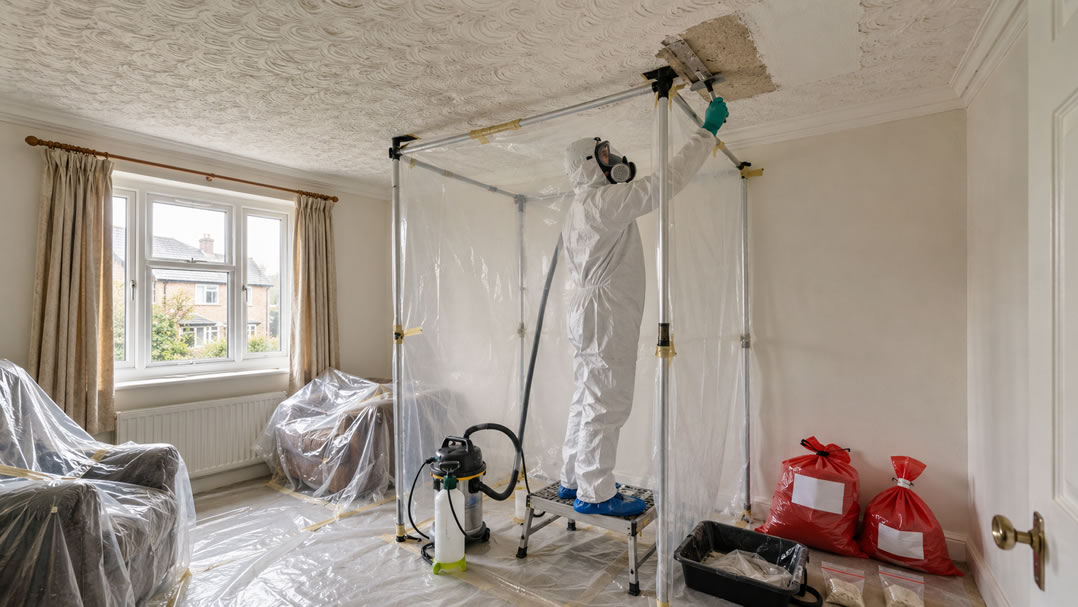
Textured ceilings were extremely popular in British homes for several decades.
Often referred to simply as Artex, these finishes appeared on ceilings and sometimes walls in a huge number of properties, particularly from the 1960s onwards.
The important issue is that some older textured coatings contained asbestos.
That does not mean every patterned ceiling is dangerous, nor does it mean every Artex-style finish contains asbestos. However, if the coating dates from before 2000 or you simply do not know when it was applied, it is sensible to treat it as potentially asbestos-containing until testing proves otherwise.
As a broad 2026 UK guide, professional testing of a suspect textured coating may cost around £50 to £150, while controlled removal of confirmed asbestos-containing Artex can commonly cost around £35 to £100 per m², depending on the method, room size, access and condition of the coating.
For a normal bedroom or living-room ceiling, a specialist removal project might therefore cost around £400 to £1,500 or more. Whole-house removal can run into several thousand pounds.
However, removal is not always necessary.
If the coating remains in good condition and is unlikely to be disturbed, options such as encapsulation, skimming or overboarding may sometimes make more sense.
This guide explains asbestos in textured coatings, testing, removal methods, costs and what homeowners should compare when requesting specialist quotes.
Does All Artex Contain Asbestos?
No.
Artex is a trade name that became commonly used to describe textured decorative coatings in general.
Some older products contained small amounts of chrysotile, commonly called white asbestos.
Other textured coatings contained no asbestos at all.
Therefore, you cannot look at a patterned ceiling and confidently decide whether it contains asbestos.
The only reliable way to know is through proper sampling and laboratory analysis.
When Was Asbestos Used in Artex?
Asbestos was historically added to some textured coatings because it helped strengthen the material and improve its properties.
Manufacturers increasingly stopped using asbestos during the 1980s.
However, because asbestos-containing products could still exist in the supply chain and the final UK asbestos ban did not take full effect until 1999, textured coatings installed before 2000 should generally be treated with caution where their composition is unknown.
In practical terms:
- pre-1980 coatings have a greater chance of containing asbestos
- 1980s coatings may still contain it
- later coatings are less likely to contain asbestos
- age alone cannot confirm the answer
Testing is the sensible approach before disturbing an unknown older coating.
What Does Asbestos Artex Look Like?
There is no single appearance.
Textured coatings were applied in many decorative styles, including:
- swirls
- stipples
- fan patterns
- broken leather effects
- peaks
- circles
- combed lines
Many have also been painted several times.
A modern non-asbestos textured ceiling can look almost identical to an older asbestos-containing one.
Therefore, appearance is not a reliable test.
Is Asbestos Artex Dangerous?
Asbestos-containing textured coating is generally considered a relatively lower-risk asbestos material because the fibres are bound within the coating.
If it remains:
- intact
- painted
- undamaged
- undisturbed
the risk of fibre release is relatively low.
The problem arises when the coating is disturbed.
Activities that may increase fibre release include:
- sanding
- grinding
- aggressive scraping
- drilling
- cutting
- breaking the ceiling
- dry removal
This is why refurbishment work needs careful planning.
What Should You Do if You Have an Artex Ceiling?
Do not panic.
First ask whether the coating actually needs to be disturbed.
If the ceiling is:
- sound
- painted
- undamaged
- staying in place
there may be no immediate reason to remove it.
However, if you plan to:
- remove the ceiling
- sand it flat
- install downlights
- carry out electrical work
- alter walls
- renovate the room
then testing becomes much more important.
How Much Does Asbestos Artex Testing Cost?
Typical UK guide prices include:
| Testing | Typical Cost |
|---|---|
| Single sample laboratory test | £30–£60+ |
| Professional sample collection | £50–£120+ |
| Sample collection and laboratory analysis | £60–£150+ |
| Several samples during one visit | £100–£250+ |
| Wider asbestos survey | £200–£500+ |
The cost depends on whether you:
- provide a sample to the laboratory
- pay a professional to take it
- test several areas
Professional sampling is generally the safer approach where asbestos is suspected.
Why Might You Need More Than One Sample?
A house may contain several visually similar textured ceilings that were actually installed at different times.
For example:
- lounge coating may date from the 1970s
- bedroom ceiling may have been redone in the 1990s
- kitchen extension may be much newer
One negative result does not automatically prove every textured coating in the property is asbestos-free.
A surveyor can advise how many samples make sense.
What Happens During Asbestos Sampling?
A trained surveyor typically:
- inspects the coating
- selects a small sampling point
- controls the area
- removes a tiny sample
- seals the sampling point
- sends the sample for analysis
The laboratory then checks whether asbestos fibres are present.
Can You Test Artex Yourself?
DIY sampling kits exist.
However, the act of taking the sample itself disturbs the material.
Therefore, many homeowners prefer professional sampling.
This also reduces the risk of:
- taking an inadequate sample
- contaminating the room
- packaging the sample incorrectly
- disturbing more material than necessary
For a relatively modest testing cost, professional collection is often worthwhile.
How Much Does Asbestos Artex Removal Cost?
Typical 2026 guide prices might include:
| Work | Typical Cost |
| Small local removal | £200–£500+ |
| Asbestos Artex removal | £35–£100 per m² |
| Small room ceiling | £400–£800+ |
| Standard bedroom ceiling | £500–£1,000+ |
| Larger lounge ceiling | £700–£1,500+ |
| Multiple rooms | £1,500–£4,000+ |
| Whole-house programme | £2,500–£6,000+ |
| Overboarding / encapsulation | £15–£35 per m²+ |
These are broad guide figures.
Costs vary significantly depending on the removal method and whether making good is included.
Why Do Artex Removal Prices Vary So Much?
Two properties can have the same size ceiling but very different quotes.
Important factors include:
- asbestos test result
- ceiling area
- coating condition
- ceiling height
- access
- number of rooms
- removal method
- room protection
- waste disposal
- making good
A single clear bedroom is easier than a furnished open-plan living space.
Small Area Removal
Sometimes only a small section needs to be removed.
For example, this may be necessary when:
- fitting a new light
- creating a small access opening
- carrying out a repair
Small controlled removal can cost around £200 to £500 or more, depending on travel, setup and disposal.
Even though the physical area is small, the contractor still needs appropriate:
- controls
- protective equipment
- waste handling
- cleaning
Therefore, small jobs can have a relatively high minimum charge.
Full Ceiling Removal
Removing the entire textured coating costs considerably more.
The contractor needs to control a much larger area and safely remove all contaminated material.
A standard room may cost around £500 to £1,500 depending on size and specification.
Making the ceiling smooth afterwards may cost extra.
Removal vs Skimming Over
There are usually two broad ways to get rid of the textured appearance.
Full removal
The asbestos-containing coating is physically removed under controlled conditions.
Encapsulation or overboarding
The asbestos remains in place but is sealed beneath a new finish.
The best approach depends on:
- coating condition
- future renovation plans
- ceiling height
- budget
- underlying ceiling
Can You Plaster Over Asbestos Artex?
Potentially, yes, if the material is in good condition and the work is properly planned.
Sealing asbestos-containing material in place is known as encapsulation.
A new plaster finish or overboarded ceiling can prevent routine contact with the original coating.
However, anyone carrying out future work still needs to know that asbestos remains underneath.
Therefore, keep records.
Skimming Over Artex
A plasterer may sometimes apply a new smooth plaster finish over a stable textured ceiling.
Typical skimming costs might be around £15 to £30 per m², although room minimum charges apply.
Before doing this, the existing surface needs to be assessed.
The contractor should avoid unnecessarily disturbing a coating that may contain asbestos.
Overboarding an Artex Ceiling
Another option is to fix new plasterboard below the existing ceiling.
This can produce a completely smooth new surface.
Advantages include:
- little disturbance to the existing coating
- neat modern finish
- easier decoration
However, it slightly lowers the ceiling.
You also need to consider future:
- light fittings
- ceiling fixings
- electrical work
because the asbestos-containing coating remains above the new board.
Removal or Encapsulation?
| Option | Removal | Encapsulation / Overboard |
| Asbestos remains | No | Yes |
| Initial cost | Higher | Usually lower |
| Disturbance | Higher | Lower |
| Future work simpler | Yes | Needs records |
| Ceiling height affected | No | Slightly with boarding |
| Waste disposal | Significant | Limited |
| Best for major renovation | Often | Sometimes |
There is no single correct choice.
When Does Full Removal Make Sense?
Removal may be worth considering when:
- the ceiling is badly damaged
- major renovation is planned
- the ceiling itself is coming down
- extensive lighting changes are planned
- structural work is required
- you do not want asbestos remaining in the property
Removing it once can simplify later refurbishment.
When Can Leaving It in Place Make Sense?
Encapsulation may be sensible where:
- the coating remains sound
- you only dislike the appearance
- no major ceiling work is planned
- removal would add unnecessary cost
Asbestos does not automatically need removing simply because it exists.
Managing sound asbestos safely in place can sometimes be the most proportionate option.
Is Asbestos Artex Removal Licensed Work?
Not necessarily.
HSE guidance treats many tasks involving asbestos-containing textured coatings as non-licensed asbestos work.
However, that does not mean the work can be carried out casually.
Workers still need:
- suitable training
- risk assessment
- appropriate controls
- correct protective equipment
- suitable waste procedures
Some larger-scale textured coating removal can become notifiable non-licensed work.
The contractor needs to assess the exact job.
What Is Notifiable Non-Licensed Work?
Notifiable non-licensed work, usually shortened to NNLW, is asbestos work that does not require a full asbestos licence but does require extra controls.
For example, large-scale removal of asbestos-containing textured coatings using methods that significantly break down the material can fall into this category.
The contractor may have duties involving:
- notification
- medical surveillance
- health records
- controlled work areas
Homeowners do not normally need to manage these technical requirements themselves.
However, the specialist you employ should understand them.
When Might a Licensed Asbestos Contractor Be Needed?
Some jobs are more complicated.
For example, textured coating may have been applied over a higher-risk material such as asbestos insulating board.
In those circumstances, the underlying material can completely change the risk level.
This is one reason proper surveying matters before demolition or major refurbishment.
How Is Asbestos Artex Removed?
Specialists use methods designed to minimise fibre release.
The exact method depends on:
- coating
- substrate
- area
- condition
One approach is controlled wet removal.
The coating is softened using suitable liquid or gel so that it can be removed without aggressive dry sanding.
Controlled Wet Removal
A typical specialist process may include:
- isolating the room
- protecting surfaces
- wearing appropriate PPE and RPE
- dampening or treating the coating
- carefully removing small sections
- placing waste into suitable packaging
- cleaning the area
- carrying out final checks
The aim is to minimise dust.
Why Dry Sanding Is a Bad Idea
Dry sanding breaks the coating into fine dust.
If asbestos is present, that dust can contain respirable fibres.
Therefore, you should not attack an unknown older textured ceiling with:
- orbital sander
- belt sander
- grinder
- dry scraper
simply because you want a flat surface.
Test first.
What About Steam Removal?
Steam or gel methods can be used for certain textured coating work.
However, larger-scale removal that causes deterioration of the coating can fall into notifiable non-licensed work.
The contractor needs to select the method based on the actual material.
Removing the Plasterboard Instead
In some situations, it may be easier to remove whole plasterboard sheets with the textured coating still attached.
This can reduce the amount of scraping.
For example, during a full refurbishment, the contractor might carefully take down complete sections rather than stripping every square metre of coating from the board.
Whether this is practical depends on:
- ceiling construction
- access
- services above
- condition
Asbestos Artex on Walls
Textured coating was also used on walls.
Removal principles are broadly similar.
However, walls may be easier to access than ceilings.
A contractor still needs to consider:
- coating condition
- underlying material
- room protection
- waste
Artex Around Light Fittings
Light fittings are a common problem.
Older textured coating may sit directly around:
- ceiling roses
- pendant lights
- spotlights
If an electrician needs to drill or enlarge holes, the coating may need testing first.
This is particularly relevant when installing downlights.
Installing Downlights in an Artex Ceiling
Downlights require large circular holes.
Cutting several holes through an asbestos-containing coating can disturb more material than replacing a simple pendant light.
If you are planning a lighting upgrade in an older home, test the ceiling before the electrician starts.
Rewiring a House With Artex Ceilings
Electrical refurbishment may involve:
- drilling
- cable access
- new light points
- ceiling removal
A refurbishment asbestos survey can sometimes make more sense than testing individual spots.
This helps identify other possible asbestos-containing materials before work begins.
Artex Removal Before a Bathroom Renovation
Bathrooms are another common trigger.
Renovation may involve:
- removing ceilings
- fitting extractor fans
- installing spotlights
- moving walls
If the ceiling is an older textured coating, test it before strip-out.
This prevents unexpected delays once the bathroom has already been dismantled.
Artex Removal Before a Kitchen Renovation
Kitchen refurbishment can involve substantial ceiling work.
For example:
- new lighting
- extractor ducting
- wall removal
- rewiring
Therefore, older textured coatings should be considered during the initial survey.
Artex Removal During a Full House Renovation
A large renovation is often the most logical time to address asbestos-containing Artex.
Contractors can coordinate:
- asbestos removal
- rewiring
- plastering
- decorating
This may be more efficient than removing one room at a time.
What Happens After Removal?
Once the coating has been removed, the ceiling may need:
- cleaning
- sealing
- repairs
- plastering
- skimming
- painting
Do not assume the removal quote automatically includes a completely decorated smooth ceiling.
Ask exactly what finish you will be left with.
Making Good Costs
After removal, additional work might include:
| Follow-On Work | Typical Cost |
| Small plaster repairs | £100–£300+ |
| Ceiling skim | £200–£500+ |
| New plasterboard ceiling | £500–£1,200+ |
| Painting ceiling | £150–£400+ |
Prices depend on room size and region.
Asbestos Waste Disposal
Removed asbestos-containing textured coating becomes controlled asbestos waste.
It needs to be:
- packaged correctly
- transported appropriately
- taken to a suitable disposal site
Waste costs should normally form part of a professional removal quotation.
Ask whether the contractor includes disposal documentation.
Can You Put Artex in a Normal Skip?
Not if it contains asbestos.
Asbestos waste needs specific handling and disposal.
Do not mix it with ordinary:
- plasterboard
- rubble
- household waste
A specialist contractor should explain the waste process.
Can You Take Asbestos Artex to the Tip?
Some local authorities accept small quantities of household asbestos waste at designated facilities.
However:
- not every site accepts it
- booking may be required
- packaging rules apply
- quantity limits can apply
Rules vary by council.
For a full ceiling removal, professional disposal is usually much more practical.
How Long Does Removal Take?
Typical timescales may include:
| Project | Typical Time |
| Small local area | A few hours |
| Small room ceiling | 1 day |
| Standard room | 1–2 days |
| Several ceilings | 2–5 days |
| Whole house | Several days to 1–2 weeks |
Making good and plastering may add additional days.
Do You Need to Leave the House?
Usually, the contractor isolates the work area.
Whether you need to leave the property depends on:
- number of rooms
- work method
- access
- household circumstances
For a single contained room, staying elsewhere may not always be necessary.
For a whole-house project, temporary relocation can be more practical.
Furniture and Room Preparation
Before work starts, you may be asked to remove:
- furniture
- curtains
- soft furnishings
- personal items
This gives the contractor space to control and protect the room.
Heavy furniture may sometimes remain if fully covered.
Can Asbestos Artex Be Painted?
Yes, sound textured coating can generally remain painted and sealed.
In fact, keeping it sealed can help prevent accidental disturbance.
Avoid sanding it back before decorating unless testing confirms it contains no asbestos.
What if the Artex Is Cracked?
A small crack does not necessarily create an emergency.
However, deteriorating asbestos-containing coating deserves assessment.
Do not keep:
- scraping
- picking
- brushing
loose material away.
Have the damage checked.
Water-Damaged Artex
Leaks can damage a textured ceiling.
Water may cause:
- cracking
- sagging
- delamination
- collapse
If the coating might contain asbestos, deal with the leak but avoid disturbing the damaged ceiling until it has been properly assessed.
Collapsed Artex Ceiling
A collapsed ceiling creates a more urgent situation.
Keep people away from the debris and avoid:
- sweeping
- vacuuming with an ordinary vacuum cleaner
- breaking material into smaller pieces
Seek professional advice.
Can a Normal Vacuum Cleaner Be Used?
No.
An ordinary household vacuum is not designed for asbestos contamination and can potentially spread fine fibres.
Specialist asbestos work uses suitable Class H vacuum equipment where required.
Buying a House With Artex Ceilings
Artex is common in older UK properties.
Its presence alone should not automatically stop a purchase.
However, you may want to know:
- whether asbestos is present
- condition
- future renovation implications
- likely removal cost
This information can help you budget.
Does Asbestos Artex Reduce House Value?
Not necessarily.
Many buyers accept older textured ceilings, particularly if they remain in good condition.
However, confirmed asbestos may affect renovation plans.
A buyer intending to:
- rewire
- remove ceilings
- remodel rooms
may factor removal costs into their budget.
Selling a House With Asbestos Artex
Known asbestos information should be passed on honestly during the sale process.
Keep any:
- survey
- laboratory result
- removal paperwork
- encapsulation records
These documents can help future owners understand what remains in the property.
Removing Artex for Appearance Only
Some homeowners simply dislike textured ceilings.
If asbestos is confirmed but the ceiling is otherwise sound, full removal is not always the cheapest way to create a modern appearance.
Compare:
- specialist removal
- encapsulation
- overboarding
before deciding.
What Affects Asbestos Artex Removal Quotes?
Ceiling size
Larger ceilings need more labour and waste handling.
Number of rooms
Several rooms may reduce the average cost per room because setup can be combined.
Coating condition
Damaged coatings can require additional controls.
Ceiling height
High stairwells and landings can be more difficult.
Underlying surface
Plasterboard, plaster and asbestos insulating board all require different consideration.
Furniture
Empty rooms are easier to prepare.
Removal method
Different techniques have different labour requirements.
Disposal
Larger quantities of asbestos waste cost more.
Making good
A bare substrate costs less than a finished, painted ceiling.
What Should an Asbestos Artex Quote Include?
Compare each contractor’s scope carefully.
| Quote Item | What to Check |
| Asbestos testing | Included or already completed? |
| Area | Exact ceiling / wall size |
| Removal method | Explained? |
| Work classification | Assessed correctly? |
| Room protection | Included? |
| PPE / controls | Included? |
| Waste packaging | Included? |
| Waste disposal | Included? |
| Cleaning | Included? |
| Making good | Included? |
| Replastering | Included? |
| Decoration | Included? |
| VAT | Included or extra? |
| Documentation | Provided? |
Removal Contractor or Plasterer?
If asbestos is confirmed, do not treat the project as an ordinary plastering job.
The asbestos work needs to be planned and carried out by people with the appropriate training and procedures.
A plasterer can then complete the final surface once the asbestos stage has been dealt with.
Some companies coordinate both.
Questions to Ask an Asbestos Contractor
Before accepting a quote, ask:
- Has the coating been tested?
- What asbestos type was identified?
- What removal method will you use?
- Is this non-licensed or notifiable non-licensed work?
- Does the job require a licensed contractor?
- How will the room be protected?
- How will the waste be packaged?
- Where will the waste go?
- Is disposal included?
- What condition will the ceiling be left in?
- Is plastering included?
- What paperwork will I receive?
- How long will the room be unavailable?
- What guarantee or completion documentation is provided?
Warning Signs in Very Cheap Quotes
Be cautious if someone proposes to:
- dry-sand the coating
- use an ordinary vacuum cleaner
- scrape it aggressively without testing
- throw debris into a normal skip
- ignore asbestos because “it’s only Artex”
A low asbestos content does not mean no controls are necessary.
Get Asbestos Artex Removal Quotes
Asbestos-containing Artex is still found in many older British homes.
Fortunately, textured coatings are generally lower risk when they remain in good condition and are left undisturbed.
The first step is therefore not automatically removal.
Instead, establish whether asbestos is actually present and decide whether the coating needs to be disturbed at all.
Testing may cost around £50 to £150, while confirmed asbestos Artex removal can broadly cost £35 to £100 per m² or around £400 to £1,500+ per room depending on the project.
Encapsulation or overboarding may provide a cheaper alternative where the material remains sound.
Use the quotation form on this page to compare asbestos Artex removal quotes from local asbestos specialists.
Frequently Asked Questions
Does all Artex contain asbestos?
No. Some older textured coatings contained asbestos, while others did not. Laboratory testing is the only reliable way to confirm it.
What years of Artex may contain asbestos?
Older textured coatings, particularly those installed before and during the 1980s, may contain asbestos. If the coating predates 2000 or its age is unknown, testing before disturbance is sensible.
How much does asbestos Artex testing cost?
Professional sampling and laboratory analysis typically costs around £50 to £150 for a straightforward sample.
How much does asbestos Artex removal cost?
A broad guide is around £35 to £100 per m², although room minimum charges and more complicated projects can increase the total.
How much does it cost to remove Artex from one ceiling?
A typical room may cost around £400 to £1,500 or more depending on its size, condition, removal method and whether replastering is included.
Is asbestos Artex dangerous if left alone?
Sound, painted textured coating is generally lower risk when it remains undisturbed. The main concern comes from drilling, sanding, cutting or removing it.
Can you plaster over asbestos Artex?
Potentially, yes. Encapsulation or overboarding can be suitable where the coating is sound and the work is properly planned.
Is it better to remove or cover asbestos Artex?
Removal makes sense where major renovation is planned or the coating is damaged. Covering can be cheaper where the material remains sound and does not need disturbing.
Can I sand an Artex ceiling?
Do not sand an older or untested textured coating. Sanding can create fine dust and may release asbestos fibres if they are present.
Does asbestos Artex removal require a licensed contractor?
Not all textured coating work is licensable. However, workers still need appropriate training and controls, and larger-scale removal can be notifiable non-licensed work.
Can you install downlights into an asbestos Artex ceiling?
The work can disturb the coating, so have an older or unknown ceiling assessed before cutting multiple holes.
Can asbestos Artex go in a normal skip?
No. Confirmed asbestos waste needs appropriate packaging, transport and disposal.
Should I compare several asbestos Artex removal quotes?
Yes. Compare the removal method, work classification, protection, waste disposal, making good and documentation as well as the total price.