

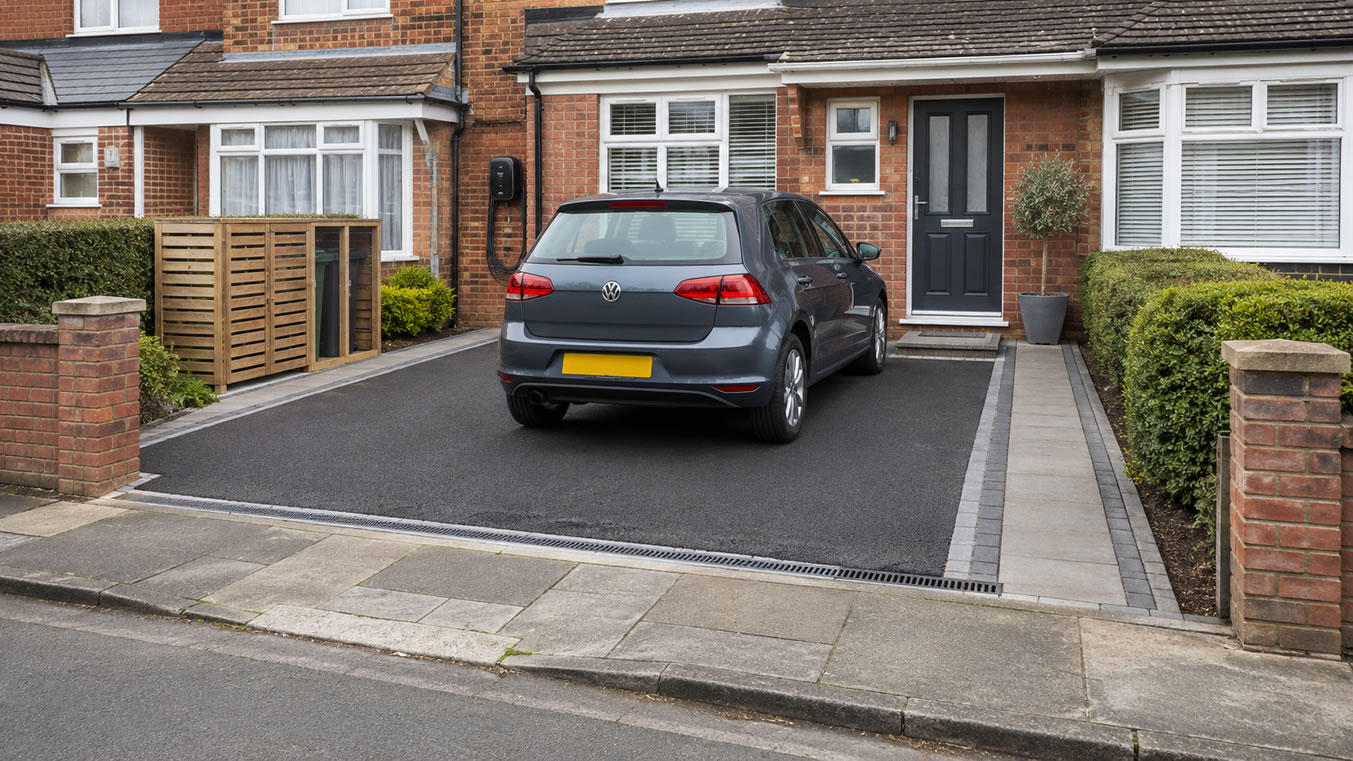
Tarmac is one of the most practical surfaces for a small driveway.
For a compact front garden where the main aim is to create a useful parking space without spending heavily on decorative paving, a properly constructed tarmac or asphalt driveway can make a lot of sense. It provides a smooth surface, takes up very little space around the edges and can usually be installed faster than block paving or individual driveway slabs.
It can also work particularly well for narrow driveways.
Because tarmac forms one continuous surface, there are no paving patterns or wide borders competing for limited space. As a result, practically all of the available area can be used for parking.
However, a small driveway does not necessarily mean a cheap or simple installation. Ground preparation, drainage, edging and access for machinery can have a major effect on cost. In fact, very small tarmac jobs can sometimes have a relatively high price per square metre because contractors still need to bring specialist equipment and hot asphalt to the property.
This guide looks at the advantages and disadvantages of tarmac for small UK driveways, how it should be constructed, typical costs, design ideas and when another surface might be a better choice.
Is Tarmac Good for a Small Driveway?
Yes. Tarmac or asphalt is particularly well suited to small driveways where homeowners want a durable, relatively low-maintenance parking surface.
Its main advantages are:
- Efficient use of limited space
- Simple appearance
- Relatively fast installation
- Good durability
- Few joints
- Easy cleaning
- Good grip
- Suitability for cars and vans
- Lower cost than many premium paving options
A compact tarmac driveway can also be upgraded visually with simple block, brick or stone edging.
Tarmac for Small Driveways at a Glance
| Feature | Small Tarmac Driveway |
|---|---|
| Suitability for one-car driveway | Excellent |
| Initial cost | Low to medium |
| Installation speed | Fast |
| Maintenance | Low |
| Weed growth | Low |
| Modern appearance | Good |
| Traditional appearance | Can be improved with edging |
| Curved areas | Excellent |
| Narrow areas | Excellent |
| Heavy cars and SUVs | Good with suitable base |
| Drainage | Needs planning |
| Local repairs | Straightforward but may remain visible |
| Lifespan | Commonly 15–25+ years |
| Colour choice | Mainly black/dark grey |
| Decorative options | Borders, setts and entrance aprons |
Tarmac or Asphalt – What Is Actually Used?
In everyday UK language, most homeowners and contractors still call black driveway surfacing “tarmac”.
Technically, modern domestic driveways are more commonly surfaced with asphalt or bitumen-bound materials rather than traditional tar-bound tarmacadam.
Modern asphalt generally contains:
- Aggregate
- Sand or fine material
- Bitumen binder
The material is laid hot and mechanically compacted.
Therefore, when asking contractors for a “tarmac driveway”, you will usually receive a quotation for a modern asphalt-based surface.
Why Tarmac Works Particularly Well on Small Driveways
Small front gardens have one major problem: every centimetre matters.
A driveway may need to accommodate:
- Car
- Opening doors
- Pedestrian access
- Wheelie bins
- Planting
- Drainage
- Path to front door
Tarmac keeps the parking surface simple.
Unlike elaborate paving, it does not require visually wide borders or patterns. A narrow edging course can provide enough structural support while leaving most of the area available for the vehicle.
Good for Narrow Driveways
A narrow driveway often works especially well with tarmac.
The surface can run directly between:
- House wall
- Fence
- Boundary wall
- Garden border
without needing numerous cut slabs.
For a very narrow driveway, this can save both space and labour.
Good for Short One-Car Driveways
Many UK terraced and semi-detached homes only have enough front garden depth for one car.
A simple layout might contain:
- Tarmac parking bay
- Narrow block border
- Small path
- Bin storage
- Drainage channel
Keeping the design simple makes a small frontage feel more organised.
How Big Does a Small Driveway Need to Be?
Vehicle dimensions vary considerably.
As a practical starting point, many ordinary cars need a parking area around:
- 2.4–2.7 metres wide
- 4.8–5.5 metres long
However, modern SUVs and estate cars can require more.
Do not design the driveway around the exact dimensions of the car.
Allow room for:
- Mirrors
- Doors
- Walking past
- House walls
- Gate posts
Local councils may also apply their own minimum parking dimensions when approving a vehicle crossover or dropped kerb.
Measure the Car Before the Driveway
This sounds obvious, but it is often overlooked.
Measure:
- Overall vehicle length
- Width
- Width including mirrors
- Door opening space
Then mark the proposed driveway using:
- Chalk
- String
- Timber
- Spray marking paint
Park the car within the marked area if possible.
This gives a much better idea of whether the layout really works.
Tarmac Makes Efficient Use of Irregular Shapes
Small front gardens are not always neat rectangles.
They may contain:
- Bay windows
- Angled boundaries
- Curved walls
- Existing paths
- Drainpipes
- Steps
Tarmac can follow these shapes much more easily than large driveway slabs.
The material can be laid around gentle curves without creating large numbers of awkward cuts.
Small Tarmac Driveway with Block Paving Border
One of the most popular designs combines:
- Black tarmac centre
- Narrow block-paved border
This provides a cleaner finished appearance while retaining most of the cost advantage of tarmac.
Possible border colours include:
- Charcoal
- Grey
- Red
- Buff
- Brown
Try to choose a colour that complements the house.
Tarmac with Granite Setts
Granite setts provide a more premium edge.
For example:
- Black asphalt
- Silver-grey granite setts
- Brick house
- Small planted border
This can make a relatively inexpensive surface look considerably more expensive.
Because only a small quantity of granite is needed around the edge, the overall cost remains lower than paving the entire driveway in stone.
Tarmac with Brick Edging
Brick-style edging can work well with:
- Victorian terraces
- Edwardian houses
- Red-brick semis
The edging should still be suitable for driveway use and installed with proper restraint.
Ordinary decorative bricks are not necessarily suitable for repeated exposure to moisture, frost and vehicle loading.
Tarmac with a Decorative Entrance Apron
Another option is to keep the majority of the driveway in tarmac but create a decorative strip at the entrance.
Possible materials include:
- Block paving
- Granite setts
- Clay pavers
- Concrete blocks
This concentrates the more expensive material in the most visible position.
Tarmac with a Paved Front Path
A small driveway can also combine:
- Tarmac parking
- Paved pedestrian path
For example, grey slabs can lead from the pavement to the front door while the car sits on the darker tarmac surface.
This clearly separates walking and parking areas.
Should You Keep Some of the Front Garden?
Where space allows, yes.
Even a narrow area of planting can improve the appearance considerably.
Possible options include:
- Low hedge
- Lavender
- Ornamental grasses
- Evergreen shrubs
- Gravel bed
- Raised planter
A completely black frontage can sometimes appear harsh.
A strip only 300–500mm wide can provide enough greenery to soften the design.
Small Tarmac Driveway and Wheelie Bins
Wheelie-bin storage is especially important for terraced and semi-detached homes.
Consider where the bins will sit before surfacing the garden.
Potential options include:
- Narrow side bay
- Timber enclosure
- Slatted screen
- Small paved recess
Avoid placing bins where they prevent the car doors opening.
Is Tarmac Suitable for a Very Small Front Garden?
Potentially, but first confirm that the car actually fits.
There is little value converting a garden into a driveway if:
- Vehicle overhangs pavement
- Doors cannot open
- Pedestrian access disappears
- Dropped kerb cannot be approved
Measure before obtaining surfacing quotes.
Small Driveway Layout Ideas
Simple One-Car Tarmac Drive
Use the whole available width with narrow edging.
Best for:
- Small semis
- Terraces
- New builds
Tarmac Drive with Side Path
Keep pedestrian access separate.
Best where the front door sits beside the parking bay.
Tarmac with Narrow Planting Strip
Retains some greenery.
Best where the frontage is wide enough to sacrifice a small amount of parking width.
Tarmac with Block Border
Adds kerb appeal at relatively low cost.
Tarmac with Bin Storage
Useful for properties without side access.
Tarmac with EV Charger
Plan electrical ducting before laying the surface.
What Goes Under a Tarmac Driveway?
The black surface is only the top part of the driveway.
A typical construction may consist of:
- Excavated ground.
- Compacted sub-base.
- Asphalt binder course.
- Asphalt surface course.
- Edge restraints.
Depending on site conditions, drainage may also be included.
Why the Sub-Base Matters
The sub-base distributes vehicle weight into the ground.
If it is weak, the driveway may develop:
- Depressions
- Cracks
- Ruts
- Edge failure
Installing more asphalt over an inadequate foundation does not properly solve the problem.
Typical Tarmac Driveway Build-Up
A contractor may propose something broadly along the following lines:
| Layer | Typical Example |
| Excavation | To suitable formation |
| Sub-base | Compacted MOT Type 1 or specified equivalent |
| Binder course | Structural asphalt layer |
| Surface course | Fine asphalt wearing layer |
| Edging | Blocks, kerbs or suitable restraint |
Exact depths depend on:
- Ground conditions
- Vehicle loading
- Existing base
- Drainage
Ask the contractor to state the proposed specification in writing.
How Deep Should a Tarmac Driveway Be Excavated?
There is no universal depth.
A complete new driveway can easily involve excavation of around 200mm or more once space is allowed for:
- Sub-base
- Binder
- Surface
Soft or unstable ground may need greater excavation.
An existing sound driveway may require considerably less.
Can an Existing Driveway Be Resurfaced?
Sometimes.
This can be particularly useful for a small driveway.
If the existing base remains:
- Stable
- Well compacted
- Properly drained
- At suitable levels
a contractor may be able to resurface it rather than excavating everything.
When Resurfacing Makes Sense
Potential candidates include:
- Old faded tarmac
- Minor surface cracks
- Worn top layer
- Local patches
The structural base must still be sound.
When Resurfacing Does Not Make Sense
Avoid simply covering:
- Major settlement
- Deep potholes
- Tree-root movement
- Widespread cracking
- Poor drainage
- Unstable base
These problems tend to return through the new surface.
Tarmac Over Concrete
Tarmac can sometimes be installed over an existing concrete driveway.
However, contractors need to consider:
- Concrete condition
- Cracks
- Levels
- Drainage
- Movement joints
- Finished height
Cracks in the concrete can eventually reflect through the asphalt.
Tarmac Over Block Paving
Laying asphalt directly over loose or moving block paving is usually a poor shortcut.
The blocks may move underneath and affect the new surface.
A proper contractor should assess whether the existing construction can realistically remain.
Why Edging Is Important
Asphalt needs support around its exposed edges.
Without restraint, the perimeter can gradually:
- Crumble
- Spread
- Break
This is particularly noticeable where vehicle tyres repeatedly cross the same edge.
Good Tarmac Driveway Edging Options
Consider:
- Concrete kerbs
- Block paving
- Granite setts
- Brick-style pavers
- Concrete edging
Decorative borders can provide both structural support and visual interest.
Should the Tarmac Go Right Up to a Fence?
It can, but a solid edge should ideally support the asphalt.
Do not rely on a lightweight timber fence board to restrain the driveway.
A kerb or block edge is normally more durable.
Drainage for a Small Tarmac Driveway
Drainage matters even on a small frontage.
Traditional dense asphalt is generally impermeable.
Water must therefore be directed somewhere appropriate.
Possible solutions include:
- Lawn
- Flower bed
- Gravel infiltration area
- Soakaway
- Drainage channel
- Porous asphalt system
Front Garden Planning Rules in England
Current Planning Portal guidance says that a new or replacement front driveway at a house does not normally need planning permission where it uses permeable surfacing, including porous asphalt, or where rainwater is directed to a lawn or border where it can drain naturally.
If more than 5m² is covered using traditional impermeable surfacing and water is not directed to a permeable area, planning permission is normally required. Additional restrictions can apply to some properties and locations.
Different planning systems apply in Scotland, Wales and Northern Ireland, so local requirements should be checked.
Is Standard Tarmac Permeable?
Normally, no.
A conventional dense asphalt driveway sheds water from its surface.
This does not mean you cannot use it on a front garden.
The driveway can instead be designed so water runs towards:
- Garden bed
- Gravel strip
- Permeable border
- Suitable drainage solution
What Is Porous Asphalt?
Porous asphalt is specifically designed to allow water through the surface.
However, the layers underneath also need to support drainage.
A genuine permeable driveway normally requires:
- Porous surface
- Open-graded underlying construction
- Suitable sub-base
- Somewhere for water to infiltrate or discharge
Porous asphalt laid over impermeable concrete would not create a fully permeable system.
Linear Drainage Channels
A channel drain can be useful:
- In front of garage
- Across driveway
- Near house
- At low point
However, the channel still needs somewhere suitable to discharge.
A drain that simply fills with water is not a complete drainage design.
Keep Tarmac Below the Damp-Proof Course
Driveway levels close to the house need careful planning.
Do not unnecessarily raise the finished surface against:
- Brickwork
- DPC
- Air bricks
- Door thresholds
The contractor should assess existing levels before excavation.
Does a Tarmac Driveway Need a Dropped Kerb?
If the car needs to cross a pavement to reach the driveway, an approved dropped kerb or vehicle crossover is normally required.
GOV.UK directs homeowners in England and Wales to their local council for the application because detailed requirements are determined locally.
Check this before constructing a new front-garden driveway.
Why Check the Dropped Kerb First?
A council may have requirements relating to:
- Parking-space dimensions
- Visibility
- Street trees
- Lamp posts
- Utility equipment
- Width of crossover
It would be frustrating to install a new tarmac parking area and then discover the vehicle crossover cannot be approved.
Tarmac for a One-Car Driveway
This is probably where tarmac makes the most sense.
A small one-car driveway benefits from:
- Simple layout
- Few cuts
- Minimal maintenance
- Fast installation
Adding one contrasting border can make it look finished without taking much usable space.
Tarmac for a Two-Car Driveway
Tarmac also becomes economical as the area increases.
For two cars, make sure the design accounts for:
- Opening both vehicles’ doors
- Pedestrian route
- Bin storage
- Drainage
Do not simply calculate two car widths with no clearance.
Tarmac for a Narrow Side Driveway
Long, narrow driveways beside houses are often excellent candidates.
Tarmac can be installed without hundreds of paving cuts around:
- Drainpipes
- Walls
- Fence posts
- Garage entrances
This can reduce labour significantly compared with large-format slabs.
Tarmac for Curved Small Driveways
Another advantage is flexibility of shape.
Asphalt can follow:
- Curved walls
- Irregular garden edges
- Sweeping entrances
Slab paving may need numerous triangular or narrow cuts in the same situation.
Tarmac for Sloping Driveways
Tarmac generally performs well on slopes.
The textured surface offers good traction, while continuous surfacing avoids multiple slab joints.
However, drainage becomes particularly important.
Water moving down a steep driveway should not be allowed to run:
- Into garage
- Towards house
- Across pavement
Is Tarmac Slippery?
Generally, tarmac provides good grip because of its textured aggregate surface.
However, it may become slippery where:
- Moss develops
- Algae grows
- Ice forms
- Oil is spilled
Shaded driveways should occasionally be inspected for organic growth.
Does Tarmac Get Hot?
Yes.
Dark asphalt absorbs heat in sunshine.
During very hot weather, the surface can become softer.
This may increase the risk of:
- Tyre scuffing
- Marks from motorbike stands
- Indentations beneath heavy static objects
Avoid Stationary Steering
Turning the steering wheel while the vehicle is completely stationary creates a strong twisting force.
On hot or relatively new asphalt, this can leave scuff marks.
Whenever possible, allow the car to move slightly while steering.
Can a Heavy SUV Use a Small Tarmac Driveway?
Yes, provided the driveway construction is appropriate.
Heavier cars place greater demands on:
- Sub-base
- Binder layer
- Edging
Tell the contractor what vehicles will normally use the drive.
What About Vans?
A properly constructed tarmac driveway can handle vans.
Regular commercial vehicle use may justify a heavier construction than a driveway serving a small hatchback.
Again, specification matters more than appearance.
Does Tarmac Crack?
It can.
Common causes include:
- Ground movement
- Tree roots
- Weak sub-base
- Water penetration
- Age
- Poor construction
Small cracks can sometimes be repaired before they become larger.
Does Tarmac Sink?
Yes, if the ground beneath settles.
Typical signs include:
- Tyre depressions
- Low spots
- Puddles
Repeated parking in exactly the same place may make weak areas more obvious.
Correct base preparation is the main defence.
Tree Roots and Tarmac
Trees close to the driveway can create problems.
Roots may:
- Lift surface
- Crack asphalt
- Distort edging
Do not simply cut major roots to make space for the driveway.
Some trees may also be protected.
Tarmac and Oil Stains
Engine oil can mark the surface.
More importantly, fuel and certain petroleum products can soften bitumen.
Deal with spills promptly.
Avoid using harsh solvents that could damage the driveway further.
Weed Growth
One advantage of tarmac is the lack of joints.
Most weeds develop:
- Along edges
- Through existing cracks
- Around manholes
This is considerably less than many poorly maintained block-paved driveways.
Moss and Algae
Moss can develop on shaded older asphalt.
Regular sweeping helps because moss often establishes where dirt and organic material accumulate.
Gentle cleaning is normally preferable to repeatedly blasting an old driveway with high pressure.
Can Tarmac Be Pressure Washed?
It can sometimes be cleaned with suitable pressure, but aggressive pressure washing can loosen aggregate from older asphalt.
Often, a stiff brush and suitable cleaner are sufficient.
Tarmac Repairs
Common repairs include:
- Crack sealing
- Edge repair
- Pothole repair
- Local patching
- Surface replacement
The main disadvantage is appearance.
Fresh asphalt is much darker than weathered material.
Will a Tarmac Patch Always Show?
Usually at first.
The new material generally begins:
- Deep black
while the existing driveway may be:
- Dark grey
- Light grey
The patch becomes less noticeable as it weathers, although a perfect colour match is unlikely.
Can a Small Driveway Be Resurfaced Instead of Replaced?
Yes, and small driveways can be good candidates if the foundation remains sound.
Resurfacing may provide:
- Fresh appearance
- New wearing layer
- Better minor levels
without full excavation.
However, structural faults should be repaired first.
How Long Does a Tarmac Driveway Last?
A properly constructed residential asphalt driveway might commonly provide around:
- 15–25 years or more
before major resurfacing or replacement becomes necessary.
Its actual lifespan depends on:
- Base
- Thickness
- Drainage
- Vehicle weight
- Tree roots
- Installation quality
- Maintenance
A poorly constructed driveway may fail far earlier.
Small Tarmac Driveway Costs
Small projects can have surprisingly high square-metre prices.
Broad UK budgeting figures might be:
| Project | Typical Budget |
| Very small resurfacing job | £1,000–£2,000 |
| Small one-car tarmac driveway | £1,500–£3,000 |
| 20m² driveway | £1,500–£3,000 |
| 30m² driveway | £2,000–£3,500 |
| 40m² driveway | £2,500–£4,500 |
| Tarmac with decorative border | Add roughly £500–£1,500+ |
These are broad estimates rather than fixed quotations.
Typical Cost Per Square Metre
A complete new tarmac driveway might broadly fall around:
- £60–£100 per m²
for straightforward work.
Small sites can cost more per square metre because contractors still have fixed costs for:
- Machinery
- Delivery
- Asphalt plant minimums
- Labour
- Transport
Therefore, do not simply multiply a large-driveway rate by 15m² and assume that will be the final price.
Why Small Tarmac Jobs Can Cost More Per Square Metre
Imagine a contractor surfaces:
- 20m² driveway
- 100m² driveway
Both jobs may still require:
- Roller
- Compactor
- Crew
- Transport
- Hot asphalt delivery
The larger job spreads those fixed costs across much more area.
This makes the small project proportionally more expensive.
What Affects the Price?
Existing Surface
Removing concrete costs more than removing soil or old gravel.
Excavation
Poor ground can require deeper excavation.
Waste Removal
Soil, concrete and old paving must be taken away.
Access
Limited access can restrict machinery.
Asphalt Quantity
Small deliveries can carry minimum charges.
Edging
Decorative block borders add materials and labour.
Drainage
Channel drains or soakaways increase cost.
Manholes
Covers may need raising or replacing.
Dropped Kerb
Usually priced separately from private driveway work.
Tarmac vs Block Paving for a Small Driveway
| Feature | Tarmac | Block Paving |
| Cost | Usually lower | Higher |
| Installation | Faster | Slower |
| Colours | Limited | Extensive |
| Patterns | Limited | Extensive |
| Weed maintenance | Low | Moderate |
| Curves | Easy | Good |
| Individual repair | Patch visible | Blocks can be replaced |
| Small-area appearance | Simple | Decorative |
| Heavy use | Good | Good |
| Resurfacing | Easy | Not applicable in same way |
Tarmac vs Slabs
Tarmac generally wins for:
- Budget
- Speed
- Irregular areas
- Low maintenance
Driveway slabs generally win for:
- Premium appearance
- Colour choice
- Individual slab replacement
For a small driveway where parking is the main objective, tarmac often offers better value.
Tarmac vs Resin
Resin provides a more decorative aggregate finish.
However, it normally costs more.
| Feature | Tarmac | Resin Bound |
| Price | Lower | Higher |
| Appearance | Basic | Decorative |
| Colour choice | Limited | Wide |
| Maintenance | Low | Low |
| Installation | Fast | More specialised |
| Repairs | Visible | Can also show |
| Permeability | Porous version available | Can be permeable |
Tarmac vs Gravel
Gravel may be cheaper initially.
However, loose aggregate can:
- Move
- Rut
- Escape onto pavement
- Need topping up
Tarmac creates a firmer, cleaner surface.
Gravel may suit traditional properties better.
Tarmac vs Concrete
Concrete is strong and durable but can cost more and requires curing.
Cracks can also be difficult to repair invisibly.
Tarmac offers:
- Faster installation
- Easier patching
- More flexible behaviour
Concrete can provide a lighter-coloured surface and more decorative possibilities.
Small Driveway Design – Keep It Simple
The most successful small tarmac driveways often contain only two or three elements.
For example:
- Tarmac
- Grey block border
- Narrow planting bed
That is usually enough.
Adding:
- Red border
- Grey border
- Gravel
- Multiple slab types
- Decorative patterns
can make a small frontage look cluttered.
Black Tarmac with Grey Edging
This combination suits many modern homes.
It works particularly well with:
- Anthracite windows
- Grey front doors
- Render
- Contemporary fencing
Tarmac with Red Block Edging
Red or brindle paving can complement:
- Traditional red brick
- Older semis
- Terraced properties
Keep the border narrow to avoid losing parking width.
Lighting for a Small Tarmac Driveway
Wall-mounted lighting works particularly well because it uses no ground space.
Options include:
- Motion light
- Downlights
- Door lighting
Avoid unnecessary bollards on narrow drives where car doors could hit them.
EV Charging
If a charger may be installed later, consider adding ducting before surfacing.
This is cheap compared with cutting a newly completed driveway.
Plan:
- Charger location
- Cable route
- Parking orientation
Utility Covers
Check for:
- Water meters
- Drain covers
- Inspection chambers
- Stop taps
Covers may need adjusting to the new finished level.
Do not simply tarmac over access points.
Common Small Tarmac Driveway Mistakes
Making the Drive Too Small
Measure the actual car first.
Using a Weak Base
The surface cannot compensate for bad groundwork.
Leaving Edges Unsupported
This encourages crumbling.
Ignoring Drainage
Even 20m² of paving can collect a substantial amount of rain.
Tarmacking Over Failed Concrete
Cracking and movement can return.
Raising Levels Too High
This can create problems around doors and brickwork.
Forgetting the Dropped Kerb
Check vehicle access before constructing the driveway.
Removing Every Bit of Planting
A narrow border can greatly improve kerb appeal.
Choosing the Cheapest Quote Without Comparing Specification
Two quotations may describe very different driveway constructions.
What Should a Tarmac Quote Include?
| Quote Item | Why It Matters |
| Driveway area | Confirms quantity |
| Excavation depth | Indicates preparation |
| Waste removal | Can be significant |
| Sub-base material | Supports vehicles |
| Sub-base depth | Major durability factor |
| Binder course | Structural asphalt layer |
| Binder thickness | Important specification |
| Surface course | Finished wearing layer |
| Surface thickness | Helps compare quotes |
| Edging | Prevents edge failure |
| Drainage | Manages rainfall |
| Manhole adjustment | Often overlooked |
| VAT | Confirms total |
| Guarantee | Defines workmanship cover |
Questions to Ask a Tarmac Contractor
- Is the area large enough for my car?
- What existing material will you remove?
- How deep will you excavate?
- What sub-base will you use?
- What compacted depth will it have?
- Is a binder course included?
- What thickness will the binder be?
- What surface course will be used?
- How thick will the finished surface be?
- How will the edges be supported?
- Where will rainwater go?
- Is porous asphalt worthwhile here?
- Are drains included?
- Will manhole covers be adjusted?
- Is all waste removal included?
- Is VAT included?
- How long before I can park on it?
- What guarantee is included?
Small Tarmac Driveway Checklist
| Check | Completed? |
| Car measured | |
| Driveway measured | |
| Door clearance checked | |
| Pedestrian access retained | |
| Dropped kerb checked | |
| Planning requirements checked | |
| Drainage designed | |
| Excavation specified | |
| Sub-base specified | |
| Binder course included | |
| Surface course specified | |
| Edging selected | |
| Bin storage planned | |
| EV duct considered | |
| Utility covers checked | |
| Several quotes compared |
Is Tarmac Worth It for a Small Driveway?
For many homes, yes.
Tarmac is particularly attractive where the priorities are:
- Practical parking
- Sensible cost
- Low maintenance
- Simple appearance
- Efficient use of space
It may be less attractive where the homeowner wants a highly decorative frontage or premium natural-stone appearance.
A good compromise is often a properly constructed asphalt driveway combined with an attractive block or stone border.
Most importantly, spend money on the construction underneath the surface.
A relatively plain tarmac driveway built on a strong base and with good drainage will usually be a better investment than a decorative surface installed over poor groundwork.
Frequently Asked Questions
Is tarmac good for a small driveway?
Yes. Tarmac works particularly well on small driveways because it creates a continuous, durable surface without using valuable space for complicated paving patterns or wide joints.
Is tarmac cheaper than block paving?
Usually. Tarmac generally requires less labour to install than individual block paving, although very small jobs may have relatively high costs per square metre.
How much does a small tarmac driveway cost?
A small one-car driveway might broadly cost around £1,500–£3,000, depending on excavation, drainage, edging and access.
Why are small tarmac driveways expensive per square metre?
Contractors still need specialist machinery, workers, transport and hot asphalt delivery. These fixed costs are spread across fewer square metres on a small job.
How long does a tarmac driveway last?
A properly constructed domestic asphalt driveway can commonly last around 15–25 years or longer, depending on groundwork, drainage and vehicle use.
Does a tarmac driveway need a sub-base?
Yes. A properly compacted sub-base distributes vehicle loads and is critical to preventing settlement and cracking.
Can you tarmac over an old driveway?
Sometimes. If the existing base is structurally sound and at suitable levels, resurfacing may be possible. Bad settlement and drainage problems should be corrected first.
Can tarmac be laid over concrete?
It can sometimes be installed over sound concrete, although cracks, levels, drainage and possible reflective cracking need consideration.
Does a small tarmac driveway need drainage?
Yes. Standard asphalt is generally impermeable, so rainwater needs to drain towards a suitable permeable area or drainage system.
Is porous tarmac available?
Yes. Porous asphalt can allow water to pass through, but the underlying driveway layers also need to be designed as part of the permeable system.
Do I need planning permission for a tarmac driveway?
For a house in England, traditional impermeable surfacing covering more than 5m² can require planning permission where rainwater is not directed to a permeable area. Porous asphalt or drainage into a lawn or border can avoid this requirement in many cases.
Do I need a dropped kerb?
If the vehicle must cross the pavement, an approved vehicle crossover or dropped kerb is normally required. Applications are handled by the relevant local council.
What edging is best for a tarmac driveway?
Concrete kerbs, block paving and granite setts are all commonly used. The edging should provide structural restraint as well as decoration.
Can tarmac handle an SUV or van?
Yes, provided the driveway base and asphalt layers are designed for the expected vehicle loading.
Is tarmac low maintenance?
Generally, yes. It has few joints and normally requires little more than cleaning, keeping drainage clear and repairing occasional cracks or edges.