
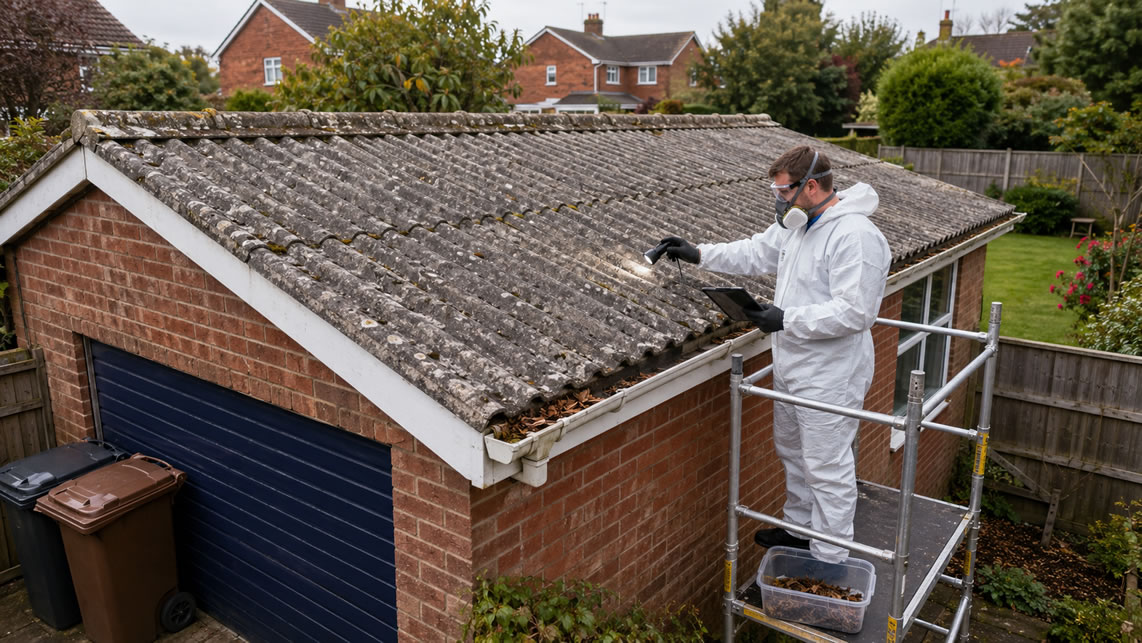
Regular roof servicing can sometimes help an old asbestos-cement roof remain usable for longer, but only if the sheets are still fundamentally sound.
The aim should not be to make an old asbestos roof look new. Instead, sensible maintenance focuses on keeping water flowing correctly, spotting damage early, dealing with isolated faults and avoiding unnecessary disturbance.
That distinction is important.
Asbestos-cement sheets can remain serviceable for many years when they are intact and left alone. However, once sheets become brittle, heavily cracked, badly weathered or repeatedly patched, servicing has limits. At that point, spending money on repeated maintenance may only delay an inevitable replacement.
There is also a serious safety issue. HSE guidance treats asbestos-cement sheets as potentially fragile roof materials, meaning they may not support a person’s weight. Maintenance work such as cleaning, inspecting or repairing therefore needs proper access planning as well as asbestos controls.
This guide looks at what asbestos roof servicing can realistically achieve, what work may help prolong roof life, which maintenance methods should be avoided and when replacement becomes the more sensible option. It is always best to get some asbestos removal quotes in and do the same for roofing.
Can Servicing Extend an Asbestos Roof’s Life?
Yes, in some cases.
Servicing can help by:
- Finding small cracks before they worsen
- Identifying leaking fixings
- Keeping gutters and valleys clear
- Preventing water from backing up beneath sheets
- Monitoring surface deterioration
- Repairing isolated weak points
- Checking flashings and ridge details
- Spotting movement in the roof structure
- Managing moss where it is genuinely causing problems
However, servicing cannot reverse serious deterioration.
It cannot make heavily degraded asbestos cement structurally new again.
Asbestos Roof Servicing at a Glance
| Roof Condition | Can Servicing Help? | Likely Approach |
|---|---|---|
| Sound and watertight | Yes | Monitor and maintain |
| Small isolated leak | Yes | Local repair |
| Failed fixing washer | Yes | Specialist repair |
| Light moss growth | Possibly | Leave or controlled treatment |
| Blocked gutter | Yes | Clear safely |
| Minor surface weathering | Yes | Monitor |
| One cracked sheet | Possibly | Repair or local replacement |
| Several cracked sheets | Limited | Consider replacement |
| Widespread delamination | Little benefit | Replacement likely |
| Sagging sheets | No meaningful extension | Professional assessment |
| Repeated patch repairs | Limited | Replacement often better |
| Corroded supporting structure | Servicing alone not enough | Structural repair and likely reroof |
What Does Asbestos Roof Servicing Actually Mean?
A sensible roof service is usually more of a condition inspection and preventative maintenance visit than an aggressive cleaning job.
It may include:
- Ground-level inspection
- Safe elevated inspection
- Gutter clearance
- Valley clearance
- Check of fixings
- Check of sheet overlaps
- Check of ridge pieces
- Check of flashings
- Inspection of internal leaks
- Assessment of moss
- Review of previous repairs
- Inspection of roof supports
The contractor should minimise disturbance to the asbestos cement.
Asbestos Roofs Should Be Treated as Fragile
This is one of the most important parts of any servicing plan.
HSE specifically lists asbestos-cement sheets among materials that can form fragile roofs and advises building owners not to assume they can support a person’s weight. Inspection and maintenance should preferably be completed from safer access arrangements where possible, such as a MEWP, scaffold, tower or other properly planned system.
Nobody should casually walk over an asbestos-cement garage roof simply because the fixing lines look solid.
How Often Should an Old Asbestos Roof Be Checked?
There is no universal servicing interval.
For a domestic garage or outbuilding, a sensible approach may include:
- Visual check from ground level once or twice a year
- Additional check after severe storms
- Internal inspection after prolonged heavy rain
- Professional inspection when new leaks appear
- More frequent monitoring once deterioration starts
The purpose is to notice changes rather than repeatedly disturb the material.
Ground-Level Checks
Homeowners can often spot problems without getting onto the roof.
Look for:
- Broken edges
- Missing ridge pieces
- Sagging
- Heavy moss
- Overflowing gutters
- Rusting fixings
- Visible cracks
- Debris collecting at low points
Binoculars or photographs from a safe position can sometimes help.
Internal Roof Checks
The inside of the garage or outbuilding can reveal more than the outside.
Check after rain for:
- Damp spots
- Drips
- Water trails
- Dark timber
- Rust marks
- Daylight through cracks
- Condensation
It is useful to mark where water appears because the entry point may be higher up the roof.
Gutter Maintenance
Keeping gutters clear is one of the simplest ways to reduce avoidable roof problems.
Blocked gutters can cause water to:
- Back up beneath sheet edges
- Overflow against walls
- Soak timber fascia
- Collect around roof joints
Regular gutter clearance can therefore help protect the roof indirectly.
Valley and Channel Clearance
Some larger asbestos roofs contain valley gutters between roof slopes.
If these become blocked, standing water may build up around old asbestos-cement sheets.
HSE specifically discusses roof cleaning and valley-gutter work on asbestos-cement and other fragile roofs, noting that safe access and asbestos controls are required.
Fixing Inspections
Older asbestos roofs often fail around the fixings.
A service should check for:
- Rust
- Failed washers
- Loose bolts
- Cracks around fixing holes
- Movement
- Missing caps
Water can penetrate around deteriorated fixing points long before the sheet itself needs complete replacement.
Can Leaking Roof Bolts Be Repaired?
Sometimes.
If the sheet around the fixing remains sound, a contractor may be able to deal with:
- Failed washer
- Loose fixing
- Minor sealing issue
However, repair methods must avoid unnecessary drilling or cracking.
If many fixing points are failing at once, this may indicate the roof is reaching the stage where full replacement is more sensible.
Sheet Overlaps
Corrugated sheets usually overlap at:
- Side laps
- End laps
These areas can deteriorate because of:
- Movement
- Dirt build-up
- Failed sealing
- Broken corners
- Fixing stress
An inspection can identify leaks before they spread further.
Ridge Pieces
The ridge at the top of the roof may contain:
- Asbestos-cement ridge sections
- Fibre-cement ridge pieces
- Metal ridge caps
Damage here can cause significant water ingress despite the main sheets remaining sound.
Ridge repair may therefore extend the useful life of an otherwise reasonable roof.
Flashings
Where the roof meets a wall or chimney, check:
- Lead flashing
- Metal flashing
- Sealed abutments
A leaking flashing may be mistaken for a failing asbestos sheet.
Fixing the flashing can sometimes stop the leak without disturbing much of the roof.
Moss on an Asbestos Roof
Moss is common on old asbestos cement.
It may collect:
- Along overlaps
- Near gutters
- Behind ridges
- In shaded areas
Moss can retain moisture and interfere with drainage, but removal needs care.
The solution is not automatically “clean the whole roof”.
Can Moss Shorten an Asbestos Roof’s Life?
Heavy growth can contribute to problems by:
- Holding moisture
- Blocking drainage
- Hiding cracks
- Accumulating debris
- Slowing drying
Light surface growth may be mostly cosmetic.
Removing it aggressively can do more harm than leaving it alone.
Should an Asbestos Roof Be Pressure Washed?
No aggressive pressure washing should be used.
Abrasive cleaning can erode the cement surface and release asbestos fibres. HSE enforcement action has been taken where asbestos-cement roof cleaning created fibre-release risks because suitable controls and planning were not in place.
Pressure washing can also damage brittle sheets.
What Cleaning Methods Are Safer?
Where cleaning is genuinely necessary, the work should follow asbestos-specific methods.
That normally means:
- Minimising abrasion
- Controlling dust
- Keeping material damp where appropriate
- Avoiding dry brushing
- Preventing contaminated run-off spreading
- Using safe access equipment
The exact method should depend on condition and contractor assessment.
Can an Asbestos Roof Be Soft Washed?
The term “soft wash” is not automatically proof that a method is safe.
A low-pressure chemical application may create less mechanical damage than pressure washing, but it still needs consideration of:
- Asbestos fibre release
- Run-off
- Roof fragility
- Chemical compatibility
- Disposal of debris
Ask what method will actually be used rather than relying on marketing terminology.
Can an Asbestos Roof Be Coated?
Sometimes.
A suitable coating or encapsulation system may help protect a weathered surface where the asbestos cement remains structurally sound.
HSE guidance notes that asbestos-containing materials can sometimes be sealed or encapsulated to reduce deterioration. For asbestos cement specifically, HSE says an alkali-resistant, water-permeable sealant should be used, while inappropriate impermeable coatings may contribute to premature failure.
When Coating May Help
A coating may be worth considering where:
- Sheets are intact
- Surface is weathered
- Roof remains stable
- Fixings are mostly sound
- Replacement is not currently required
It may help reduce further surface erosion.
When Coating Is a Poor Idea
Coating does not solve:
- Broken sheets
- Sagging
- Rotten timber
- Corroded steel
- Major cracking
- Failed laps
- Structural movement
It can also hide defects and make future inspection more difficult.
Can Encapsulation Add Years to an Asbestos Roof?
Potentially, but only if the roof is suitable.
HSE’s broader asbestos-management guidance notes that some encapsulation systems can provide long-term protection when used on sound materials, but suitability depends on the condition of the asbestos-containing material and the coating system used.
It should not be treated as a guaranteed lifespan extension.
Minor Repairs
Small, localised repairs may prolong service life.
Examples include:
- One leaking fixing
- Small crack
- Damaged ridge piece
- Failed flashing
- Minor edge damage
HSE guidance also makes the point that repair is generally most appropriate where damage is slight rather than extensive.
When Repair Stops Being Sensible
Repeated repairs can become a warning sign.
If a roof needs attention every year, it may indicate:
- Widespread ageing
- Brittle sheets
- Fixing failure
- Structural movement
At that stage, servicing becomes reactive rather than preventative.
Roof Support Inspection
An old asbestos roof depends on the structure underneath it.
A service should consider:
- Timber purlins
- Rafters
- Metal frames
- Bolts
- Wall plates
- Corrosion
- Rot
A perfectly reasonable roof sheet may still fail if the supporting frame moves.
Timber Roof Problems
Look for:
- Rot
- Insect damage
- Split purlins
- Sagging
- Loose connections
Water leaks can accelerate timber deterioration.
Steel Roof Problems
Older steel frames may suffer:
- Rust
- Section loss
- Failed bolts
- Distortion
These problems should be addressed before simply patching the covering.
Condensation vs Roof Leak
Not every drip means the asbestos roof has failed.
Uninsulated garages can suffer condensation when:
- Warm damp air hits cold roof sheets
- Vehicles bring in moisture
- Ventilation is poor
Condensation often appears across a broad area, while leaks may follow specific cracks or fixings.
Correct diagnosis matters before paying for repairs.
Ventilation
Improving ventilation can sometimes reduce condensation.
Possible measures include:
- Wall vents
- Eaves ventilation
- Ridge ventilation
- Improved air movement
Any work close to asbestos cement needs appropriate planning.
Can Insulation Extend Roof Life?
Not directly.
Insulation can make a garage more comfortable and reduce some condensation problems, but it does not strengthen asbestos cement.
Poorly designed insulation may even hide leaks.
If major insulation work is planned, replacing an old asbestos roof at the same time can be worth considering.
Overcladding an Asbestos Roof
Some owners consider installing a new covering above the old sheets.
This can reduce the need for immediate removal but introduces important issues:
- Additional weight
- Fixings through asbestos
- Hidden deterioration
- Future removal cost
- Condensation
- Structural loading
Overcladding should therefore be assessed as a complete roofing system rather than treated as a simple cover-up.
Is Overcladding Better Than Removal?
Sometimes, particularly on larger commercial or agricultural buildings.
For a small domestic garage, complete removal and replacement may be simpler long term.
Compare:
- Current roof condition
- Structural capacity
- Access
- Replacement material
- Future building use
Routine Service vs Full Refurbishment
| Work | Service | Refurbishment |
| Inspect roof | Yes | Yes |
| Clear gutters | Yes | Yes |
| Check fixings | Yes | Yes |
| Minor local repair | Yes | Yes |
| Replace several sheets | Sometimes | Yes |
| Coat whole roof | Sometimes | Yes |
| Structural repairs | Limited | Yes |
| Replace roof covering | No | Yes |
| Add insulation | No | Yes |
| New drainage | Minor | Yes |
How Much Longer Can Servicing Make an Asbestos Roof Last?
There is no reliable fixed figure.
A sound roof might continue for many years with minor maintenance.
A badly weathered one may continue deteriorating despite servicing.
Useful life depends on:
- Sheet quality
- Age
- Exposure
- Previous maintenance
- Roof pitch
- Fixings
- Moss
- Structure
- Local weather
Avoid contractors promising a specific extra lifespan without a proper inspection.
Signs Servicing Is Still Worthwhile
Servicing is more likely to provide value where:
- Roof is mostly watertight
- Only one or two faults exist
- Sheets remain hard and intact
- There is no widespread sagging
- Surface erosion is limited
- Building use is basic storage
- Roof will not need regular access
Signs Replacement Is Better
Replacement becomes more attractive where:
- Several sheets are cracked
- Leaks return repeatedly
- Fixings fail across the whole roof
- Surface is heavily weathered
- Sheets are sagging
- Structural work is required
- Roof is covered in old patches
- Garage is being converted
- Solar panels are planned
- Long-term use of the building is expected
Repair vs Replace Table
| Situation | Service/Repair | Replace |
| Sound roof | ✓ | |
| One leaking fixing | ✓ | |
| One damaged ridge | ✓ | |
| Heavy gutter debris | ✓ | |
| Minor moss issue | ✓ | |
| One cracked sheet | Possibly | Possibly |
| Several cracked sheets | Limited | ✓ |
| Frequent leaks | ✓ | |
| Sagging sheets | ✓ | |
| Corroded supports | Structural work | Usually |
| Conversion planned | ✓ | |
| Solar planned | Usually | |
| Extensive old patching | ✓ |
Replacement Materials
Common asbestos-roof alternatives include:
- Fibre cement
- Box-profile steel
- Insulated steel panels
- Tile-effect metal
- EPDM
- GRP
- Felt roofing
The best material depends on how the building is used.
Fibre-Cement Replacement
Modern non-asbestos fibre cement can provide a similar appearance to old corrugated sheets.
Advantages include:
- Familiar look
- Good weather resistance
- Suitable for garages
- Cement-based construction
It can be useful where owners want to retain the original style.
Box-Profile Steel
A very common garage-roof replacement.
Advantages include:
- Lightweight
- Fast installation
- Good durability
- Wide colour choice
Condensation needs consideration.
Insulated Metal Panels
These are a stronger option where the garage becomes:
- Workshop
- Gym
- Hobby room
- Utility space
They combine weatherproofing and insulation.
EPDM or GRP
For roofs converted to a proper boarded low-slope deck, EPDM or GRP can provide a clean modern solution.
This normally involves more structural alteration than simply replacing corrugated sheets.
Typical Asbestos Roof Servicing Costs
Broad UK budgeting figures might include:
| Work | Typical Cost |
| Visual roof inspection | £100–£250 |
| Detailed asbestos roof assessment | £150–£350 |
| Gutter clearance | £100–£300 |
| Minor fixing repair | £250–£600 |
| One local leak repair | £250–£700 |
| Minor sheet-edge repair | £300–£800 |
| Ridge repair | £400–£1,000 |
| Specialist moss treatment | £500–£1,500+ |
| Encapsulation/coating | £1,000–£3,000+ |
| Garage roof replacement | £2,000–£5,000+ |
These are broad estimates only.
Access costs can make a large difference.
When Servicing Costs Start to Add Up
Imagine an old garage roof needs:
- £400 fixing repair
- £500 ridge repair
- £600 cleaning or treatment
- £700 additional leak repair
That can quickly approach the cost of a more permanent replacement.
This is why contractors should distinguish between:
- One-off maintenance
- Ongoing deterioration
Is Annual Servicing Necessary?
Usually not for a simple domestic asbestos garage roof.
An annual professional visit may make sense where:
- Roof is large
- Site is exposed
- Valleys block frequently
- Roof is already deteriorating
For many homeowners, periodic visual inspection and professional assessment when something changes is more proportionate.
Does Cleaning Make the Roof Last Longer?
Not automatically.
Removing a small amount of harmless staining does little to extend roof life.
Cleaning may help where growth is:
- Blocking gutters
- Holding large amounts of debris
- Preventing drainage
Otherwise, unnecessary cleaning can increase disturbance.
Does Painting Make the Roof Last Longer?
Possibly, but only where:
- Correct coating is used
- Surface is prepared safely
- Sheets remain sound
- Coating remains maintained
Painting cannot restore structural strength to a failing sheet.
Does Fixing Leaks Quickly Help?
Yes.
Stopping water entry can help protect:
- Timber roof supports
- Metal fixings
- Garage contents
- Wall plates
It can also prevent minor defects becoming larger.
Can Servicing Prevent Asbestos Fibre Release?
Good management can reduce unnecessary disturbance.
Leaving sound cement intact, preventing damage and avoiding aggressive cleaning can all help keep fibres bound within the cement matrix.
However, weathering continues over time, which is why condition monitoring remains important.
Should You DIY Asbestos Roof Servicing?
Basic visual checks from ground level are reasonable.
Avoid DIY tasks involving:
- Roof access
- Drilling
- Cutting
- Pressure washing
- Breaking sheets
- Scraping
- Power tools
These combine asbestos exposure risks with fall risks.
What Should a Roof Servicing Quote Include?
| Item | Why It Matters |
| Roof condition assessment | Shows whether servicing makes sense |
| Asbestos confirmation | Clarifies material |
| Access method | Critical for fragile roof |
| Gutter work | Often worthwhile |
| Fixing check | Common leak source |
| Crack assessment | Helps identify deterioration |
| Cleaning method | Must be asbestos appropriate |
| Repair method | Should minimise disturbance |
| Coating specification | Important if encapsulating |
| Waste handling | Needed for removed material |
| Future recommendation | Helps plan replacement |
| VAT | Confirms total |
| Guarantee | Clarifies repair limitations |
Questions to Ask a Contractor
- Is the roof still worth maintaining?
- Which parts are deteriorating?
- Are the sheets still structurally sound?
- Can the leak be repaired locally?
- How will you access the roof?
- Will anyone stand directly on the sheets?
- Is cleaning actually necessary?
- What cleaning method will you use?
- Will you pressure wash it?
- Do any fixings need replacement?
- Are the ridge sections sound?
- Is the roof frame in good condition?
- Would coating genuinely help?
- How long might servicing realistically extend useful life?
- At what point would you recommend replacement?
- Is asbestos waste included?
- What guarantee applies?
Red Flags
Be cautious if a contractor proposes to:
- Walk directly over asbestos sheets
- Pressure wash the roof
- Grind sheet edges
- Drill numerous new holes
- Break sheets deliberately
- Coat badly cracked roofing
- Ignore sagging
- Skip structural inspection
- Promise the roof will last “another 20 years” without assessment
Roof Servicing Checklist
| Check | Completed? |
| Ground-level inspection | |
| Internal leak check | |
| Gutters checked | |
| Valleys checked | |
| Ridge checked | |
| Fixings checked | |
| Sheet cracks checked | |
| Moss assessed | |
| Flashings checked | |
| Structure checked | |
| Safe access planned | |
| Asbestos controls confirmed | |
| Repair vs replace compared | |
| Future use considered |
Frequently Asked Questions
Can roof servicing prolong an asbestos roof’s life?
Yes, where the sheets remain structurally sound. Servicing can help by keeping drainage clear, finding small faults early and repairing isolated leaks.
How often should an asbestos roof be serviced?
There is no fixed interval. Periodic visual checks and professional assessment when leaks or deterioration appear are usually more useful than unnecessary frequent disturbance.
Can an asbestos roof be cleaned?
Yes, but only where cleaning is actually needed and using methods suitable for asbestos cement.
Can you pressure wash an asbestos roof?
Aggressive pressure washing should not be used because it can damage the cement surface and release asbestos fibres.
Does removing moss make an asbestos roof last longer?
Only where moss is interfering with drainage or trapping substantial debris. Light growth does not automatically need removal.
Can leaking asbestos roof bolts be repaired?
Sometimes. A failed washer or isolated fixing may be repairable where the surrounding sheet remains sound.
Can an asbestos roof be sealed or coated?
Some sound asbestos-cement roofs can be treated with suitable specialist coatings. HSE guidance says the coating needs to be appropriate for asbestos cement.
Can coating save a badly damaged roof?
No. Coatings cannot fix broken sheets, sagging, failed supports or widespread cracking.
Is it safe to walk on an asbestos roof?
No assumption should be made that asbestos cement will support a person’s weight. HSE treats asbestos-cement sheets as potentially fragile roof materials.
Is servicing cheaper than replacement?
Initially, yes. However, repeated repairs can eventually cost enough that full replacement offers better value.
When should an asbestos roof be replaced?
Replacement becomes more sensible where leaks recur, multiple sheets are cracked, fixings are failing widely, the roof sags or major refurbishment is planned.
Can a garage roof be replaced with metal sheets?
Yes. Box-profile steel is a common modern replacement, although condensation control should be considered.
Is modern fibre cement a good replacement?
Yes. Non-asbestos fibre cement can provide a similar appearance to older asbestos-cement roofing.
Should an asbestos roof be replaced before installing solar panels?
Usually, an ageing asbestos roof is better addressed before committing to a long-term solar installation.
Can I service an asbestos roof myself?
Ground-level inspection is reasonable, but work involving access, drilling, cutting, scraping or cleaning should be approached as asbestos and fragile-roof work.