
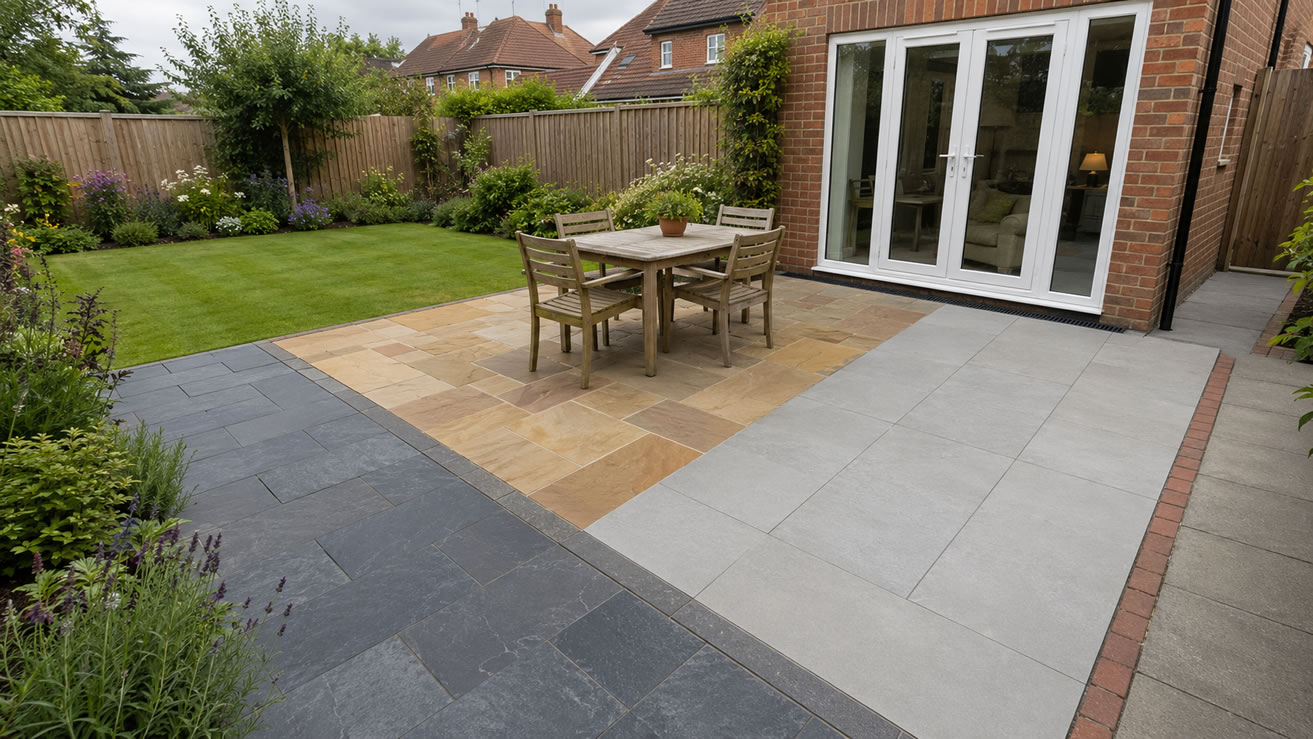
Choosing patio slabs is one of the biggest decisions in any garden landscaping project.
The paving affects not only how the patio looks but also how much maintenance it needs, how slippery it may become, how well it handles frost and how much the finished installation will cost.
UK homeowners can now choose from a wide range of paving materials, including:
- Porcelain
- Indian sandstone
- Limestone
- Granite
- Slate
- Concrete slabs
- Reconstituted stone
- Clay pavers
- Natural stone setts
Each material has strengths and weaknesses.
Porcelain is popular for modern gardens because it provides a consistent finish and relatively low maintenance. Indian sandstone offers more natural variation and often suits traditional properties. Concrete remains one of the most economical choices, while limestone and granite can provide a more premium appearance.
The best patio slabs are therefore not always the most expensive one. It depends on the garden style, budget, amount of shade, expected foot traffic and how much maintenance the homeowner is willing to carry out.
This guide compares the main garden patio slab types used in the UK and explains what to consider before choosing one.
Patio Slab Types at a Glance
| Patio Material | Appearance | Maintenance | Typical Cost Level | Best Suited To |
|---|---|---|---|---|
| Porcelain | Clean and contemporary | Low | Medium to high | Modern gardens |
| Indian sandstone | Natural and varied | Moderate | Medium | Traditional gardens |
| Limestone | Smooth and understated | Moderate | Medium to high | Modern or classic patios |
| Granite | Premium and textured | Low to moderate | High | High-end patios |
| Slate | Dark and distinctive | Moderate | Medium to high | Contemporary gardens |
| Concrete slabs | Wide choice | Moderate | Low to medium | Budget-conscious projects |
| Reconstituted stone | Stone-like appearance | Moderate | Medium | Traditional-style patios |
| Clay pavers | Warm and traditional | Moderate | Medium to high | Period properties |
| Natural stone setts | Rustic and premium | Moderate | High | Borders and feature areas |
What Makes a Good Patio Slab?
A good patio slab should provide a balance of:
- Durability
- Weather resistance
- Slip resistance
- Suitable thickness
- Attractive appearance
- Easy maintenance
- Consistent sizing
- Appropriate surface texture
- Reasonable installation cost
The paving also needs to suit the proposed use.
A patio used mainly for outdoor dining has different requirements from a path, driveway or swimming-pool surround.
Porcelain Patio Slabs
Porcelain has become one of the most popular premium patio materials in the UK.
It is manufactured from refined clay and other materials fired at very high temperatures.
This creates a dense, hard paving slab with relatively low water absorption.
Typical finishes imitate:
- Natural stone
- Concrete
- Timber
- Marble
- Slate
Advantages of Porcelain Paving
Low Water Absorption
Porcelain absorbs very little moisture compared with many natural stones.
This can help reduce:
- Frost damage
- Staining
- Algae penetration
- Surface deterioration
Consistent Appearance
Porcelain slabs are manufactured to controlled dimensions.
That makes it easier to create:
- Straight joints
- Uniform patterns
- Contemporary layouts
Wide Range of Styles
Porcelain can imitate expensive natural materials while offering a more consistent finish.
Relatively Low Maintenance
Because the surface is dense, dirt and staining tend to remain closer to the surface.
Disadvantages of Porcelain Paving
Higher Installation Skill
Porcelain is less forgiving than some traditional slabs.
It generally requires:
- Full mortar bed
- Suitable bonding slurry
- Accurate cutting
- Consistent falls
- Correct jointing
Hard to Cut
Dense porcelain often needs professional diamond cutting equipment.
Can Look Less Natural
Some homeowners prefer the variation found in natural stone.
Higher Material Cost
Budget porcelain can be affordable, but premium products can cost considerably more than basic concrete slabs.
Is Porcelain Slippery?
Outdoor porcelain should be selected specifically for external use.
Many outdoor products have textured surfaces designed to provide better grip.
However, any patio can become slippery when:
- Algae grows
- Leaves accumulate
- Ice forms
- Grease is spilled
- Surface drainage is poor
Check the manufacturer’s slip-resistance rating rather than assuming all porcelain performs the same.
Indian Sandstone Patio Slabs
Indian sandstone remains one of the most popular natural stone options for UK patios.
It has a naturally riven surface and considerable colour variation.
Common colours include:
- Buff
- Grey
- Brown
- Green
- Raj blend
- Fossil tones
- Mixed autumn shades
Advantages of Indian Sandstone
Natural Appearance
Every slab varies slightly.
This creates a more traditional and less uniform finish.
Wide Colour Choice
The stone works with many house styles.
Reasonable Cost
Indian sandstone can provide natural stone at a lower price than some premium alternatives.
Good Availability
It is widely stocked by UK paving merchants.
Disadvantages of Indian Sandstone
Porous Surface
Sandstone absorbs more water than porcelain.
Therefore, it may be more susceptible to:
- Staining
- Algae
- Frost damage in poor-quality stone
- Surface weathering
Colour Variation
Some homeowners like natural variation; others may find it too inconsistent.
Maintenance
It may need periodic cleaning.
Optional sealing can also help depending on the stone and desired appearance.
What Does Riven Sandstone Mean?
Riven stone has a naturally split surface.
Rather than being perfectly flat, it may contain:
- Texture
- Small ridges
- Natural clefts
- Surface variation
This creates character and can improve grip.
However, heavily riven slabs may be less comfortable for:
- Narrow chair legs
- Tables
- Wheelchairs
- Pushchairs
Smooth or Sawn Sandstone
Sawn sandstone has a flatter, more contemporary finish.
It can suit modern gardens while retaining natural colour variation.
Compared with riven sandstone, it usually costs more because of additional processing.
Limestone Patio Slabs
Limestone offers a smoother appearance than many sandstone products.
Typical colours include:
- Black
- Grey
- Blue
- Buff
- Cream
It is commonly used in both traditional and modern gardens.
Advantages of Limestone
- Attractive natural texture
- Relatively consistent colouring
- Premium appearance
- Comfortable walking surface
- Works well with contemporary designs
Disadvantages of Limestone
- Can fade over time
- Some dark limestone becomes noticeably lighter
- Can stain
- May need sealing
- Acidic cleaning products can damage the stone
Black Limestone
Black limestone creates a dramatic dark patio when newly installed.
However, one important characteristic is colour change.
Without suitable maintenance, dark limestone can fade towards:
- Grey
- Charcoal
- Pale grey
Some homeowners like the weathered appearance. Others prefer to use suitable sealers to retain a darker finish.
Granite Patio Slabs
Granite is an extremely hard natural stone.
It is commonly available in:
- Silver grey
- Dark grey
- Black
- Pink
- Mixed tones
Surface finishes may include:
- Flamed
- Bush hammered
- Textured
- Sawn
Advantages of Granite
- Very durable
- Excellent wear resistance
- Premium appearance
- Low water absorption compared with many stones
- Suitable for high-traffic areas
- Good resistance to frost
Disadvantages of Granite
- Higher cost
- Heavy slabs
- Hard to cut
- Installation can take longer
- Some finishes can be slippery if poorly selected
Slate Patio Slabs
Slate creates a distinctive dark and layered appearance.
Common colours include:
- Black
- Blue-grey
- Green
- Purple
The natural cleft surface can produce a strong contemporary look.
Advantages of Slate
- Attractive colour variation
- Distinctive texture
- Strong modern appearance
- Suitable for feature patios
Disadvantages of Slate
- Some products can delaminate
- Quality varies
- Edges may chip
- Wet slate can become slippery
- Colour can change when weathered
Good-quality exterior slate should be selected for UK frost conditions.
Concrete Patio Slabs
Concrete remains one of the most widely used patio paving materials.
Modern concrete slabs are available in far more styles than older plain grey paving.
They may imitate:
- Sandstone
- Slate
- Limestone
- Timber
- Granite
Advantages of Concrete Slabs
Lower Cost
Basic concrete slabs are usually among the cheapest patio materials.
Wide Availability
Replacement slabs are often easier to find.
Large Choice
Concrete paving is available in:
- Different colours
- Different sizes
- Textured finishes
- Smooth finishes
- Decorative patterns
Suitable for Many Garden Styles
Basic grey slabs suit utility areas, while premium moulded products can create more decorative patios.
Disadvantages of Concrete Paving
- Colour may fade
- Surface may weather
- Some slabs absorb staining
- Moss and algae can develop
- Cheaper products may look less natural
Pressed Concrete Slabs
Pressed concrete slabs are usually relatively simple and economical.
They work well for:
- Garden paths
- Shed bases
- Utility patios
- Budget seating areas
They may not provide the premium appearance of porcelain or natural stone but can be very practical.
Decorative Concrete Paving
Higher-quality concrete paving can imitate natural stone surprisingly well.
Features may include:
- Textured surfaces
- Mixed colours
- Tumbled edges
- Irregular shapes
- Multiple slab sizes
This can provide a middle ground between basic concrete and expensive natural stone.
Reconstituted Stone Paving
Reconstituted stone is manufactured using stone aggregates and cement-based materials.
It is designed to imitate natural paving.
Possible advantages include:
- Consistent sizes
- Traditional appearance
- Lower cost than some natural stones
- Wide design choice
Maintenance is broadly similar to concrete paving.
Clay Pavers
Clay pavers create a distinctive traditional appearance.
They are made from fired clay rather than concrete.
Colours may include:
- Red
- Brown
- Orange
- Dark blue
- Multi-tone blends
Advantages of Clay Pavers
- Strong colour retention
- Traditional appearance
- Durable material
- Suitable for period properties
- Can be arranged in attractive patterns
Disadvantages of Clay Pavers
- More joints than large slabs
- Installation can take longer
- Higher labour cost
- Moss may grow in shaded joints
Clay pavers work particularly well in smaller courtyards and heritage-style gardens.
Natural Stone Setts
Stone setts are smaller paving units commonly made from granite, sandstone or limestone.
They are often used for:
- Patio borders
- Paths
- Edging
- Feature areas
- Courtyards
Using setts across an entire patio can be expensive due to the amount of labour involved.
Mixed-Size Patio Packs
Natural stone and concrete paving are often sold in mixed-size patio packs.
These create a random-looking layout using several slab sizes.
Common formats include:
- Large rectangles
- Medium rectangles
- Squares
- Small feature slabs
The pattern looks informal and works particularly well with sandstone.
Single-Size Slabs
Using one slab size creates a more orderly appearance.
Popular modern layouts include:
- 600 × 600mm
- 900 × 600mm
- Large rectangular porcelain patio slabs
Large-format paving can make smaller gardens feel less cluttered.
Large Patio Slabs
Large slabs reduce the number of joints.
Advantages include:
- Cleaner appearance
- Faster visual flow
- Less joint maintenance
- Contemporary style
However, large slabs are:
- Heavy
- Harder to handle
- More difficult to bed evenly
- More difficult to cut
Poor installation can result in rocking slabs.
Small Patio Slabs
Smaller slabs suit:
- Curved gardens
- Detailed layouts
- Cottage-style patios
- Small courtyards
They require more joints and usually more labour.
Patio Slab Thickness
Patio slabs should be suitable for pedestrian use.
Common thicknesses vary considerably by material.
Typical examples include:
| Material | Common Patio Thickness |
| Porcelain | Around 20mm |
| Natural sandstone | Around 18–25mm |
| Limestone | Around 18–25mm |
| Granite | Around 20–30mm |
| Concrete slabs | Around 30–50mm |
| Clay pavers | Around 50mm or more |
Exact specifications vary by product.
Do not assume a thin indoor tile can be used outdoors.
Can Patio Slabs Be Used for Driveways?
Not automatically.
Driveways experience much greater loading from vehicles.
Standard patio slabs can:
- Crack
- Rock
- Break
- Move
Driveway paving normally needs:
- Suitable slab thickness
- Stronger base
- Appropriate bedding
- Vehicle-rated product
Always check the product specification.
Patio Slab Comparison
| Material | Durability | Slip Resistance | Maintenance | Cost |
| Porcelain | Excellent | Good with outdoor finish | Low | Medium-high |
| Sandstone | Good | Generally good | Moderate | Medium |
| Limestone | Good | Good when textured | Moderate | Medium-high |
| Granite | Excellent | Excellent when textured | Low | High |
| Slate | Good to very good | Variable | Moderate | Medium-high |
| Concrete | Good | Good | Moderate | Low-medium |
| Clay | Excellent | Good | Moderate | Medium-high |
Best Patio Slab for Low Maintenance
Porcelain is often the strongest starting choice.
Reasons include:
- Low water absorption
- Dense surface
- Reduced staining
- Easier cleaning
- Consistent finish
However, joints and drainage still need maintenance.
No patio is completely maintenance-free.
Best Patio Slab for Traditional Gardens
Natural sandstone is a popular choice.
It works particularly well with:
- Brick houses
- Cottage gardens
- Older properties
- Timber fencing
- Traditional planting
Clay pavers and reclaimed stone can also suit older homes.
Best Patio Slab for Modern Gardens
Popular choices include:
- Porcelain
- Sawn sandstone
- Granite
- Smooth limestone
- Large-format concrete
Grey and charcoal tones are especially common in contemporary garden designs.
Best Patio Slab for a Small Garden
Large-format slabs can make a small patio appear more spacious.
Good options include:
- Porcelain
- Smooth sandstone
- Large concrete slabs
Keep the number of colours and patterns relatively limited.
An overly complicated design can make a compact garden feel smaller.
Best Patio Slab for a Shaded Garden
Shade encourages:
- Moss
- Algae
- Slow drying
Therefore, choose a surface with good wet slip resistance.
Textured porcelain, sandstone and suitable granite can work well.
Regular cleaning may still be needed.
Which Patio Slabs Are Most Slippery?
Slip resistance depends on surface finish rather than material alone.
Potentially slippery surfaces include:
- Highly polished stone
- Smooth wet slate
- Indoor-grade porcelain
- Algae-covered concrete
- Sealed surfaces with inappropriate coatings
For external patios, choose paving specifically designed for outdoor use.
Frost Resistance
UK paving must cope with repeated freeze-thaw cycles.
Porcelain generally performs very well because of low water absorption.
Good-quality granite and appropriately selected natural stone also perform well.
Lower-grade porous stone may deteriorate if water freezes within it.
Which Patio Slabs Fade?
Potential fading varies.
Concrete
Pigments and surface finishes can fade over time.
Black Limestone
Can fade noticeably to grey.
Sandstone
Usually weathers gradually.
Porcelain
Generally has good colour stability.
Granite
Usually retains colour well.
Clay
Normally has excellent colour retention because colour extends through the material.
Patio Slabs and Staining
Common patio stains include:
- Barbecue grease
- Leaves
- Rust
- Plant pots
- Bird droppings
- Soil
- Algae
- Drinks
- Oil
Porous natural stone generally absorbs stains more readily than dense porcelain.
Quick cleaning reduces the chance of permanent marks.
Should Natural Stone Be Sealed?
Sealing is optional for many patio stones.
Potential advantages include:
- Reduced staining
- Easier cleaning
- Colour enhancement
- Reduced water absorption
Potential disadvantages include:
- Ongoing resealing
- Changed appearance
- Uneven application
- Increased slipperiness with unsuitable products
Always use a sealer designed for the exact stone.
Does Porcelain Need Sealing?
Most porcelain paving does not need sealing because the slab itself has very low porosity.
However, grout or jointing materials may have their own maintenance requirements.
Check manufacturer guidance.
Patio Jointing Options
Common joint materials include:
- Cement mortar
- Brush-in compounds
- Resin jointing
- Slurry grout
- Specialist porcelain grout
The correct product depends on:
- Joint width
- Slab type
- Bedding system
- Patio use
Poor jointing can fail even when the slabs remain sound.
Traditional Mortar Pointing
Cement-based pointing is widely used with natural stone.
Advantages include:
- Strong joints
- Traditional finish
- Low material cost
However, poor mixtures may:
- Crack
- Crumble
- Stain slabs
- Become loose
Correct preparation matters.
Brush-In Jointing Compounds
Pre-mixed jointing compounds are popular for patio refurbishment.
Advantages include:
- Fast application
- Clean finish
- Range of colours
The joint depth and base must meet product requirements.
Thin joints over loose bedding may fail.
Porcelain Grout
Porcelain patios often use specialist jointing grout.
This provides:
- Consistent colour
- Neat joints
- Strong finish
Installation needs care because grout residue can mark the surface if left to cure.
Patio Foundations
The slab itself is only part of the patio.
A typical construction may include:
- Excavated ground.
- Compacted sub-base.
- Full mortar bed.
- Bonding slurry where required.
- Patio slab.
- Jointing material.
Poor groundwork can cause even expensive slabs to fail.
How Deep Should a Patio Base Be?
A typical domestic patio may use approximately:
- 100mm compacted sub-base
- 30–50mm mortar bedding
The exact construction depends on:
- Ground conditions
- Slab thickness
- Drainage
- Patio use
Soft ground may require deeper excavation.
Why Dot-and-Dab Installation Is a Problem
Some poor patio installations use blobs of mortar rather than a full bed.
This can leave hollow areas under slabs.
Potential problems include:
- Cracking
- Rocking
- Water pockets
- Frost damage
- Staining patterns
- Weak support
A full mortar bed generally provides better support.
Porcelain Bonding Slurry
Because porcelain absorbs very little water, ordinary mortar may not bond reliably to its underside.
Installers commonly apply a specialist slurry primer.
This improves adhesion between:
- Slab
- Mortar bed
Missing this step can result in loose slabs.
Patio Falls and Drainage
Patios need a slight gradient so rainfall can drain away.
Water should not be directed towards:
- House walls
- Doors
- Air bricks
- Garage
- Conservatory
Poor falls can create:
- Puddles
- Moss
- Slippery surfaces
- Damp problems
Typical Patio Fall
Installers often create a fall of roughly:
- 1:60 to 1:80
depending on surface and site conditions.
That means the patio drops gradually away from the property.
Patio Levels Against the House
Finished paving should normally remain below the damp-proof course.
A commonly used rule of thumb is around 150mm below the DPC, although individual construction details can differ.
Where this cannot be achieved, specialist drainage or detailing may be required.
Patio Drainage Channels
Linear drainage channels can be used near:
- Patio doors
- Conservatories
- House walls
- Garage entrances
The channel needs somewhere suitable to discharge.
Simply installing a drain without an outlet does not solve drainage.
Patio Slab Maintenance
Routine maintenance may include:
- Sweeping
- Removing leaves
- Cleaning algae
- Checking joints
- Replacing loose pointing
- Removing weeds
- Cleaning spills
- Checking drainage
Different materials require different cleaning methods.
Can Patio Slabs Be Pressure Washed?
Many patios can be pressure washed carefully.
However, excessive pressure can:
- Remove pointing
- Damage softer stone
- Etch surfaces
- Expose aggregate
- Damage sealers
Keep the nozzle at a suitable distance and use moderate pressure.
Patio Moss and Algae
Moss and algae grow most readily where patios are:
- Shaded
- Damp
- Poorly drained
- Beneath trees
- North facing
Regular sweeping and keeping drainage clear can reduce growth.
Patio Weeds
Weeds usually establish in:
- Damaged joints
- Deposited soil
- Cracks
- Edges
They do not normally grow upward through a properly constructed solid patio base.
Repairing failed joints helps reduce regrowth.
Patio Slab Repair
Common repairs include:
- Replacing cracked slab
- Lifting rocking slabs
- Repointing joints
- Levelling sunken areas
- Repairing drainage
- Replacing edge units
One advantage of slab paving is that local repairs can often be carried out without replacing the entire patio.
Matching Replacement Patio Slabs
Matching old paving can be difficult.
Potential problems include:
- Discontinued colours
- Weathering
- Changed manufacturers
- Different slab thickness
- Natural stone variation
Keeping spare slabs after installation is useful.
Should You Keep Spare Patio Slabs?
Yes.
A few spare slabs can be valuable for:
- Future repairs
- Utility work
- Drainage installation
- Garden redesign
Store them safely and label the product if possible.
Typical Patio Slab Costs
These are broad UK material-only estimates.
| Patio Material | Typical Material Cost |
| Basic concrete slabs | £20–£40 per m² |
| Decorative concrete | £30–£60 per m² |
| Indian sandstone | £25–£55 per m² |
| Limestone | £30–£65 per m² |
| Slate | £35–£70 per m² |
| Porcelain | £30–£80 per m² |
| Granite | £50–£100+ per m² |
| Clay pavers | £40–£80+ per m² |
Premium products can cost considerably more.
Typical Installed Patio Costs
| Patio Type | Typical Installed UK Cost |
| Basic concrete patio | £70–£110 per m² |
| Sandstone patio | £80–£130 per m² |
| Limestone patio | £90–£140 per m² |
| Porcelain patio | £100–£160 per m² |
| Granite patio | £120–£200+ per m² |
| Complex premium patio | £150–£250+ per m² |
These are broad budgeting figures.
Excavation, drainage, access and retaining work can significantly increase cost.
Example Patio Budgets
| Patio Size | Broad Installed Budget |
| 10m² | £1,000–£2,000 |
| 15m² | £1,300–£2,700 |
| 20m² | £1,700–£3,500 |
| 30m² | £2,400–£5,000 |
| 40m² | £3,200–£6,500+ |
Small patios often cost more per square metre because fixed labour and machinery costs are spread across a smaller area.
What Affects Patio Installation Cost?
Slab Material
Granite and premium porcelain cost more than basic concrete.
Patio Size
Larger patios often have a lower cost per square metre.
Ground Preparation
Removing:
- Soil
- Old paving
- Concrete
- Tree roots
adds labour and disposal costs.
Access
A rear garden with no side access may require all materials to pass through the house.
Drainage
Channels and soakaways increase cost.
Cutting
Complex shapes require more slab cutting.
Retaining Walls
Sloping gardens may need structural work.
Steps
Steps require additional labour and detailing.
Patio Slab Cost vs Lifetime
The cheapest slab is not always the cheapest long-term choice.
For example:
- Basic concrete has a low initial cost
- Porcelain may need less cleaning
- Granite can last for decades
- Poor sandstone may deteriorate sooner
- Premium paving still fails if installed badly
Installation quality often matters as much as slab cost.
Choosing Patio Slabs by House Style
Victorian or Edwardian Home
Consider:
- Sandstone
- Clay pavers
- Limestone
- Reconstituted stone
Modern New Build
Consider:
- Porcelain
- Granite
- Large concrete slabs
- Smooth sandstone
Cottage
Consider:
- Riven sandstone
- Reclaimed stone
- Clay pavers
- Setts
Contemporary Extension
Large porcelain or smooth natural stone can visually continue the modern design outdoors.
Choosing Patio Slabs by Colour
Grey
Works well with:
- Modern homes
- Grey windows
- Render
- Contemporary planting
Buff
Works well with:
- Red brick
- Traditional gardens
- Sandstone walls
Black
Creates strong contrast but may show:
- Dust
- Water marks
- Fading
Mixed Natural Colours
Good for informal and cottage-style gardens.
Should a Patio Match the House?
It does not need to match exactly.
A better approach is often to complement:
- Brickwork
- Roof colour
- Window frames
- Doors
- Render
- Garden walls
Taking a sample slab and viewing it beside the property can help.
Patio Borders
A contrasting border can define the patio.
Possible materials include:
- Granite setts
- Clay pavers
- Block paving
- Contrasting porcelain
- Sandstone setts
Keep borders relatively simple on small patios.
Patio Steps
The same paving material can often be used on steps.
Pay attention to:
- Slip resistance
- Step height
- Edge visibility
- Overhangs
- Drainage
Porcelain step edges may need specialist finishing pieces.
Patio Around a Conservatory
Key issues include:
- Door thresholds
- Damp-proof course
- Drainage
- Falls
- Existing foundations
Avoid raising patio levels too high against the building.
Patio Around Bifold Doors
Large doors often encourage patios to be installed nearly level with internal floors.
This can look excellent but requires careful drainage design.
Possible solutions include:
- Linear channels
- Recessed thresholds
- Correct falls
- Detailed waterproofing
Poor installation can send rainwater towards the house.
Patio Under Garden Furniture
Smooth surfaces work well for tables and chairs.
Very uneven riven paving can cause furniture to wobble.
Good options for dining patios include:
- Porcelain
- Sawn sandstone
- Limestone
- Smooth concrete
Patio Around a Barbecue
Porcelain and dense stone are relatively easy to clean, but grease should still be removed promptly.
Avoid placing disposable barbecues directly on paving because heat can:
- Mark surfaces
- Crack stone
- Damage sealers
Use a suitable barbecue stand.
Patio Around a Fire Pit
Heat can damage some paving materials.
Keep fire pits:
- Raised
- Insulated
- Away from combustible materials
Check manufacturer guidance for porcelain and composite paving.
Patio Around a Hot Tub
A hot tub needs a strong, level base.
The patio must support:
- Tub
- Water
- Occupants
This can create loads far greater than ordinary pedestrian use.
A dedicated reinforced base may be required.
Patio Slab Installation Mistakes
Choosing Indoor Porcelain
Indoor tiles may not have adequate frost or slip performance.
Laying on Mortar Dabs
This can create hollow slabs.
Poor Falls
Water collects and encourages algae.
Missing Porcelain Primer
Slabs may detach from the mortar.
Thin Sub-Base
Settlement can occur.
Weak Edges
Outer slabs may move.
Wrong Jointing Product
Joints crack or wash out.
Raising Levels Too High
This can contribute to damp problems.
Buying Too Few Slabs
Matching may be difficult later.
How Much Extra Paving Should You Order?
Allow for:
- Cuts
- Breakages
- Natural variation
- Future repairs
A common allowance is around:
- 5–10%
More may be needed for complex patterns or natural stone.
Patio Slab Decision Table
| Priority | Good Starting Option |
| Lowest cost | Basic concrete |
| Modern appearance | Porcelain |
| Natural appearance | Sandstone |
| Premium durability | Granite |
| Traditional property | Sandstone or clay |
| Low maintenance | Porcelain |
| Dark contemporary patio | Slate or dark porcelain |
| Best colour retention | Porcelain, granite or clay |
| Budget natural stone | Indian sandstone |
| Small garden | Large-format porcelain |
| Shaded garden | Textured paving with good slip resistance |
| Period courtyard | Clay pavers or natural stone |
What Should a Patio Quote Include?
| Quote Item | Why It Matters |
| Patio area | Defines project size |
| Excavation | Important for correct levels |
| Waste removal | Old soil and slabs need disposal |
| Sub-base type | Supports patio |
| Sub-base depth | Affects stability |
| Mortar bed | Should generally be full bed |
| Slab manufacturer | Defines product |
| Slab thickness | Confirms specification |
| Bonding primer | Important for porcelain and some stone |
| Jointing material | Affects appearance and durability |
| Patio falls | Prevents standing water |
| Drainage | Protects house and patio |
| Cutting | May add labour |
| Steps | Often priced separately |
| Borders | Adds detail and cost |
| VAT | Confirms final total |
| Guarantee | Explains workmanship cover |
Questions to Ask a Patio Installer
- Which slab material suits this garden?
- Is the paving suitable for outdoor UK use?
- What thickness is it?
- How slippery is it when wet?
- Does it need sealing?
- How much maintenance will it require?
- What sub-base will you install?
- How deep will you excavate?
- Will the slabs sit on a full mortar bed?
- Will you use bonding slurry?
- How will the patio drain?
- What fall will be created?
- How will levels relate to the house DPC?
- What jointing material will you use?
- Are steps and borders included?
- Will you leave spare slabs?
- Does the price include waste removal?
- Is VAT included?
- What guarantee is provided?
Patio Slab Checklist
| Check | Completed? |
| Patio size measured | |
| Material selected | |
| Slip resistance checked | |
| Frost resistance checked | |
| Colour viewed outdoors | |
| Maintenance considered | |
| Extra slabs ordered | |
| Excavation depth agreed | |
| Sub-base specified | |
| Mortar bed specified | |
| Bonding primer included if required | |
| Jointing material selected | |
| Drainage planned | |
| Falls agreed | |
| DPC level checked | |
| Borders agreed | |
| Steps agreed | |
| Spare slabs retained |
Frequently Asked Questions
What are the best patio slabs?
There is no single best material. Porcelain is popular for low maintenance, sandstone for natural appearance, concrete for lower cost and granite for premium durability.
Is porcelain better than sandstone?
Porcelain generally needs less maintenance and absorbs less water. Sandstone offers more natural colour and texture and often suits traditional gardens better.
Are porcelain patio slabs slippery?
Outdoor porcelain is available with textured, slip-resistant finishes. Indoor porcelain should not automatically be used outside.
Does Indian sandstone need sealing?
Not always. Sealing can reduce staining and change the appearance, but many sandstone patios remain unsealed.
Which patio slabs are cheapest?
Basic pressed concrete slabs are normally among the cheapest paving options.
Which patio slabs last the longest?
Granite, porcelain, clay and good-quality natural stone can all provide very long service lives when correctly installed.
Is limestone good for patios?
Yes. Limestone provides an attractive smooth appearance, although some colours can fade and the stone may benefit from sealing.
Is black limestone suitable for a patio?
Yes, but homeowners should expect some colour fading unless suitable maintenance products are used.
Can patio slabs be laid directly on soil?
No. A durable patio normally requires excavation, compacted sub-base and a suitable bedding layer.
Should patio slabs be laid on a full mortar bed?
A full mortar bed provides better support than isolated mortar dabs and reduces the risk of rocking and hollow areas.
Does porcelain paving need primer?
Porcelain generally requires a suitable slurry primer on the underside to help it bond to the mortar bed.
How much does a new patio cost?
Installed patio prices commonly range from around £70 per square metre for basic paving to £150–£250 per square metre or more for premium or complex projects.
What patio slabs are best for a small garden?
Large-format porcelain, smooth sandstone and simple concrete slabs can make a compact garden feel less visually cluttered.
Can patio slabs be pressure washed?
Many can, but excessive pressure can damage softer materials and remove jointing. Use a suitable pressure and cleaning method for the specific paving.
Should I keep spare patio slabs?
Yes. Keeping several matching slabs makes future repairs much easier if the product is later discontinued.