

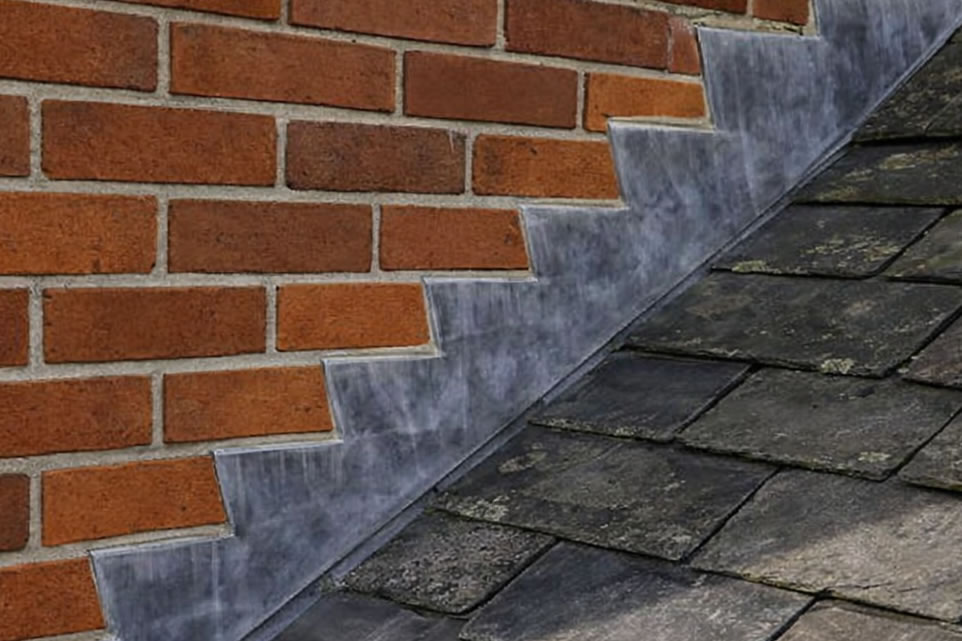
If you’ve got a damp patch near a chimney breast, a drip in the loft after heavy rain, or staining that mysteriously appears only in windy weather, there’s a strong chance the issue is chimney flashing.
Chimney flashing is the waterproof “join” between the chimney stack and the roof covering. When it fails, rainwater can track under tiles and felt, then show up inside your home.
This guide explains chimney flashing repairs in plain English: what it is, why it leaks, how it’s repaired properly in the UK, what affects the cost, and how to compare quotes without getting sold a quick-fix.
What is chimney flashing (and what are soakers)?
A typical UK pitched roof chimney junction usually includes:
- Step flashing (lead): visible lead pieces that step up the chimney as they overlap each row of tiles/slates.
- Soakers: hidden pieces beneath the tiles that catch water and direct it onto the tile surface.
- Apron flashing: at the front/lower side of the chimney, where water runs down towards gutters.
- Back flashing / back gutter (saddle): on the uphill side of the chimney where water can build up.
Flashing parts at a glance
| Part | Where it sits | What it does | Common failure |
|---|---|---|---|
| Apron flashing | Front (downhill) side | Directs water onto tiles | Lifting, splits, poor overlap |
| Step flashing | Side cheeks | Seals each “step” up the chimney | Loose edges, poor chases, incorrect laps |
| Soakers | Under tiles at sides | Captures water behind tiles | Missing, too small, incorrectly placed |
| Back gutter / saddle | Rear (uphill) side | Diverts heavy runoff around chimney | Blockage, poor shape, undersized leadwork |
Signs your chimney flashing is failing
Some clues strongly point to leadwork/flashing rather than “general roof leaks”:
- Damp patch appears after wind-driven rain (not always after light rain)
- Water staining in the loft next to the chimney rather than random roof areas
- Drips seem to originate where the chimney meets tiles/slates
- Flashing looks lifted, rippled, cracked, split, or poorly sealed
- Mortar chase (the groove cut into the chimney) looks cracked or has gaps
- Moss/debris buildup behind the chimney (water pooling risk)
Why chimney flashing leaks (the real reasons)
Chimney flashing often fails for practical, predictable reasons:
- Lead splits from movement
Roofs and chimneys move differently with temperature changes. Over time, lead can fatigue if it’s poorly detailed or over-fixed. - Incorrect laps/overlaps
If the lead doesn’t overlap tiles correctly, water can run behind it (especially in wind). - Missing or incorrect soakers
Some “repairs” skip soakers or use the wrong size, meaning water still gets under tiles. - Poor chasing into the brickwork
Lead should be properly chased into mortar joints and sealed/pointed correctly. Surface mastic alone doesn’t last. - Water overload at the back of the chimney
The uphill side can take a beating in heavy rain. Without a proper back gutter/saddle, water can be forced under coverings. - Patch jobs with sealant
Sealant can temporarily slow leaks but often fails quickly and can hide the real issue.
Repair vs replace: what’s appropriate?
Not every chimney needs full flashing replacement. Sometimes a targeted repair is enough.
| Situation | Likely best option | Why |
|---|---|---|
| Small gap in chase or localised lift | Local repair + re-secure + correct sealing | Fixes the entry point without full rework |
| Lead is split, heavily fatigued or patched repeatedly | Replace flashing (often with new soakers) | Splits usually return if you only patch |
| Missing/incorrect soakers | Lift tiles and fit correct soakers + step flashing | Without soakers, water can still track behind tiles |
| Back gutter poorly formed or blocked | Rebuild back gutter/saddle detail | Prevents pooling and wind-driven ingress |
| Chimney bricks/mortar are failing too | Combine flashing work with repointing/brick repairs | The chase won’t hold if mortar is crumbling |
Common chimney flashing repair methods (and what “good” looks like)
1) Re-chase and re-point the lead (properly)
A roofer may cut/clean the chase, re-seat the lead, and re-point the chase so it’s watertight and secure.
2) Replace step flashing + install correct soakers
This is a “best practice” approach for persistent leaks. Tiles are lifted carefully, soakers are fitted under each course, then step flashing is installed and chased into the chimney.
3) Replace apron flashing at the front
If the leak is downhill side only, the apron may be the culprit—especially if it’s too short or poorly overlapped.
4) Rebuild the back gutter / saddle
For chimneys on steeper roofs or in exposed areas, the uphill side can be the main failure point. A properly formed saddle/back gutter detail makes a big difference.
Costs: what you’re really paying for
Chimney flashing costs vary because safe access often drives the price more than materials.
Typical cost drivers
| Cost driver | Impact on price |
|---|---|
| Scaffolding vs ladder access | Scaffolding can be the biggest line item |
| Storeys/height and roof pitch | Higher and steeper = more labour and safety |
| Extent of leadwork | Front only vs full perimeter with soakers |
| Tile/slate type and condition | Delicate or older coverings need more care |
| Back gutter complexity | More detailed leadwork = more time |
Indicative UK price ranges (guide only)
| Job type | Typical range | Notes |
|---|---|---|
| Minor flashing repair / re-seal small section | £150–£450 | Often only if safe access is straightforward |
| Re-chase and re-point lead edges | £250–£650 | Depends on length of chase and access |
| Replace apron flashing (front) | £300–£900 | More if scaffold required |
| Replace side flashing + soakers (one side) | £450–£1,200 | Tiles lifted; soakers installed |
| Full chimney flashing replacement (all sides) | £700–£2,000+ | Access/scaffold drives variation |
| Back gutter / saddle rebuild | £400–£1,500 | Highly dependent on roof layout |
The best way to compare quotes is to make sure everyone is quoting the same scope (soakers included? back gutter included? chasing included?).
Lead vs “lead alternatives”: a practical comparison
Some contractors offer lead alternatives. There are situations where alternatives are used, but for many UK chimney junctions, traditional lead detailing remains common.
| Material | Pros | Cons | Best for |
|---|---|---|---|
| Lead | Durable when installed correctly; proven detail | Theft risk; higher material cost | Long-term chimney junctions |
| Lead substitute flashing | Often cheaper; lighter | Longevity varies by product; detailing still matters | Budget-conscious jobs / specific applications |
| Sealant-only patch | Quick and cheap | Typically short-lived; can hide problems | Temporary stop-gap only (not a proper repair) |
“Quote checklist”: what to ask roofers before you book
When you request chimney repair quotes, ask each roofer:
- Are you repairing or replacing flashing — and why?
- Are soakers included (if side flashing is involved)?
- Is the lead chased into the chimney and properly pointed/sealed?
- What’s included in access: scaffold, ladder, roof ladder?
- Will you check the back gutter/saddle detail (uphill side)?
- Are tiles/slates being replaced if any crack during lifting?
- What guarantee do you provide, and what does it cover?
Simple quote comparison table (copy into notes)
| Item | Roofer A | Roofer B | Roofer C |
|---|---|---|---|
| Scaffold included | |||
| Soakers included | |||
| Re-chase & point lead | |||
| Back gutter checked | |||
| Tile replacements allowed | |||
| Guarantee | |||
| Total price |
How to get a faster, more accurate quote
When filling in your quote request, include:
- Your postcode area
- Property type and storeys (e.g., 2-storey semi)
- Roof type (tile or slate) if you know it
- Where the leak shows (ceiling near chimney / loft / chimney breast)
- When it happens (heavy rain, wind-driven rain)
- Photos from ground/upstairs window if safe
- Whether there’s a conservatory/extension below (access detail)
FAQs: chimney flashing repair (UK)
Is chimney flashing always lead in the UK?
Lead is very common on UK chimneys, but some properties have substitutes or older detailing. What matters most is the quality of the junction detail (including soakers where needed).
Can you just seal chimney flashing with mastic?
Sealant can sometimes slow a leak temporarily, but it’s rarely a lasting fix if the lead is split, the chase is failing, or soakers are missing.
Why does it leak only when it’s windy?
Wind-driven rain can be pushed up under lifted flashing edges or into gaps at the chase line. It often indicates a junction problem rather than a random tile leak.
Do I need scaffolding for flashing repairs?
Not always, but safe access is crucial. Many roofers will recommend scaffold for chimneys due to height and the need to work carefully around tiles.
Should flashing repairs be done with repointing at the same time?
If mortar joints are crumbling where the chase needs to be cut/held, combining the jobs can be more effective and avoid repeat access costs.